
Orchid Care Guide — Canada
How to grow and rebloom phalaenopsis orchids in Canadian homes — watering, light, getting a new flower spike, and using Canadian winter conditions to your advantage.
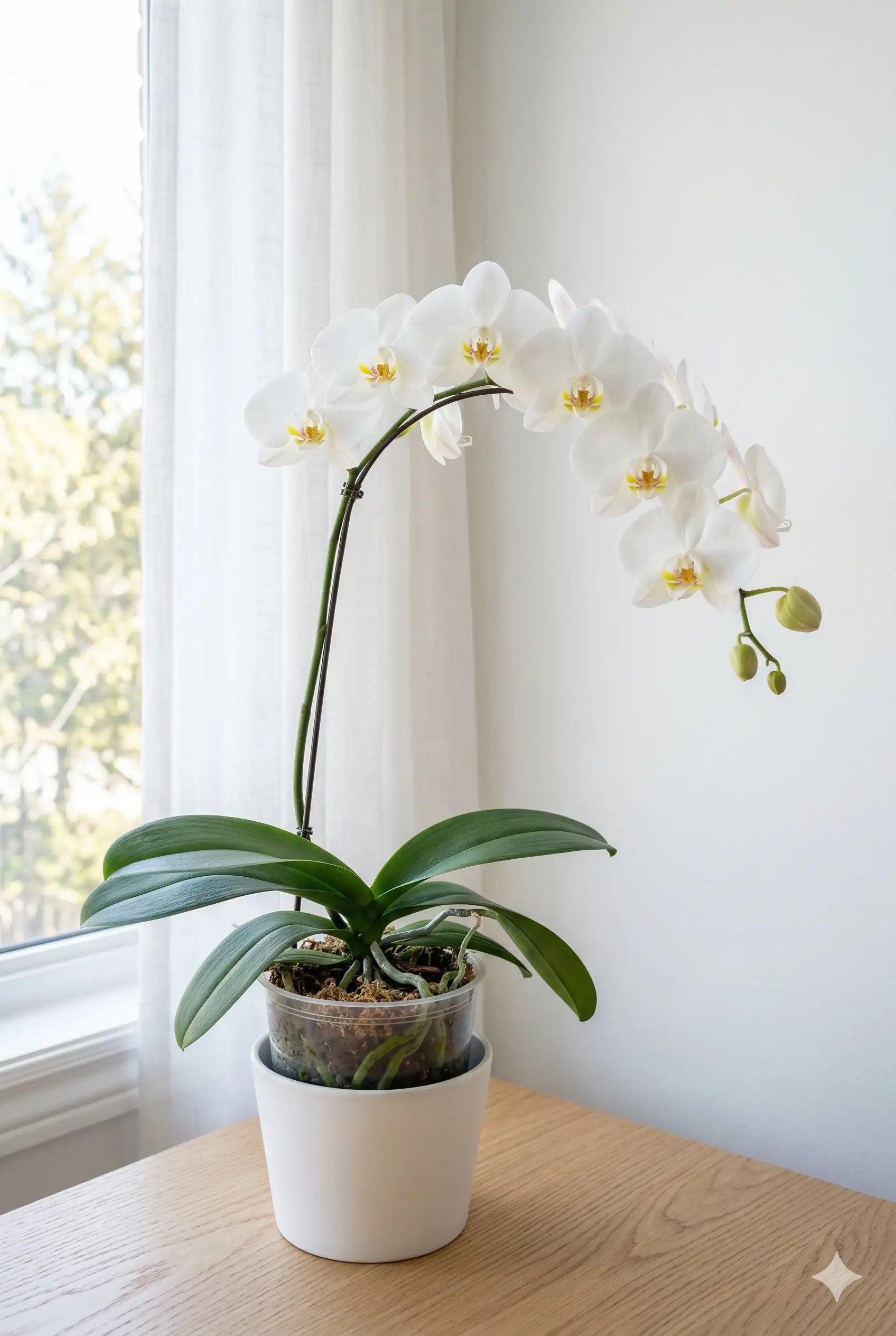
Orchid (Phalaenopsis — moth orchid) care in Canada is more forgiving than most people expect — and the Canadian climate actually provides one advantage that warmer climates don't. The temperature drop between warm days and cool nights near windows in fall is exactly the signal phalaenopsis orchids need to initiate a new flower spike. Most Canadian homes provide this naturally from September through November without any effort.
The two things that kill orchids in Canada are overwatering and the ice cube myth. This guide covers the correct approach to both, plus exactly how to trigger reblooming using your Canadian window conditions.
Orchid at a glance: Water — thoroughly every 7–14 days, never ice cubes. Light — east or west window, bright indirect. Rebloom trigger — cool nights near window in September–October. Winter — reduce watering, stop fertilising, keep near window. Humidity — 50–70%, pebble tray in winter.
Is your Orchid getting enough light this winter?
A Canadian winter cuts daylight roughly in half. See what your city actually gets this month, and whether a grow light is needed.
🍸 Orchid Quick Care Card
The Ice Cube Myth — Why It's Wrong
⚠️ Never water orchids with ice cubes
The ice cube watering method was created as a marketing gimmick — it has no horticultural basis. Phalaenopsis orchids are tropical plants from warm, humid Southeast Asian forests. Cold water damages their roots and causes stress. Over time, repeated ice cube watering leads to root tip damage, reduced blooming, and declining plant health.
The correct method: use room-temperature water (or filtered water left overnight), water thoroughly at a sink until water flows freely from drainage holes, let drain completely for 10–15 minutes, then return the orchid to its spot. Do this every 7–10 days in summer, every 10–14 days in winter.
How to Rebloom an Orchid — The Canadian Advantage
Phalaenopsis orchids initiate a new flower spike in response to a 5–8°C temperature differential between day and night sustained over 4–6 weeks. Canadian homes near windows provide this naturally every fall — warm days with cool nights as outdoor temperatures drop. This is genuinely an advantage over heated climates where indoor temperatures stay consistent year-round.
Cut the flower spike above the second node (bump) from the base. This can produce a secondary spike from the same stem. Alternatively cut to the base to encourage a completely new spike — takes longer but produces a stronger bloom.
Fertilise monthly with a balanced orchid fertiliser at half strength. Keep in bright indirect light. The plant is rebuilding energy reserves. No flower spike will appear during this period — this is normal.
Place within 30 cm of an east or west window. Cool Canadian nights near the glass provide the temperature drop the orchid needs. Stop fertilising. Leave it completely undisturbed for 6–8 weeks.
A new pointed green growth appears from the base of a leaf. This is the flower spike, not a root (roots are rounder at the tip). Resume monthly fertilising at half strength. Keep position stable — rotating or moving the plant causes buds to orient incorrectly or drop.
Phalaenopsis blooms last 2–4 months if the plant is kept away from heating vents, fruit bowls (ethylene gas causes bud drop), and cold drafts. Canadian holiday timing works perfectly — spike in October, blooms in December through February.
Light Requirements in Canada
Leaf colour is the most reliable indicator of correct light. Bright medium green is correct. Dark green means insufficient light — the plant is producing more chlorophyll to compensate. Yellow-green or reddish tinge means too much direct sun.
East window — Best
Gentle morning light, no harsh afternoon sun. Ideal year-round in Canada. The orchid gets good light without risk of burning.
West window — Good
Afternoon light — add a sheer curtain in summer to prevent burning. Good for reblooming as it provides the light intensity needed for energy accumulation.
South window — Use with caution
Sheer curtain required in summer. In winter the lower sun angle is fine without filtering. Best position for reblooming September–November when you need the cool nights.
North window — Avoid
Insufficient light for reliable reblooming. Orchid will stay alive but unlikely to produce new flower spikes. Move to east or west if not reblooming.
How to Water Orchids in Canada
Reading the roots through the clear inner pot is the most reliable way to know when to water — more reliable than a fixed schedule, since Canadian winter light and temperatures vary significantly.
Root colour guide: Bright green — recently watered, don't water yet. Silver-white — approaching dry, water soon. Grey and wrinkled — too dry, water immediately. Brown and mushy — root rot from overwatering — let dry and reduce frequency. Use room-temperature filtered water. Never ice cubes. Always drain completely.
Overwatering kills more houseplants than anything else. A 3-in-1 soil meter shows you exactly when the root zone is dry — push the probe in for an instant moisture, light, and pH reading. No batteries needed.
Affiliate link — GrowersGuide.ca may earn a commission on qualifying purchases, at no extra cost to you. Learn more.
The other thing Canadian houseplants run short on all winter is light. From November to March most homes are too dim to keep plants growing — leaves stretch toward the window, variegation fades, and new growth stalls. A small full-spectrum LED grow light on a timer bridges the dark months, even for tough low-light plants that only survive (rather than grow) in a dim room.
Affiliate link — GrowersGuide.ca may earn a commission on qualifying purchases, at no extra cost to you. Learn more.
Why no fixed schedule works: How fast orchid bark or moss dries depends on temperature, light levels, room humidity, and plant size. A Phalaenopsis in a bright warm room in summer may need water every 7 days; the same orchid in low winter light near a cool window can go 14 days. The root colour test accounts for all of these automatically. See what affects drying rate →
Orchid Troubleshooting
Buds dropping before opening
Bud blast — caused by cold drafts (very common in Canadian winter near leaky windows), heating vent dry air, ethylene gas from fruit, or sudden move. Keep away from drafts and fruit bowls. Never move a spiking or blooming orchid.
Yellow leaves
The lowest oldest leaf yellowing occasionally is natural ageing. Multiple yellowing leaves: overwatering or root rot — check roots and reduce watering. Yellow with reddish tinge: too much direct sun — filter the window.
Roots growing out of the pot
Completely normal — aerial roots reaching out is a sign of a healthy, happy orchid. Do not cut them. Do not stuff them back in the pot. When repotting (every 2 years, in spring), use a pot just large enough to contain the roots comfortably in fresh orchid bark.
No new spike after 12 months
The orchid hasn't experienced sufficient temperature differential. Move to within 30 cm of a window in September. If the room stays at 21°C year-round with no variation, the reblooming trigger never fires. A brief period of cool nights (13–16°C) at the window for 4–6 weeks is the solution.
How Orchids Multiply — Keikis
Phalaenopsis orchids are not propagated from cuttings or by division the way most houseplants are — they grow from a single central crown and cannot be split. Instead, they occasionally produce a keiki (Hawaiian for “baby”): a small plantlet that grows on its own, complete with leaves and roots, usually on an old flower spike. A keiki is a free new orchid — an exact clone of the parent.
Spotting a keiki
A keiki appears as a tiny cluster of leaves growing from a node on an old flower spike (occasionally from the base of the plant). It is easy to tell from a new flower spike: a spike is a single pointed green growth, while a keiki quickly develops small flat leaves — and then its own roots. Keikis often form when an orchid has been kept warm with an old spike left on, or after slight stress.
When and how to separate it
Wait until the keiki has two or three leaves and several of its own roots at least 5–8 cm long — this can take many months, so be patient. Then cut the spike about 2–3 cm either side of the keiki with clean, sterilised scissors, and pot the keiki into fine orchid bark in a small pot. Keep it warm, humid, and in bright indirect light while it establishes. Separating a keiki before it has its own roots is the most common reason they fail.
Encouraging a keiki — and a realistic note
Some growers leave a healthy old flower spike on the plant specifically in the hope of a keiki, and “keiki paste” (a hormone product) brushed onto a spike node can induce one. Be realistic, though: most Canadian orchid owners simply buy new plants, since a keiki takes a year or more to reach blooming size. Treat a keiki as a happy bonus rather than a reliable way to build a collection.
Orchid Types at Canadian Garden Centres
This guide covers Phalaenopsis care specifically — the moth orchid sold at virtually every Canadian grocery store, Home Depot, and IKEA. Other orchid genera have very different requirements.
White, pink, or purple. 1–2 arching spikes with 5–15 flowers. Blooms 2–4 months. The most widely available orchid in Canada. This guide applies fully to these.
Small plants with 3–7 cm flowers. Dries out faster — water every 5–7 days. Often reblooms more readily than large standards. Popular in Canada as gifts. Same core care.
Spotted, striped, or multicoloured flowers. Increasingly common at Canadian specialty plant shops. Same care as standard — only the flower pattern differs.
A different genus — requires a cool dry rest period in fall to bloom, more direct light, and very different watering. Occasionally sold in Canada; not covered by this guide's care advice.
Frequently Asked Questions
Are orchids safe for cats?
Yes — phalaenopsis orchids are non-toxic to cats and dogs. They are one of the few flowering houseplants that is completely pet-safe. Cats may chew the leaves but won't be harmed.
How long do orchid blooms last?
Phalaenopsis blooms last 2–4 months — longer than almost any other flowering houseplant. Keep away from fruit, heating vents, and cold drafts to maximize bloom life. Canadian winter conditions (cool, consistent indoor temperatures away from vents) are actually very good for bloom longevity.
Should I repot my orchid?
Repot every 2 years in spring, or when the bark medium has broken down into fine particles (it stops draining well). Use fresh orchid bark, not regular potting soil. Choose a pot just large enough to contain the roots — orchids prefer to be slightly tight. Clear plastic pots let you monitor root health easily.
How often should I water an orchid in Canada?
Water phalaenopsis orchids every 7–10 days in summer and every 10–14 days in fall and winter. The most reliable method is the ice cube myth — ignore it. Instead, take the orchid to a sink, water thoroughly until it flows from the drainage holes, let drain completely, and return to its spot. Never let roots sit in standing water. The bark or moss medium should approach dryness before the next watering. In Canadian winters with low light, orchids need less water — check the roots through the clear pot: green or silver-white roots are healthy, wrinkled grey roots need water.
How do I get my orchid to rebloom in Canada?
Orchids rebloom in response to a temperature drop of 5–8°C between day and night for 4–6 weeks. In Canada this happens naturally near windows in fall — the glass cools at night while daytime temperatures stay warm. Place your orchid within 30cm of a window in September and October. Stop fertilising in fall. Once a new flower spike appears (a pointed green growth, not a root), resume normal care. Most Canadian homes provide the temperature differential naturally from September through November — this is actually an advantage over climates without distinct seasonal temperature swings.
Why is my orchid not reblooming?
The most common reason orchids don't rebloom in Canada is insufficient light combined with consistent temperatures. If your orchid is in a room that stays 20–22°C year-round with no window proximity, it never experiences the cool night signal it needs to initiate a new flower spike. Move it to within 30cm of a window in September. Second cause: the flower spike was cut too short — cut above the second node from the base to encourage a secondary spike from the same stem. Third: the plant needs more light year-round — east or west window, not a north-facing room.
How much light does an orchid need in Canada?
Phalaenopsis orchids need bright indirect light — an east or west-facing window is ideal. South windows work if filtered with a sheer curtain in summer. North windows don't provide enough light for reliable reblooming. In Canadian winters, move your orchid as close to the window as possible without touching cold glass. The reduced winter light is actually fine for the orchid during its rest period — but it needs good light from March through September to build the energy reserves that fuel the next bloom cycle. Leaves should be bright green, not dark green (too little light) or yellow-green (too much direct sun).
What is the best way to water orchids — ice cubes or regular water?
Regular water is correct — never use ice cubes. The ice cube method was a marketing gimmick. Cold water shocks tropical orchid roots and damages them over time. Use room-temperature water. Take the orchid to a sink, water thoroughly, let drain for 10–15 minutes, and return to its spot. In Canada, use filtered or overnight-settled water — chlorine and fluoride in tap water can damage roots over time. The key is thorough watering followed by complete drainage, not frequent small amounts. Every 7–10 days in summer, every 10–14 days in winter is the right rhythm.
How do I care for an orchid in a Canadian winter?
Canadian winters are actually ideal for triggering orchid reblooming because of the natural temperature differential near windows. Key adjustments: move to your brightest window (east or west, 30cm from glass); reduce watering to every 10–14 days as growth slows; stop fertilising from November through February; and allow the natural cool night temperatures near windows to provide the reblooming cue. Keep away from heating vents which create very dry air — orchids prefer 50–70% humidity and benefit from a pebble tray or humidifier in Canadian winter. Do not move the plant once positioned for fall — stability supports spike initiation.
🐾 Have pets? See our Pet-Safe Houseplants guide — which common houseplants are toxic to cats and dogs, which are safe, and what to do if a pet eats one.
📖 More Houseplant Guides
Care guides for popular Canadian houseplants.
Also Growing Vegetables?
Free planting calendars for 30+ vegetables across every major Canadian city.