
Rubber Plant Indoor Care — Canada
How to care for rubber plants (Ficus elastica) indoors in Canadian homes — how often to water, light, why it drops leaves, Canadian winter care, and propagation.
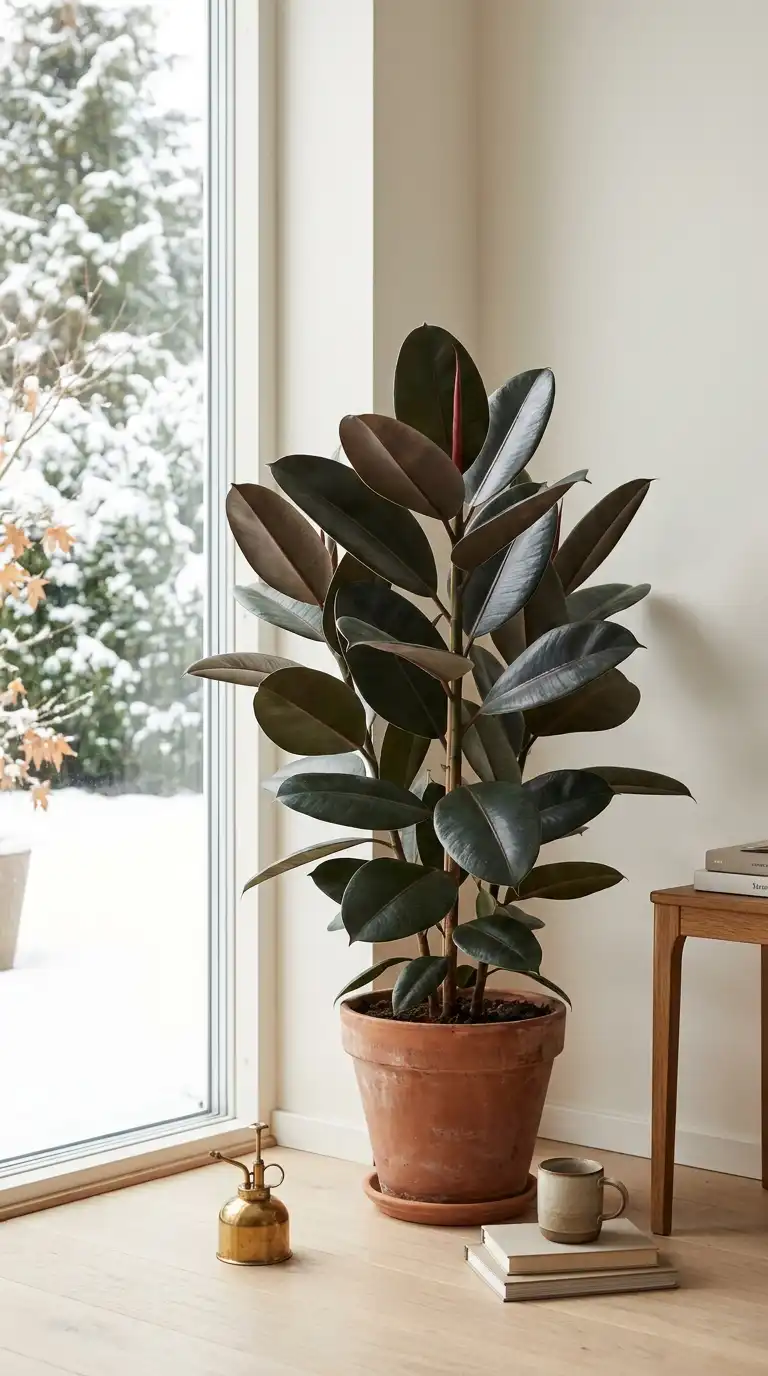
Rubber plant indoor care in Canada — for Ficus elastica — is more forgiving than fiddle leaf fig care but follows many of the same principles — bright light, consistent watering, and protection from cold drafts. The rubber plant's deep burgundy or dark green leaves make it one of the most architecturally striking houseplants available, and it handles the challenges of Canadian homes better than FLF while delivering a similar bold visual statement.
This guide covers the complete rubber plant care routine for Canada — watering, light, and how to prevent and fix leaf drop — plus how to prune it bushy, when to repot, how to feed it, and everything you need for the bold variegated varieties that are increasingly popular in Canadian plant shops.
Rubber plant at a glance: Light — bright indirect, 1–2m from window. Water — when top 3–5cm dry, consistent schedule. Dropping leaves? — cold draft, overwatering, or moved location. Winter — keep from cold glass, humidifier helpful, stop fertilising. Sap — irritates skin, wear gloves when pruning.
Is your Rubber Plant getting enough light this winter?
A Canadian winter cuts daylight roughly in half. See what your city actually gets this month, and whether a grow light is needed.
🌿 Rubber Plant Quick Care Card
Why Rubber Plants Drop Leaves — Canadian Causes
Leaf drop is the most common rubber plant problem in Canada. Unlike snake plants and pothos which signal problems slowly, rubber plants drop leaves relatively quickly when stressed. Understanding the cause determines the fix.
Cold drafts — most common Canadian cause
Rubber plants are sensitive to cold air — a draft from an opening exterior door, a poorly sealed window, or cold air moving along an exterior wall can cause leaf drop within days. In Canadian winters this is the most common cause of sudden leaf drop. Check the plant's position: is it near a frequently opened exterior door? Is there cold air movement from a nearby window? Move the plant to a warmer interior position or eliminate the draft source.
Overwatering — year-round risk, worse in winter
Root rot from overwatering causes lower leaves to yellow then drop. Check the soil — if it's consistently wet, allow it to dry more between waterings and ensure the pot has drainage. In Canadian winter when light is low and growth slows, soil stays wet much longer — reduce watering frequency significantly from October through February.
Moving the plant — stress response
Rubber plants drop leaves when moved to a new position, even a better one. This is a stress response as the plant adjusts its leaf orientation to new light angles. The drop is usually temporary — stop after a few leaves if the new conditions are right. Avoid moving in winter when the plant is already stressed. If you must move the plant, do so gradually over several weeks.
Insufficient light — slow decline
Rubber plants in low light slowly drop lower leaves as the plant conserves resources. This is gradual rather than sudden — if you're losing one or two leaves per month steadily, move to brighter indirect light. South-facing windows become critical in Canadian winters when daylight drops to 8–9 hours.
How to Water Rubber Plant in Canada
Rubber plants like consistent watering — they don't want to dry out completely like a cactus, but they also can't tolerate consistently wet soil. The top 3–5 cm being dry is the right trigger point.
Rubber plant watering schedule — Canada: Summer (May–Sept): every 7–10 days. Fall (Oct–Nov): every 10–14 days. Winter (Dec–Feb): every 10–14 days (check soil). Spring (Mar–Apr): every 7–10 days. Use room-temperature water. Always check before watering — don't follow a fixed schedule.
Overwatering kills more houseplants than anything else. A 3-in-1 soil meter shows you exactly when the root zone is dry — push the probe in for an instant moisture, light, and pH reading. No batteries needed.
Affiliate link — GrowersGuide.ca may earn a commission on qualifying purchases, at no extra cost to you. Learn more.
The other thing Canadian houseplants run short on all winter is light. From November to March most homes are too dim to keep plants growing — leaves stretch toward the window, variegation fades, and new growth stalls. A small full-spectrum LED grow light on a timer bridges the dark months, even for tough low-light plants that only survive (rather than grow) in a dim room.
Affiliate link — GrowersGuide.ca may earn a commission on qualifying purchases, at no extra cost to you. Learn more.
Why no fixed schedule works: How fast soil dries depends on temperature, light levels, pot material, room humidity, and plant size — not the calendar. A rubber plant in a terracotta pot near a bright window in summer dries twice as fast as the same plant in plastic in a shaded corner in winter. The top 3–5 cm finger test accounts for all of these automatically. See what affects soil drying rate →
Light Requirements — More Forgiving Than Fiddle Leaf Fig
Rubber plants are a more practical choice for Canadian homes than fiddle leaf figs precisely because they tolerate a wider range of light. They still need bright indirect light for best growth, but medium-light positions that would cause a FLF to decline are acceptable for rubber plants.
☀️ Bright Indirect — Best
Within 1–2 m of a south, east, or west window. Fastest growth, best leaf colour, most stable. Required for variegated types (Tineke, Ruby) to maintain pink and cream markings.
🪟 Medium Light — Acceptable
2–3 m from a window. Dark-leaved varieties (Burgundy, Abidjan) do well here. Slower growth but stable. A position that would stress a fiddle leaf fig is usually fine for a rubber plant.
✖ Low Light — Not Recommended
North windows or far from any window — rubber plants slowly decline in these conditions, dropping lower leaves progressively. Not suitable for low-light Canadian positions.
Canadian Winter Care
Eliminate cold draft sources near the plant
Check every possible cold air source near your rubber plant in winter: window seals (apply draft tape if leaky), nearby exterior doors (move the plant away from entrances), and exterior wall cold zones. A rubber plant positioned near a front door in a Toronto or Ottawa winter will drop leaves every time the door opens in January. This is the most preventable cause of Canadian rubber plant problems.
Keep 20–30 cm from window glass
Window glass in Canadian winter is cold — even double-glazed. Leaves within 10 cm of cold glass develop brown patches and the plant may drop those leaves. Keep a gap of at least 20 cm from the glass. South-facing windows in winter are the best light source because the sun is lower in the sky — the plant benefits from the light without the cold glass risk if positioned slightly back from the window.
Humidifier recommended — not essential
Rubber plants prefer 40–60% humidity — Canadian furnace air at 25–30% is below this. A small humidifier nearby helps prevent brown leaf edges. Unlike monstera or peace lily which show dramatic symptoms in dry air, rubber plants tolerate low humidity better. A humidifier is beneficial but the plant won't decline rapidly without one.
Reduce watering and stop fertilising
Growth slows in Canadian winters — reduce watering and stop fertilising from November through February. Resume monthly feeding with balanced fertiliser at half strength in March. Clean leaves with a damp cloth occasionally in winter — dusty leaves photosynthesize less efficiently, which matters more in low winter light.
How to Propagate Rubber Plants
Rubber plants propagate from stem cuttings. The latex sap requires one important extra step that most guides skip.
Use clean sharp scissors. Cut below a leaf node. Milky white latex sap will immediately flow from the cut — this is normal. Keep 2–3 leaves on the cutting, removing any lower leaves.
Critical step most guides miss: Let the cut end sit exposed to air for 30–60 minutes until the latex sap dries and seals. If you place the cutting in water immediately, the sap prevents rooting. Once sealed, the cut end is ready for water or soil.
Water: place in a glass of room-temperature water, change every 3–5 days, roots in 3–6 weeks. Soil: plant in moist well-draining mix, keep humid with a plastic bag tent. Bright indirect light. Best in spring or early summer in Canada.
Pot into well-draining mix with perlite. Keep slightly moist for 2–3 weeks while establishing. New growth signals successful rooting. Resume normal care once a new leaf appears.
How to Prune a Rubber Plant — and Make It Bushy
Left alone, a rubber plant grows as a single tall stem — a trait called apical dominance, where the growing tip suppresses the buds below it. That's why so many rubber plants in Canadian homes end up as one bare, leggy pole. The fix is to prune the tip, which releases those lower buds and makes the plant branch.
The bushy trick: cut the main stem just above a leaf node with clean, sharp scissors, removing as much or as little height as you like. Within a few weeks the plant pushes two or more new shoots from the nodes just below the cut — turning one stem into several. Repeat on the new stems as they grow to build a full, bushy plant.
- Best time in Canada: spring through early summer (April–July), when active growth makes the plant respond fastest. Avoid pruning in winter.
- Wear gloves. The cut releases milky latex sap that irritates skin — blot it with a paper towel and it stops within minutes.
- Don't waste the top. The piece you cut off roots into a whole new plant — see the propagation steps above.
- Want branching without losing height? Notch the stem instead — cut about a third of the way through, just above a node. This interrupts apical dominance enough to wake the bud below while keeping the plant's height.
When and How to Repot a Rubber Plant
Rubber plants like to be slightly snug, so don't rush to repot — but a genuinely root-bound plant slows down and dries out too fast. Repot young plants every 1–2 years and mature ones every 2–3 years, when you see the signs below.
- Roots circling out of the drainage holes or pushing the plant up out of the pot
- Water runs straight through and the soil dries within a day or two
- Growth has slowed even in good light and the growing season
- The plant is top-heavy and tips its pot over
How to repot: move up only one pot size (about 2–3 cm wider in diameter) — a pot that's too big holds water and rots the roots. Use a well-draining mix with extra perlite and a pot with drainage holes. The best time in Canada is spring (March–May) as light returns and growth resumes; never repot in winter when the plant is already stressed by low light. Water in, then hold off on fertiliser for 4–6 weeks while the roots settle.
Feeding a Rubber Plant
Rubber plants aren't heavy feeders, but in good light they grow fast enough to appreciate regular feeding during the growing season. Feed with a balanced liquid fertiliser at half strength once a month from March through September, and stop completely from October through February when low Canadian light slows growth — feeding a resting plant just builds up salts and can burn the roots. If lower leaves pale evenly across the plant in summer despite good light and watering, that's the cue it wants feeding.
Popular Rubber Plant Varieties in Canada
Deep burgundy-red to near-black leaves. The most dramatic and widely available rubber plant in Canada. Most tolerant of medium light. Classic statement plant for Canadian interiors.
Classic dark glossy green. Very widely available at Canadian garden centres and hardware stores. The most vigorous grower. Good for medium-light positions.
Cream and green variegation with occasional pink tones. Stunning but needs brighter light than solid varieties to maintain variegation. Increasingly available at Canadian specialty plant shops.
Pink, cream, and green tricolour variegation — the most colourful rubber plant. Needs the most light to maintain colour. Rarer in Canada but available from specialty shops and online nurseries.
The darkest rubber plant — glossy leaves so deep a maroon they read as near-black, with a reddish sheen in good light. Like Burgundy it tolerates medium light well. Increasingly stocked at Canadian garden centres.
A compact cultivar with smaller, rounder, dark-green leaves held closely along the stem, so it stays bushier and shorter than Robusta. A good choice for tighter Canadian rooms where a full-size rubber tree would be too large.
Rubber Plant Troubleshooting
Dropping leaves
In Canada: most likely a cold draft — check all nearby windows and exterior door proximity. Also: overwatering (lower yellow leaves drop), insufficient light (gradual steady loss), or stress from being moved. Fix the cause and leave the plant alone for 4–6 weeks.
Yellow lower leaves
Overwatering — most common cause. Reduce watering frequency. Ensure drainage holes are present. Natural ageing of the very oldest lowest leaves is normal — occasional single yellow leaves at the base are fine.
Brown edges or patches
Cold draft or cold glass contact (most common in Canadian winter) — move away from windows and check for drafts. Also: low humidity (humidifier), direct sun scorching (filter light or move back).
Variegation fading to green
Tineke and Ruby varieties revert toward solid green in low light — move to a brighter indirect light position. This is especially common in Canadian winters as light levels drop. A grow light helps maintain variegation through November to February.
Frequently Asked Questions
Why is my rubber plant dropping leaves?
In Canada, most commonly a cold draft — check for nearby exterior doors, leaky windows, or cold wall positioning. Also: overwatering, moving the plant, or insufficient light. Fix the stressor and leave the plant alone for 4–6 weeks to recover.
Is rubber plant better than fiddle leaf fig for Canadian homes?
For most Canadian homes, yes. Rubber plants tolerate medium light (FLF needs bright light), are less sensitive to being moved, and recover from stress more readily. They deliver a similar bold visual impact with lower maintenance. The fiddle leaf fig's higher light requirement is harder to meet in Canadian winter conditions.
Can I put my rubber plant outside in Canadian summer?
Yes — rubber plants benefit from outdoor placement in Canadian summer. Choose a spot with bright shade (no direct afternoon sun) and introduce gradually over 1–2 weeks. Bring back indoors before night temperatures drop below 13°C — typically early September in most cities. Return to the same indoor spot.
How do I clean rubber plant leaves?
Wipe leaves with a damp soft cloth — clean leaves photosynthesize more efficiently, which matters in Canadian winters with limited light. Wear gloves as the latex sap irritates skin. Don't use leaf-shine products which can clog leaf pores. Clean every 4–6 weeks or when you notice dust buildup.
How do I make my rubber plant bushy?
Prune the growing tip. Rubber plants have strong apical dominance — one tall stem — so cutting the main stem just above a leaf node releases the buds below it, and the plant pushes two or more new shoots within a few weeks. Do it in spring or early summer, wear gloves for the sap, and root the cut top as a new plant. To branch without losing height, notch the stem a third of the way through above a node instead. See the pruning section above.
When should I repot my rubber plant?
When it's root-bound — roots out the drainage holes, water running straight through, slowed growth, or the plant going top-heavy. That's roughly every 1–2 years for young plants, 2–3 for mature ones. Move up only one pot size (2–3 cm wider); too big a pot rots the roots. Repot in spring as growth resumes, never in the low-light Canadian winter.
How fast do rubber plants grow, and how tall do they get?
In good light they're fast — 30–60 cm of new height in a single growing season, reaching 2 m or more indoors over a few years, with growth pausing over the dark Canadian winter. You set the final size yourself: top the main stem to keep it shorter and bushier, and keep it slightly root-bound to slow it down.
🐾 Have pets? See our Pet-Safe Houseplants guide — which common houseplants are toxic to cats and dogs, which are safe, and what to do if a pet eats one.
📖 More Houseplant Guides
Care guides for popular Canadian houseplants.
Also Growing Vegetables?
Free planting calendars for 30+ vegetables across every major Canadian city.