
Monstera Care in Canada — Which One You Have
Three plants are sold as “monstera” and a fourth isn’t a monstera at all. Work out which one is in your pot, then the care that all of them share in a Canadian home — and the two things our climate changes.
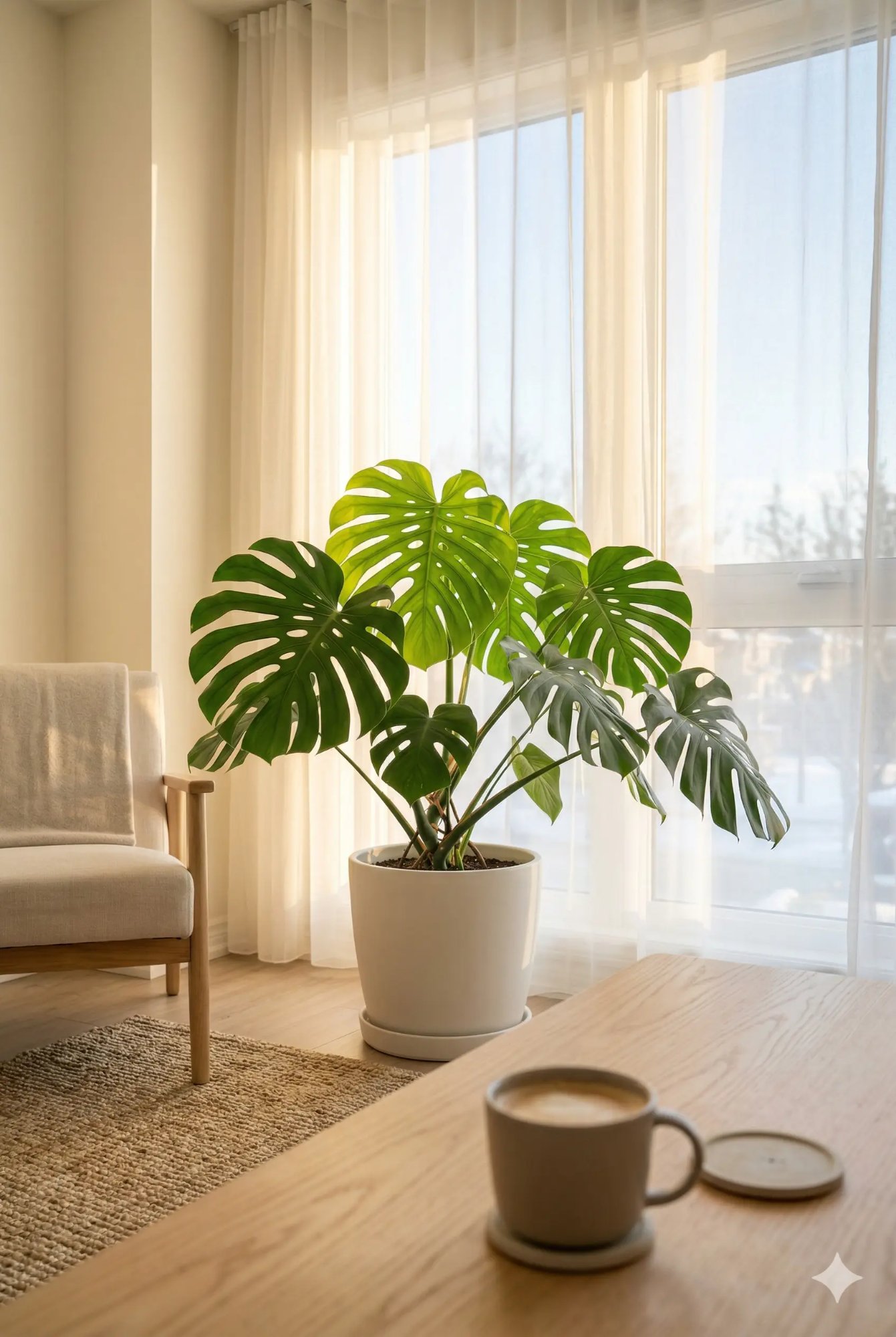
Monstera care in Canada is mostly ordinary houseplant care, with two exceptions that our climate forces and that guides written in France, Florida or New Zealand have no reason to mention. The first is that our winter is genuinely darker than anything this plant met in the wild, which changes what a new leaf looks like for four months of the year. The second is that our summer is short enough that when you can put it outside — and when you must bring it back — is a different answer in Victoria than in Saskatoon.
Before any of that, though: there are three different plants sold under the name, they want slightly different things, and one very common plant sold as a “split-leaf philodendron” is not a monstera at all.
Monstera care at a glance: Light — the brightest indirect spot you have; within 1–2 m of a window. Water — when the top 5–7 cm is dry: roughly every 7–14 days in summer, 14–21 in winter. Cold — nothing below 13 °C, and keep leaves 10 cm off winter glass. Small winter leaves — normal here, and it is the light, not your care. Toxic to cats and dogs.
Your Monstera Has Two Different Years — And One of Them Is Canadian Winter
Monstera deliciosa is native to a band running from southern Mexico down to Panama, roughly 8° to 20° north. The useful thing about that range is how little its day length moves: at the December solstice the shortest day across it runs from about 10h55 at the northern edge to 11h39 at the southern. The plant has never, in its evolutionary history, had a day much under eleven hours.
Here is what it gets in Canada instead. These are computed from each city’s latitude, so they are exact and they are the same every year:
| City | Shortest day (21 Dec) | Longest day (21 Jun) |
|---|---|---|
| Edmonton, AB | 7h27 | 17h03 |
| Calgary, AB | 7h54 | 16h33 |
| Winnipeg, MB | 8h05 | 16h21 |
| Vancouver, BC | 8h11 | 16h15 |
| Montréal, QC | 8h42 | 15h41 |
| Ottawa, ON | 8h43 | 15h40 |
| Halifax, NS | 8h48 | 15h34 |
| Toronto, ON | 8h55 | 15h27 |
Day length computed from latitude for 8 cities using the standard CBM solar model — see our climate-data methodology. Indoor light through a window is a small fraction of outdoor light on top of this.
What follows from it, and it is the most misread thing about monstera in Canada: a leaf that opens in January is not a failed leaf. Leaf size and the number of splits are decided while the leaf is still forming, by the light available then. From roughly November to February, in every city in that table, new leaves come out smaller and plainer than the ones that opened in July. That is the season, not your watering, and the plant will resume normal leaves in spring without you changing anything.
Is your Monstera getting enough light this winter?
A Canadian winter cuts daylight roughly in half. See what your city actually gets this month, and whether a grow light is needed.
Which Monstera Is This?
Look at the holes, not the overall shape. Leaf size, thickness and where the holes sit separate the three species quickly, and separate all three from the plant that is most often mistaken for one.
| If the leaves are… | It is | Full guide |
|---|---|---|
| Large (30 cm and up when mature), thick and leathery, with splits running in from the edge and holes near the midrib | Monstera deliciosa Swiss cheese plant |
Deliciosa care → |
| Smaller (10–25 cm), thinner, on a slender trailing or climbing stem, with holes usually fully enclosed — ringed by leaf all the way round | Monstera adansonii Swiss cheese vine, monkey mask |
Adansonii care → |
| So thin they are nearly translucent, with more hole than leaf and a slightly wavy edge | Possibly Monstera obliqua worth checking properly |
What to look at → |
| Deeply cut, but with no holes at all — every cut runs in from the edge and stops | Not a monstera a tree philodendron, sold as “split-leaf philodendron” |
Tell them apart → |
One caution on the third row. Kew’s Plants of the World Online records that the name Monstera obliqua is often misapplied to the far more widespread Monstera adansonii — so a label is not evidence. That is a fact about the name and the trade, not about your plant; the obliqua page sets out what to actually look at.
The Care All Three Share
The species pages go into what differs. This is the part that doesn’t.
Cold glass is the Canadian one
Room temperature is rarely the problem in a Canadian home. The window is. On a cold night the inner surface of the glass can sit many degrees below the air a few centimetres away, and a leaf resting against it is at the glass temperature, not the room temperature — which is how a plant in a room at 21 °C ends up with blackened patches on exactly the leaves that touched the pane. Keep about 10 cm of air between foliage and winter glass, and check the frame for a draught while you are there.
This pulls against the advice to move plants closer to the window in winter, and both are right: get the plant as close to the glass as you can without letting leaves touch it. If you are carrying a new plant home in January, the walk from the shop to the car matters too — see bringing plants home in winter.
Monstera is killed far more often by a watering can than by neglect, and the winter interval is where people get caught — the soil stays wet for two weeks in January where it dried in one in July. A probe reads the moisture at root depth rather than the surface, which is the number that matters. No batteries.
Affiliate link — GrowersGuide.ca may earn a commission on qualifying purchases, at no extra cost to you. Learn more.
Summer Outdoors — The Window in Your City
A monstera does genuinely well outside for the Canadian summer, in shade or dappled light, and comes back in with better colour and bigger leaves than it would have grown indoors. How long that holiday can be is a climate question, and it is the one thing on this page a guide written anywhere else cannot answer for you.
The table is built from Environment and Climate Change Canada frost normals for 12 cities. Read the two dates carefully — they are outer limits, not targets.
| City | Earliest it can go out last spring frost |
Must be back in by first fall frost |
Frost-free days |
|---|---|---|---|
| Victoria, BC | Mar 10 | Dec 15 | 280 |
| Vancouver, BC | Mar 15 | Nov 30 | 260 |
| Toronto, ON | Apr 20 | Nov 1 | 195 |
| Halifax, NS | May 10 | Oct 18 | 161 |
| Ottawa, ON | May 9 | Oct 12 | 156 |
| Montréal, QC | May 9 | Oct 7 | 151 |
| St. John's, NL | May 24 | Oct 13 | 142 |
| Quebec City, QC | May 17 | Sep 28 | 134 |
| Edmonton, AB | May 14 | Sep 23 | 132 |
| Calgary, AB | May 23 | Sep 21 | 121 |
| Winnipeg, MB | May 25 | Sep 20 | 118 |
| Saskatoon, SK | May 25 | Sep 12 | 110 |
Frost dates from ECCC climate normals via our frost date calculator, which covers more cities than fit here. The spread is the point: Victoria has 280 frost-free days against Saskatoon’s 110 — the same plant gets more than twice the summer outdoors in one city as the other.
Three things the dates don’t say.
The last frost is the earliest possible date, not a comfortable one. Monstera stops growing below 13 °C, and spring nights sit below that for weeks after the frost risk has passed. We publish frost dates per city; we do not have a per-city date for the first reliably 13 °C night, and we would rather say so than invent one. In practice most people wait two to three weeks past the last frost and watch the overnight forecast.
The first frost is a deadline, not a target. By the time frost arrives the plant has already had weeks of nights below its floor. Bring it in while nights are still in double figures.
Move it out gradually. A plant that has spent the winter two metres from a window will burn in direct sun in an afternoon. Deep shade for a week, dappled light after that, and never full midday sun.
Why the Leaves Aren’t Splitting
The most-asked monstera question, and it has three answers that stack rather than compete.
- Light. In Canada this is almost always the binding one, for the reason set out at the top of this page.
- Age. A young plant produces plain leaves whatever you do — generally you should not expect reliable fenestration before the plant’s 2nd or 3rd year. Published figures vary; treat it as “a couple of years” rather than a date.
- Support. Monstera are climbers, and climbing is what switches them out of juvenile growth. A plant sprawling over the pot rim keeps making juvenile leaves.
One thing worth knowing before you go looking for a fix: an existing leaf will never develop splits. Fenestration happens as the leaf forms and is fixed once it unfurls. Everything you change affects the next leaf. Both the depth of this — and it goes deep — lives on the deliciosa page and in training a monstera to climb.
Support is the lever you control that light isn't. A monstera that grips a pole with its aerial roots shifts into mature growth, and mature growth is where the big fenestrated leaves come from. This K-Brands 2-pack stacks taller as the plant climbs. Worth far more to a deliciosa than to a trailing adansonii.
Affiliate link — GrowersGuide.ca may earn a commission on qualifying purchases, at no extra cost to you. Learn more.
Go Deeper on Your Species
Frequently Asked Questions
Why aren't my monstera's leaves splitting?
Three things have to line up before a monstera fenestrates: enough light, enough maturity, and ideally something to climb. In Canada light is almost always the one that's missing. A monstera evolved where the shortest day of the year is close to eleven hours; in Toronto the shortest day is 8h55 and in Edmonton 7h27, and that light arrives through glass at a low angle. A plant under two or three years old also produces plain leaves regardless of light — that is normal and not a fault. Giving it a moss pole is the second biggest lever after light, because a climbing monstera switches into mature growth.
Why is my monstera growing small leaves in winter?
Because it is January, not because you are doing something wrong. Leaf size on a monstera is set while the leaf is forming, by the light available at the time. Every Canadian city sits between roughly 7h30 and 9h of daylight at the December solstice, against 10h55 to 11h39 in the plant's native range — and indoor light through a window is a fraction of outdoor light on top of that. A leaf that opens between November and February will normally be smaller and less fenestrated than the one before it. It is not a failed leaf, and the plant is not sick. The leaf that opens in June will be bigger again.
How often should I water a monstera?
Check the soil rather than the calendar. Water when the top 5–7 cm is dry — which in a Canadian home usually works out to every 7–14 days from spring through early autumn, and every 14–21 days through the winter. The interval roughly doubles in winter because the plant is using far less water in low light, and watering on a summer rhythm in winter light is the most common way a monstera is killed here: soil that cannot dry out rots the roots.
Which monstera do I have?
Look at the holes. On a Monstera deliciosa the mature leaves are large — 30 cm and up — thick and leathery, with splits that run in from the edge as well as holes near the midrib. On a Monstera adansonii the leaves are smaller, thinner and the holes are usually fully enclosed, ringed by leaf all the way round, on a slender stem that trails or climbs. If the leaf is deeply cut but has no holes at all — every cut reaches the edge and stops — it is very likely not a monstera but a tree philodendron, which is sold under the name split-leaf philodendron.
Can a monstera go outside for the summer in Canada?
Yes, in shade or dappled light, once nights are reliably warm — but the last spring frost is the earliest possible date, not a comfortable one. Monstera stops growing below about 13 °C, and spring nights sit below that for weeks after the frost risk has passed. Bring it back in well before the first fall frost, which is the absolute deadline rather than the target. Move it out gradually over a week or two: a plant that has spent the winter two metres from a window will scorch in direct sun within an afternoon.
Is monstera toxic to cats and dogs?
Yes. All monstera contain insoluble calcium oxalate crystals in their leaves and stems. A pet that chews a leaf typically gets immediate mouth and throat irritation, drooling and difficulty swallowing rather than a systemic poisoning, but it is genuinely painful and worth a call to a vet. Keep the plant out of reach, and be aware that a trailing adansonii hanging within reach of a cat is far easier to get at than a deliciosa in a floor pot.
What temperature is too cold for a monstera?
Below about 13 °C growth stops, and sustained exposure below that causes blackened patches and leaf drop. The Canadian trap is not room temperature — it is window glass. The inner surface of a window on a cold night can sit far below the temperature of the room a few centimetres away, and a leaf resting against it is at the glass temperature, not the room temperature. Keep about 10 cm between foliage and winter glass, and check for a draught at the frame.
Does a monstera need a moss pole?
It doesn't need one to survive, but it needs one to look like the plants in the photographs. Monstera are climbers — in the wild they scramble up trees, and the size and fenestration of their leaves increases as they climb. A plant left to sprawl over the pot rim stays in juvenile growth and keeps producing smaller, plainer leaves. Adding support is the most reliable thing you can do for leaf size after light, and it matters most for Monstera deliciosa; a trailing adansonii is often grown deliberately without one.
📖 More houseplant guides
Care and diagnosis for Canadian homes.
Putting plants outside this summer?
Your city’s frost dates decide the window — look yours up in seconds.