
ZZ Plant Indoor Care — Canada
How to care for ZZ plants (Zamioculcas zamiifolia) indoors in Canadian homes — how often to water, light, Canadian winter care, propagation, and why this is the best plant for dark apartments and dry heated homes.
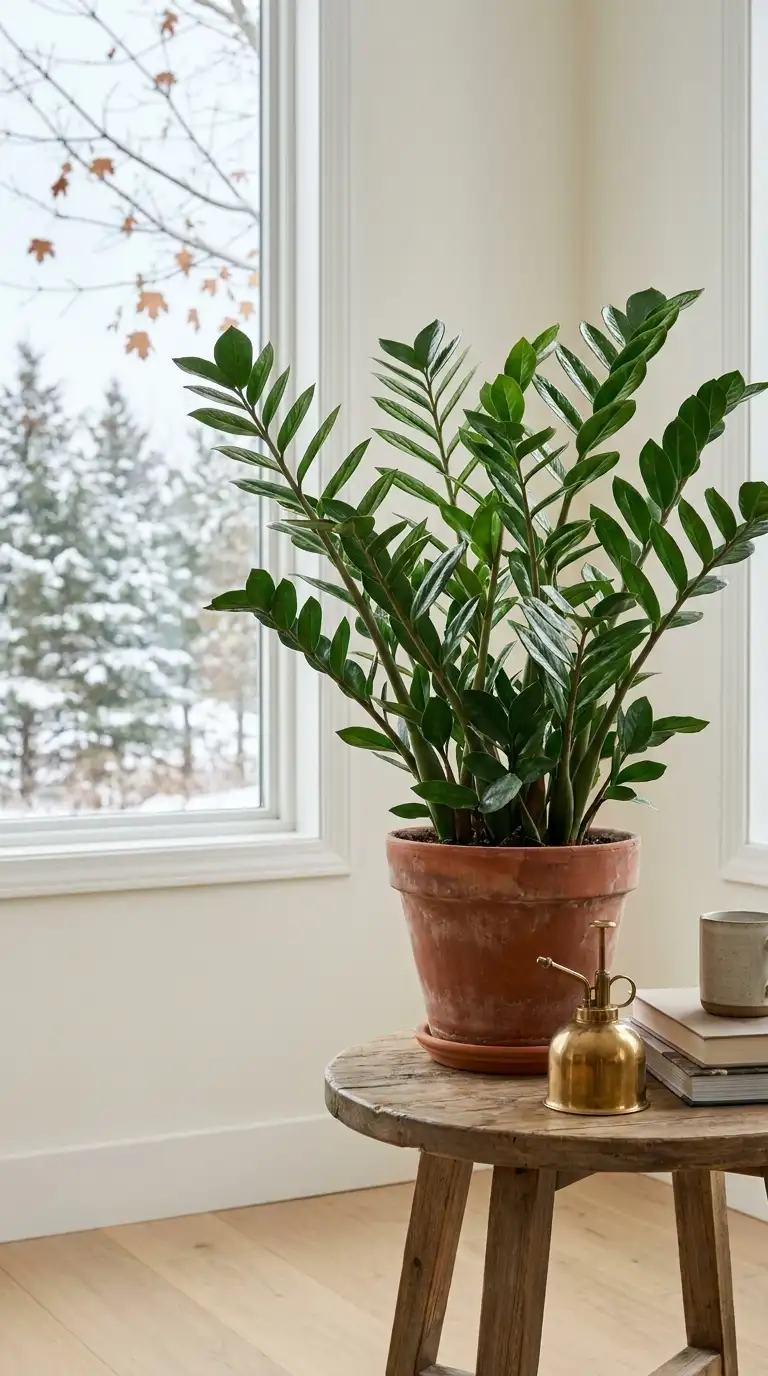
ZZ plant indoor care in Canada — for Zamioculcas zamiifolia — is genuinely easy — this is the closest thing to a no-fail houseplant that exists. Its large underground rhizomes store water for months, its waxy leaves handle the dry air from Canadian forced-air heating without complaint, and it tolerates low light that would kill a monstera, pothos, or fiddle leaf fig. The dry air of a Canadian winter that damages humidity-loving tropicals is simply not a problem for a ZZ plant.
There is one way to kill a ZZ plant in Canada: overwatering. This guide covers the complete care routine, how to avoid the only real threat, propagation, and why this is the right choice for Canadian apartments with limited light.
ZZ plant at a glance: Water — only when completely dry, every 2–6 weeks. Light — tolerates very low light, even north windows. Humidity — loves dry Canadian winter air. Difficulty — very easy. #1 killer — overwatering. Best for — dark apartments, neglect-prone owners, dry heated homes.
Is your Zz Plant getting enough light this winter?
A Canadian winter cuts daylight roughly in half. See what your city actually gets this month, and whether a grow light is needed.
🌿 ZZ Plant Quick Care Card
How to Identify a ZZ Plant
ZZ plants are sometimes confused with other tropical foliage houseplants — particularly young philodendrons, sansevieria (snake plant), and even artificial plants because of how glossy and uniform the leaves look. Use these markers to confirm what you have.
| Feature | ZZ Plant | Often confused with |
|---|---|---|
| Stem pattern | Multiple stems rise vertically from soil with paired leaflets arranged like a feather | Philodendron has a single vine; snake plant has flat upright blades |
| Leaf shape | Small oval leaflets (3–5 cm), thick and waxy, deep emerald green | Philodendron leaves are heart-shaped; pothos leaves are larger and matte |
| Leaf texture | Glossy, almost lacquered — often mistaken for artificial | Most lookalikes have matte or velvety leaves |
| Base of plant | Potato-like rhizomes visible at soil level — the water-storage organ that makes ZZ drought-tolerant | No other common houseplant has visible aboveground rhizomes |
| Growth direction | Upright stems that arch outward as they mature | Pothos and philodendron trail downward; snake plant stays rigidly vertical |
Bought from IKEA, Canadian Tire, or Home Depot in Canada? The plant tag almost always reads "ZZ" or "Zamioculcas zamiifolia" — but new variety releases (Raven, Zenzi, Akebono) are increasingly common at Canadian specialty plant shops and may be labelled only by cultivar name. See the variety section below for visual differences.
Why ZZ Plants Suit Canadian Homes
Most tropical houseplants struggle with at least one aspect of Canadian winter conditions. The ZZ plant is the exception — its natural adaptations align almost perfectly with what our homes provide in winter.
🌓 Low winter light — not a problem
ZZ plants evolved in the dry understory of East African forests with very limited light. Canada's short winter days and north-facing rooms match these conditions well. The plant simply grows slower — it doesn't deteriorate.
💧 Dry furnace air — preferred
Canadian forced-air heating drops humidity to 25–30% in winter. The ZZ plant's thick waxy leaves are specifically adapted to retain moisture in dry conditions — it handles this better than any other common houseplant except snake plant.
🍌 Drought tolerance — built-in
The large underground rhizomes store months of water. If you travel, forget to water, or simply get busy — a ZZ plant survives. It's the most forgiving houseplant for irregular watering schedules.
How to Water a ZZ Plant in Canada
ZZ plants store water in large underground rhizomes — potato-like structures that sit below the soil surface. These rhizomes mean the plant has its own built-in water reservoir, making it extraordinarily drought-tolerant. The watering rule is simple: wait until the soil is completely dry all the way to the bottom, then water thoroughly.
ZZ plant watering schedule — Canada: Summer (May–Sept): every 2–4 weeks. Fall (Oct–Nov): every 4–5 weeks. Winter (Dec–Feb): every 4–6 weeks or longer. Spring (Mar–Apr): every 3–4 weeks. In very low light, water even less — soil dries extremely slowly.
Use a wooden skewer or moisture meter to check soil all the way to the bottom of the pot — the rhizomes sit deep and the soil around them must be dry before watering again. In Canadian winters, it's completely normal and correct to go 6–8 weeks without watering. When you do water, water thoroughly until it drains from the holes, then empty the saucer and don't water again for weeks. Never let a ZZ plant sit in standing water.
Overwatering kills more houseplants than anything else. A 3-in-1 soil meter shows you exactly when the root zone is dry — push the probe in for an instant moisture, light, and pH reading. No batteries needed.
Affiliate link — GrowersGuide.ca may earn a commission on qualifying purchases, at no extra cost to you. Learn more.
The other thing Canadian houseplants run short on all winter is light. From November to March most homes are too dim to keep plants growing — leaves stretch toward the window, variegation fades, and new growth stalls. A small full-spectrum LED grow light on a timer bridges the dark months, even for tough low-light plants that only survive (rather than grow) in a dim room.
Affiliate link — GrowersGuide.ca may earn a commission on qualifying purchases, at no extra cost to you. Learn more.
Why no fixed schedule works: Soil drying rate depends on temperature, light, pot material, room humidity, and plant size. A ZZ plant in a terracotta pot near a bright window dries faster than one in plastic in a dim corner — sometimes twice as fast. The skewer test automatically accounts for all variables. See what affects soil drying rate →
Light Requirements — Canada's Best Low-Light Plant
ZZ plants are the benchmark for low-light tolerance among common houseplants — even more tolerant than snake plants. They grow in conditions where most houseplants would simply stop surviving.
Bright Indirect — Fastest Growth
Near an east, west, or south window. Best growth rate, deepest green colour. The ZZ plant grows fastest here but this placement isn't necessary — it's a bonus.
Medium Light — Good
2–4 m from a window. Steady growth, good health. The most common placement in Canadian homes.
Low Light — Survives Well
North windows, hallways, offices. Growth is very slow — perhaps 1–2 new stems per year — but the plant stays healthy and attractive. Water even less in low light as soil dries extremely slowly.
Direct Sun — Avoid
Direct sun scorches the waxy leaves, causing yellow or brown bleached patches. Keep out of direct sunlight through south or west windows, especially in summer.
Canadian Winter Care — Almost No Changes Needed
Of all common houseplants, ZZ plants require the fewest adjustments for Canadian winters. The main changes are reducing watering frequency and stopping fertilisation.
Reduce watering significantly — the only real adjustment
In Canadian winter, a ZZ plant in low light may need water only once every 6–8 weeks. The rhizomes store water and growth slows dramatically in low light. Check soil with a skewer all the way to the bottom — only water when completely dry. The most common Canadian ZZ plant mistake is continuing to water every 2–3 weeks year-round without adjusting for the slower drying in winter light.
Dry furnace air is fine — no humidifier needed
Unlike monstera, pothos, and peace lily, ZZ plants don't need extra humidity in Canadian winters. The thick waxy coating on the leaves prevents moisture loss in dry air. This is one of the genuine advantages of ZZ plants over other tropical houseplants for Canadian homes.
Keep from cold glass — same as all tropical plants
ZZ plants tolerate cooler temperatures (down to about 10°C) better than most tropicals, but leaves touching cold window glass in Canadian winter still develop damage. Keep a 5 cm gap from the glass. The plant tolerates being near windows but shouldn't be pressed against cold glass.
Stop fertilising November through March
ZZ plants grow very slowly in Canadian winters. Fertilising during dormancy causes nutrient buildup and root tip burn. Resume in April with a balanced liquid fertiliser at half strength, once monthly through September.
Is the ZZ Plant Toxic? Pet and Child Safety
Yes — ZZ plants are mildly toxic to cats, dogs, and humans if chewed or ingested, and the sap can irritate skin and eyes. But the danger is far smaller than the viral "cancer plant" rumour suggests. Here is what is actually true.
The active compound: all parts of Zamioculcas zamiifolia contain calcium oxalate crystals — sharp microscopic needles that cause burning, mouth irritation, drooling, and vomiting if chewed. The same compound is in dieffenbachia, philodendron, pothos, and peace lily. It is not absorbed systemically — there is no risk of poisoning, organ damage, or long-term harm.
The ASPCA classifies ZZ plants as toxic to cats and dogs at the mild level — the same category as Christmas cactus and African violet (those are non-toxic, sorry — same SOURCE). Confirm: ASPCA ZZ plant entry.
If a pet or child chews a ZZ plant
- Rinse the mouth with cool water to flush the calcium oxalate crystals.
- Offer milk or yogurt — the calcium binds to the oxalates and reduces irritation.
- Watch for swelling, breathing trouble, or persistent vomiting. These are rare but warrant a vet or doctor visit.
- Most cases resolve within a few hours without intervention. Pets typically spit it out after one taste because of the immediate burn.
- In Canada, call the Pet Poison Helpline (1-855-764-7661) for pets or the local poison control centre for children if you are concerned.
The "ZZ plant causes cancer" myth — debunked
A viral 2010 internet rumour claimed the ZZ plant was so toxic it was banned in some countries and caused cancer just from touching it. This is completely false. The claim originated from a confused reading of a 1980s study identifying calcium oxalate as a skin irritant — at no point was carcinogenicity demonstrated. ZZ plants are sold openly in every country where houseplants are legal, including across Canada.
Reasonable precaution, not panic: wash your hands after handling cuttings to avoid the sap. Wear gloves if you have sensitive skin. Keep the plant somewhere a determined toddler or cat cannot strip the leaves. That is all.
What about air purification?
The 1989 NASA Clean Air Study included ZZ plants and showed they removed some indoor toxins (xylene, toluene) in a sealed chamber. But a 2019 review of all subsequent research concluded houseplants in a normal home cannot move enough air to make a measurable difference — you would need hundreds of plants per room. ZZ is not better or worse than other houseplants here. Keep it for the look, the low-maintenance, and the dark-room tolerance — not for cleaner air.
How Big Do ZZ Plants Get? Growth Rate & Lifespan
ZZ plants are slow growers — that is the headline. A new ZZ from a Canadian garden centre is usually 30–45 cm tall and stays close to that size for the first one to two years. With consistent care, expect the following over time.
| Age | Typical height | What to expect |
|---|---|---|
| 1 year | 30–45 cm | Same size as the day you bought it; one new stem may emerge |
| 3 years | 45–60 cm | Visibly fuller with 2–3 extra stems; ready for first repotting |
| 5 years | 60–90 cm | Statement-piece size; stems begin to arch outward |
| 10+ years | 90–120 cm | Maximum indoor size; rhizomes may need division |
Annual growth rate: 5–15 cm per year in bright indirect light, less in low light, almost zero in winter under Canadian indoor conditions. If you want faster growth, increase light (do not increase water — that will rot the rhizomes).
Lifespan: with reasonable care, ZZ plants live 15–25 years indoors and individual rhizomes can persist far longer. Mature ZZ plants in Canadian homes are often passed down or shared as cuttings — they outlive most furniture. Repot every 2–3 years when the rhizomes visibly press against the pot wall.
How to Propagate ZZ Plants
ZZ plants propagate slowly — patience is required regardless of method. Spring is the best time in Canada when increasing light supports new growth.
Division — Fastest Method
Unpot the plant and separate the rhizomes into sections, each with at least one stem and roots attached. Pot each section in fresh cactus mix. Best done in spring. Easiest and most reliable method — new sections establish quickly from the existing rhizomes.
Leaf Cuttings — Very Slow
Remove a healthy leaf with its petiole (short stem) and plant upright in moist cactus mix, burying just the petiole. A small rhizome forms at the base over 3–9 months before a new stem emerges. Very slow but satisfying. Wear gloves — the sap irritates skin.
ZZ Plant Troubleshooting
Yellow stems or leaves, mushy base
Rhizome rot from overwatering. Unpot immediately — inspect rhizomes, remove all mushy brown sections with clean scissors, let dry for several hours, repot in fresh cactus mix with heavy perlite. Wait 3–4 weeks before watering again. This is the only common ZZ plant problem in Canada.
Yellow or pale leaves, not mushy
Too much direct sun — bleaching from light that's too intense. Move away from the window or filter with a sheer curtain. Natural ageing of the oldest lowest leaves is also normal — a few yellowing older leaves is fine.
No new growth
In Canadian winter, no growth is completely normal — ZZ plants are dormant. In summer with no new growth: the plant may be severely root-bound (repot into a slightly larger pot in spring) or in too-low light. Move to brighter indirect light. ZZ plants are naturally slow growers — even in ideal conditions, a few new stems per season is normal.
Brown leaf tips
Unlike most tropical plants, low humidity is not the cause for ZZ plants. Most likely: cold glass contact, fluoride in tap water (use filtered or settled water), or physical damage. ZZ plants rarely develop the chronic brown tips that affect peace lily and pothos in Canadian winters.
ZZ Plant Varieties Available in Canada
Classic deep green glossy leaves. Most widely available at Canadian garden centres, hardware stores, and grocery stores. The benchmark ZZ plant.
Striking near-black leaves — new growth emerges bright green then darkens to deep purple-black. Same care as standard ZZ. Increasingly available at Canadian specialty plant shops. A dramatic statement plant.
Compact variety with smaller, more tightly packed leaves that curl slightly inward. Stays under 30 cm — perfect for small Canadian spaces, shelves, and desks. Same drought tolerance as full-size ZZ plants.
New growth emerges bright lime-yellow before slowly greening, giving the plant a two-tone glow. Slower-growing than standard ZZ and a little more light-hungry to keep the pale colour. A specialty-shop find in Canada.
Leaves marbled and streaked with cream and white. Rare and slow-growing — the variegated, less-chlorophyll leaves need bright indirect light and can revert to plain green in a dim spot. The most expensive ZZ at Canadian plant shops.
Frequently Asked Questions
Is ZZ plant good for a dark Canadian apartment?
Yes — it's our top recommendation for dark Canadian apartments. ZZ plants tolerate north-facing windows, positions far from windows, and dimly lit rooms that would cause other houseplants to fail. Growth is slower in low light but the plant stays healthy and attractive.
Is ZZ plant toxic to cats?
Yes — ZZ plants are toxic to cats and dogs. They cause mouth irritation, drooling, and vomiting if chewed. All parts of the plant are toxic and the sap irritates skin. Keep out of reach of pets and wear gloves when handling. Contact your vet if your pet ingests any part of the plant.
Is ZZ plant toxic or carcinogenic?
ZZ plants are toxic if ingested (they contain calcium oxalate crystals) but are not carcinogenic. The cancer myth is widely circulated online but has no scientific basis. The plant is no more dangerous than many other common houseplants — normal precautions (keep from pets and children, wear gloves when handling sap) are sufficient.
How often do I water ZZ plant in winter in Canada?
Every 4–6 weeks or longer — always check that soil is completely dry all the way to the bottom before watering. In low light in Canadian winter, some ZZ plants go 8 weeks or more between waterings with no ill effects. The rhizomes store more than enough water to bridge these gaps.
How fast do ZZ plants grow?
Slowly. Expect 5–15 cm of new height per year in bright indirect light, less in low light, and almost none during Canadian winter. A new store-bought ZZ at 30–45 cm will reach 60–90 cm only after about 5 years and roughly 90–120 cm at 10 years — their typical indoor maximum. Increase light (not water) to speed growth.
How long do ZZ plants live?
Indoors with reasonable care, ZZ plants live 15–25 years and individual rhizomes can persist much longer. Mature ZZ plants in Canadian homes are often passed down or shared as cuttings — they outlive most furniture. Repot every 2–3 years when rhizomes press visibly against the pot wall.
How do I tell a ZZ plant apart from a philodendron or snake plant?
ZZ plants have multiple upright stems with paired oval leaflets that look feather-like; snake plants are flat upright blades with no stem branching; philodendrons trail or vine with heart-shaped leaves. The ZZ's glossy leaves are often mistaken for artificial. The visible potato-like rhizomes at the soil line are unique — no other common houseplant has them.
How often should I water a ZZ plant in Canada?
ZZ plants store water in large underground rhizomes (potato-like structures) and need watering only when the soil is completely dry all the way through — typically every 2–4 weeks in summer and every 3–6 weeks in winter. In Canadian winters with low light and cool indoor temperatures, soil stays wet for weeks after watering. The ZZ plant's rhizomes provide a substantial water reserve — the plant can survive months without water. Overwatering causes yellowing stems and rhizome rot, which is essentially the only way to kill a ZZ plant in Canada.
How much light does a ZZ plant need in Canada?
ZZ plants are the best low-light houseplant for Canadian homes — they tolerate conditions that would kill most other plants, including north-facing windows, positions 3–4 metres from any window, and dimly lit offices. They grow fastest in medium to bright indirect light but survive and stay healthy in very low light. This makes them the ideal choice for dark Canadian apartments, north-facing rooms, and office spaces with limited natural light. Direct sun scorches the waxy leaves — always keep out of direct sunlight. In Canadian winters, the reduced daylight barely affects a ZZ plant's health.
Why is my ZZ plant turning yellow?
Yellow stems or leaves on a ZZ plant almost always indicate overwatering and rhizome rot — the underground storage structures have rotted from consistently wet soil. Unpot the plant and inspect the rhizomes: healthy rhizomes are firm and white or pale tan; rotted rhizomes are soft, brown or black, and smell unpleasant. Remove all rotted sections with clean scissors, let dry for several hours, and repot in fresh cactus mix or potting soil with heavy perlite. Only water again when completely dry. Reduce watering frequency significantly. Natural ageing of the oldest lowest leaves causes occasional yellowing — this is normal if just one or two leaves.
Can ZZ plants survive in a dark Canadian apartment?
Yes — ZZ plants are the top recommendation for dark Canadian apartments. They survive in light conditions that no other common houseplant handles well, including rooms with only north-facing windows, interior rooms with borrowed light from hallways, and positions 3–4 metres from the nearest window. Growth in very low light will be very slow — potentially one or two new stems per year — but the plant remains healthy and maintains its glossy, attractive appearance. The waxy leaves also handle the dry air from Canadian forced-air heating better than almost any other tropical plant.
How do I propagate a ZZ plant?
ZZ plants can be propagated by division or leaf cuttings, though both methods are slow. Division is easiest: unpot the plant, separate the rhizomes into sections each with stems and roots attached, and pot separately. Leaf cuttings are very slow — place individual leaves (with their petiole stem) upright in moist well-draining soil or water. A small rhizome will form at the base over 3–9 months before a new stem emerges. Best time to propagate in Canada: spring (March through May) when increasing light supports new growth. Never propagate in winter — the slow growth becomes even slower in low light.
Is the ZZ plant toxic to pets and people?
Yes — ZZ plants are toxic to cats, dogs, and humans. All parts of the plant contain calcium oxalate crystals that cause mouth and throat irritation, nausea, vomiting, and skin irritation on contact with sap. Keep out of reach of pets and children. When repotting or propagating, wear gloves to avoid skin irritation from the sap. Despite persistent myths, ZZ plants are not carcinogenic — this misconception likely arose because of their toxic properties, but no scientific evidence supports the cancer claim. They are toxic if ingested but not more dangerous than many other common houseplants.
🐾 Have pets? See our Pet-Safe Houseplants guide — which common houseplants are toxic to cats and dogs, which are safe, and what to do if a pet eats one.
📖 More Houseplant Guides
Care guides for popular Canadian houseplants.
Also Growing Vegetables?
Free planting calendars for 30+ vegetables across every major Canadian city.