
Snake Plant Care Guide — Canada
How to grow and care for snake plants (Sansevieria / Dracaena trifasciata) in Canadian homes — watering, light, Canadian winter care, propagation, and why overwatering is the only real threat.
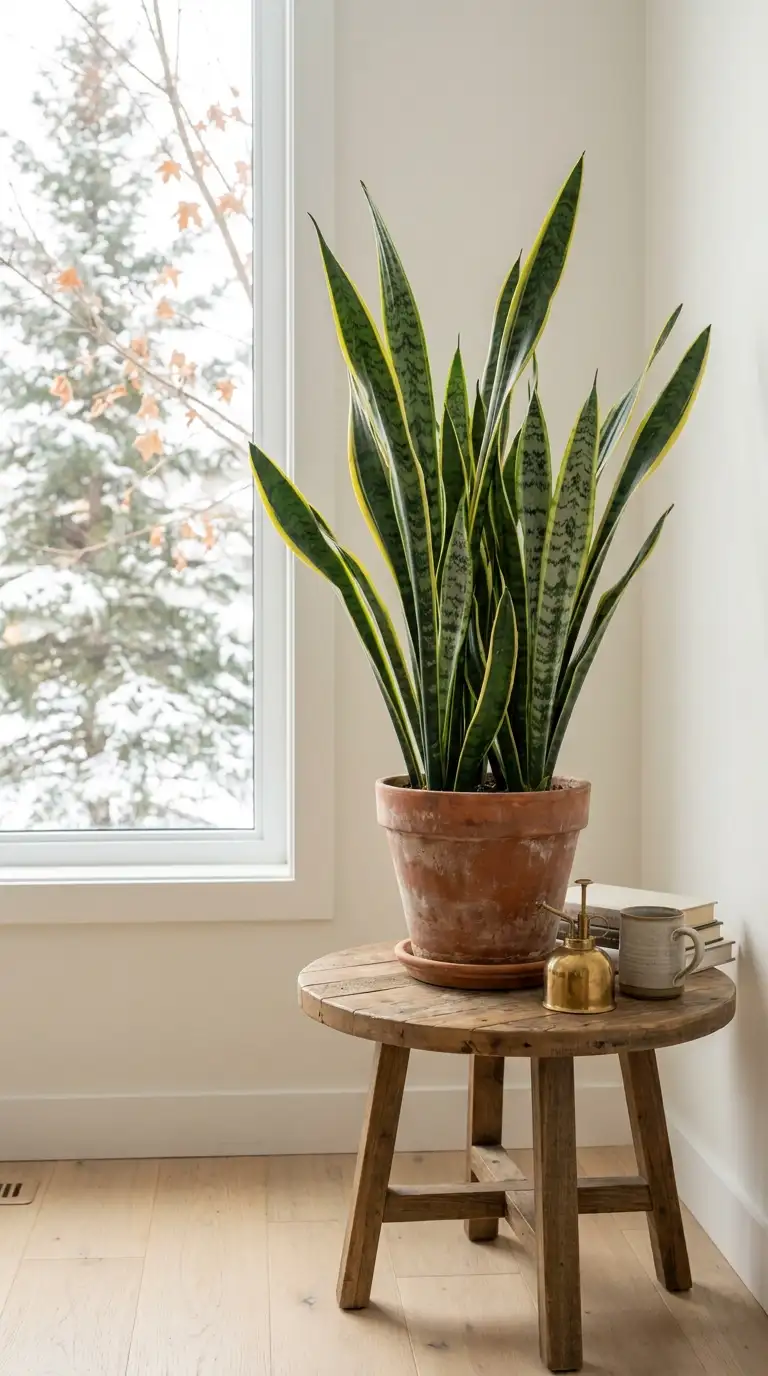
Snake plant (Dracaena trifasciata, formerly Sansevieria) care in Canada is about as straightforward as houseplants get — this is one of the most indestructible plants you can own. It tolerates low light, dry furnace air, irregular watering, and neglect better than almost any other common houseplant. The dry air from Canadian forced-air heating that damages monstera and pothos actually suits the snake plant perfectly. There is effectively one way to kill it: overwatering, particularly in winter when Canadian homes have low light and the soil never dries out.
This guide covers the complete care routine for snake plants in Canada, seasonal adjustments, propagation methods, and how to recover a snake plant from root rot — the only common problem you're likely to encounter.
Snake plant care at a glance: Water — only when bone dry, every 2–8 weeks. Light — tolerates anything from low light to bright indirect. Humidity — loves dry Canadian winter air. Temperature — 15–30°C, keep from cold glass. #1 killer — overwatering in winter. If in doubt, don't water.
Is your Snake Plant getting enough light this winter?
A Canadian winter cuts daylight roughly in half. See what your city actually gets this month, and whether a grow light is needed.
🌿 Snake Plant Quick Care Card
How to Water a Snake Plant in Canada
Snake plants are succulents — their thick, stiff leaves store water, and their roots are adapted to dry conditions. The golden rule of snake plant watering is: only water when the soil is completely dry all the way through. Not just the surface — push a finger or wooden skewer all the way to the bottom of the pot. If there's any moisture, wait.
Snake plant watering schedule — Canada: Summer (May–Sept): every 2–4 weeks. Fall (Oct–Nov): every 3–5 weeks. Winter (Dec–Feb): every 4–8 weeks or less. Spring (Mar–Apr): every 3–4 weeks. These are guides — always check the soil. When in doubt, don't water.
Water thoroughly when you do water — pour until water flows from drainage holes, then let drain completely and empty the saucer. Never let a snake plant sit in standing water. In Canadian winters, it's completely normal and correct to go 6–8 weeks between waterings. The plant is dormant, the low light means almost no water is being used, and the cool temperatures slow evaporation. Respect this cycle and your snake plant will live for decades.
Overwatering kills more houseplants than anything else. A 3-in-1 soil meter shows you exactly when the root zone is dry — push the probe in for an instant moisture, light, and pH reading. No batteries needed.
Affiliate link — GrowersGuide.ca may earn a commission on qualifying purchases, at no extra cost to you. Learn more.
The other thing Canadian houseplants run short on all winter is light. From November to March most homes are too dim to keep plants growing — leaves stretch toward the window, variegation fades, and new growth stalls. A small full-spectrum LED grow light on a timer bridges the dark months, even for tough low-light plants that only survive (rather than grow) in a dim room.
Affiliate link — GrowersGuide.ca may earn a commission on qualifying purchases, at no extra cost to you. Learn more.
Why no fixed schedule works: Soil drying rate depends on temperature, light, pot material, room humidity, and plant size — not the calendar. A snake plant near a bright window in July may need water in 2 weeks; the same plant in low winter light might go 8 weeks. The finger test to the bottom of the pot automatically accounts for all of these. See what affects soil drying rate →
Light Requirements — The Most Flexible Houseplant in Canada
Snake plants are the benchmark for light tolerance among common houseplants. They genuinely thrive across a range that would kill most other plants — from the low light of a north-facing apartment window to the bright indirect light of a south-facing room.
☀️ Bright Indirect
Near an east, west, or south window. Fastest growth, best colour, most pups (offshoots). Best for the most dramatic plants.
🪟 Medium Light
2–3 m from a window. Good steady growth. The most common placement in Canadian homes. Ideal balance of convenience and health.
🌓 Low Light
North windows, hallways, offices. Growth is very slow but the plant remains healthy. Water even less frequently — soil takes weeks to dry in low light. Snake plants survive here indefinitely.
Canadian Winter Care — Why Snake Plants Actually Thrive
Unlike most tropical houseplants, snake plants genuinely suit Canadian winter conditions in most respects. The dry air from forced-air heating that damages humidity-loving plants like monstera is perfectly fine for a snake plant. The challenges are low light and the temptation to overwater.
Dry furnace air is not a problem — it's preferred
Canadian forced-air heating drops indoor humidity to 25–30% in winter. For monstera and pothos this causes brown tips and stress. For a snake plant, it's comfortable — this plant evolved in arid conditions in West Africa and tolerates low humidity with no ill effects. No humidifier needed for snake plants.
Overwatering in winter is the only real threat
In Canadian winter, a snake plant may need water as rarely as once every 6–8 weeks — or not at all in December and January if the pot is large or in low light. The combination of dormancy, low light, and cool temperatures means soil stays wet for weeks after watering. Watering on a summer schedule in winter is the most reliable way to kill a snake plant through root rot.
Keep away from cold window glass
Like most houseplants, snake plant leaves touching or pressed against cold window glass in a Canadian winter develop brown or translucent cold-damage patches. Keep a 5–10 cm gap from the glass. Moving the plant slightly back from the window in winter also compensates for the lower sun angle, which actually improves light penetration through south windows from November to February.
Stop fertilising November through March
Snake plants grow very slowly or not at all in Canadian winters. Fertilising during dormancy causes salt buildup in the soil which burns roots. Resume in April with a balanced liquid fertiliser at half strength, once a month through September.
How to Propagate Snake Plants
Snake plants can be propagated by division or leaf cuttings. Division is easiest and the only method that preserves variegation in striped varieties like Laurentii.
Division (preserves variegation)
Unpot the plant and gently pull or cut apart the root ball into sections, each with roots and leaves attached. Pot each section separately in well-draining soil. Best done in spring. Least stressful propagation method — both parent and divisions recover quickly.
Leaf cuttings (reverts to solid green)
Cut a healthy leaf into 5–8 cm sections. Plant upright in moist cactus mix, keeping the same orientation as grown (bottom-end down). Roots develop in 4–8 weeks. New plants will be solid green — variegated edge markings (like Laurentii's yellow border) are lost with this method.
How to Make Your Snake Plant Fuller Without Repotting
A snake plant looks sparse when the rhizome is barely pushing new pups — usually from low light, no feeding, or a too-large pot. None of these require repotting to fix. Snake plants actually prefer being root-bound, and crowding the rhizome is what triggers it to send up new leaves around the edge. Four in-pot adjustments will visibly thicken a sparse plant over one growing season:
1. Move it to brighter light
Snake plants survive in low light but only push new pups in bright indirect light. Move within 1–2 m of an east, west, or south-facing window for 6–8 weeks and you'll see new leaf spears emerging from the soil along the rhizome edge.
2. Feed lightly in spring & summer
A balanced 20-20-20 houseplant fertiliser diluted to quarter strength, once a month from April through September. Snake plants don't need much — but they need some. Without any feeding, a mature plant in old soil simply runs out of nitrogen and stops producing new leaves.
3. Top-dress with fresh soil
Scrape out the top 2–3 cm of tired potting mix and replace it with fresh cactus or succulent mix. Adds slow-release nutrients and improves drainage without disturbing the rhizome. Do this in spring; the new soil meets new roots as growth picks up.
4. Plant pups back into the same pot
If you've already propagated by division and have rooted pups, replant 2–3 of them around the edge of the original pot rather than into separate containers. The mother and pups fill in the space and the cluster looks dense within a season.
⚠️ Ice cube myth: The viral trick of dropping ice cubes on a snake plant's soil to make it fuller doesn't actually trigger new pups — there's no horticultural mechanism that connects cold-water stress with rhizome activation. What works in the videos is usually the regular slow watering pattern (slow melt = light, even moisture), but cold tap water on tropical roots can cause stress and brown leaf tips. Use room-temperature water; the bushiness comes from light, food, and time.
Snake Plant Troubleshooting
Yellow, mushy, or soft leaves at the base
Root rot from overwatering. Unpot immediately — inspect roots, cut away all brown mushy sections with clean scissors. Let roots air dry for several hours. Repot in fresh cactus mix or potting soil with heavy perlite. Wait at least 2–3 weeks before watering again. This is the most common snake plant problem in Canada, especially in winter.
Brown tips or edges
Cold glass contact (keep 5–10 cm from window), tap water fluoride or salt buildup (flush with distilled water occasionally), or physical damage. Unlike most tropical plants, dry air is rarely the cause for snake plants.
Leaves falling over or drooping
Either overwatering (leaves become soft and heavy) or the pot is too small and the plant is top-heavy. Check the soil — if wet, reduce watering. If the roots are pot-bound (circling the bottom, coming out drainage holes), repot into a slightly wider container in spring.
No new growth
In Canadian winters, no growth is normal and expected — snake plants are dormant. In spring and summer, lack of growth usually means insufficient light or the plant is severely root-bound. Move to brighter light and check whether repotting is needed.
Popular Snake Plant Varieties in Canada
"Snake plant" covers a wide range of cultivars, from the familiar yellow-edged Laurentii to dwarf rosettes, near-black leaves and cylindrical spears. They all share the same drought-tolerant, low-light care — the differences are purely in looks and size. One rule applies across all the variegated types: only division preserves the variegation; leaf cuttings revert to plain green.
| Variety | Appearance | Form & size | Notes |
|---|---|---|---|
| Laurentii ('Laurentii') | Green cross-banding, bright yellow edges | Upright, 60–120 cm | The classic; most widely sold in Canada. Divide only, to keep the edges |
| Zeylanica / Standard (D. trifasciata) | Grey-green wavy cross-banding, no yellow edge | Upright, 60–100 cm | The common hardware-store snake plant; extremely tough |
| Moonshine ('Moonshine') | Pale silvery sage-green, faint banding | Upright, 40–60 cm | Needs bright indirect light to hold the pale colour |
| Black Coral ('Black Coral') | Very dark green with fine silvery banding | Upright, 50–90 cm | Deep colour holds even in lower light |
| Black Gold ('Black Gold') | Near-black green leaves, bold gold edges | Upright, 60–100 cm | High-contrast alternative to Laurentii |
| Hahnii (Bird's Nest) ('Hahnii') | Short rosette of cross-banded leaves | Compact rosette, under 20 cm | Ideal for desks, shelves and small spaces |
| Golden Hahnii ('Golden Hahnii') | Bird's-nest rosette with yellow leaf edges | Compact rosette, under 20 cm | Variegated dwarf; divide only to keep the gold |
| Futura Superba ('Futura Superba') | Shorter, wider Laurentii-type with yellow edges | Compact upright, 30–50 cm | A tidy, space-saving take on Laurentii |
| Bantel's Sensation ('Bantel's Sensation') | Narrow leaves with white vertical stripes | Slim upright, 50–90 cm | Slow-growing and prized; needs good light or it reverts |
| Whale Fin (D. masoniana) | A single huge paddle-shaped, mottled leaf | Broad, 30–60 cm | A dramatic statement plant; usually sold as one leaf |
| Cylindrica (D. angolensis) | Round, spear-like cylindrical leaves | Upright, 60–90 cm | Often braided or fanned ('Starfish') at garden centres |
| Twisted Sister ('Twisted Sister') | Short, twisting leaves with gold variegation | Compact, 30–40 cm | A curly novelty form; divide only to keep the colour |
Frequently Asked Questions
How often should I water a snake plant in winter in Canada?
Every 4–8 weeks — or not at all in December and January if the pot is large or the plant is in low light. Always check that soil is completely dry all the way through before watering. When in doubt, wait another week and check again.
Can snake plants survive in a low-light Canadian apartment?
Yes — snake plants are the best houseplant for low-light Canadian apartments. They tolerate north-facing windows and positions far from windows that would kill most other plants. Growth will be very slow, but the plant remains healthy. Water even less frequently in low light as soil dries slowly.
Is a snake plant the same as sansevieria?
Yes — snake plants were previously classified as Sansevieria and reclassified as Dracaena trifasciata in 2017. Both names refer to the same plant. You'll still find them sold as "Sansevieria" at many Canadian garden centres. Other common names include mother-in-law's tongue and Saint George's sword.
Why is my snake plant turning yellow?
Almost certainly overwatering. Check the soil — if it's wet or the plant feels soft and mushy at the base, root rot has begun. Unpot, remove rotted roots, let dry, and repot in fresh cactus mix. Reduce watering frequency significantly going forward.
How often should I water a snake plant in Canada?
Snake plants are extremely drought-tolerant — water only when the soil is completely dry all the way to the bottom of the pot. In Canadian summers this is typically every 2–4 weeks. In winter, when growth stops entirely, watering every 4–8 weeks or even less is appropriate. Snake plants store water in their thick leaves and can survive weeks without water. The number one cause of snake plant death in Canada is overwatering — particularly in winter when Canadian homes have low light and cool temperatures. Always check that soil is bone dry before watering.
How much light does a snake plant need in Canada?
Snake plants tolerate an exceptionally wide range of light — from bright indirect light near a south or west window all the way to low light in a north-facing room or far from any window. This makes them ideal for Canadian apartments and offices where light is limited, especially in winter. For best growth, place in medium to bright indirect light. In low light, the plant simply grows more slowly — it will not die. Direct hot afternoon sun through a south window can scorch leaves, but morning light from an east window is beneficial.
Why is my snake plant turning yellow or mushy?
Yellow or mushy leaves on a snake plant almost always indicate overwatering and root rot. Snake plants are succulents — their thick leaves store water and their roots rot quickly in consistently wet soil. Check the soil: if it's wet, unpot the plant, inspect the roots, trim any brown mushy sections with clean scissors, let the roots air dry for several hours, and repot in well-draining cactus mix or potting soil with added perlite. Only water again once the soil is completely dry. In Canadian winters this problem is especially common because low light and cool temperatures mean soil stays wet for weeks.
Can I grow snake plants anywhere in my Canadian home?
Yes — snake plants are one of the most placement-flexible houseplants. They tolerate north-facing windows (very low light), hallways, bathrooms (if there's some natural light), and far from windows. They also tolerate the very dry air from Canadian forced-air heating better than most tropical plants, making them ideal for Canadian homes in winter. The only placements to avoid: directly touching cold window glass in winter (causes cold damage), and completely dark rooms with no natural light whatsoever (the plant will survive briefly but decline over months).
How do I propagate snake plants?
Snake plants can be propagated three ways. Division: the easiest — when repotting, separate the plant at the roots into two or more sections and pot each separately. Leaf cuttings in water: cut a healthy leaf into 5–8 cm sections, place upright in water (keeping the same orientation as they grew — bottom down), and roots appear in 3–6 weeks. Leaf cuttings in soil: same sections planted upright in moist well-draining soil. Note: variegated snake plants (like Laurentii with yellow edges) will revert to solid green when propagated from leaf cuttings — only division preserves the variegation.
Do snake plants clean the air in Canadian homes?
Snake plants were included in NASA's Clean Air Study and shown to remove certain volatile organic compounds (VOCs) from enclosed test chambers. However, subsequent research has shown that the quantity of plants needed to measurably improve air quality in a real home is impractically large — hundreds of plants per room. So while snake plants do technically filter some air pollutants, the effect in a typical Canadian home is minimal. They are excellent houseplants for many reasons — tolerance of low light, dry air, and neglect — but treating them as air purifiers sets unrealistic expectations.
How do I make my snake plant fuller without repotting it?
Four in-pot adjustments push a sparse snake plant to thicken over one growing season without ever unpotting it. First, move it to brighter indirect light within 1–2 metres of a window — new pups only emerge in good light. Second, feed quarter-strength balanced houseplant fertiliser once a month from April through September. Third, top-dress with 2–3 cm of fresh cactus mix in spring without disturbing the rhizome. Fourth, plant any propagated pups back into the original pot rather than separate containers to fill in the cluster. Snake plants actually prefer being root-bound — crowding the rhizome is what triggers new leaf spears. The viral ice-cube trick has no horticultural mechanism behind it and can stress tropical roots with cold water; use room-temperature water.
🐾 Have pets? See our Pet-Safe Houseplants guide — which common houseplants are toxic to cats and dogs, which are safe, and what to do if a pet eats one.
📖 More Houseplant Guides
Care guides for popular Canadian houseplants.
Also Growing Vegetables?
Free planting calendars for 30+ vegetables across every major Canadian city.