
African Violet Care Guide — Canada
How to grow African violets in Canadian homes year-round — bottom watering, continuous blooming, winter care, and the grow light trick that keeps them flowering through our darkest months.
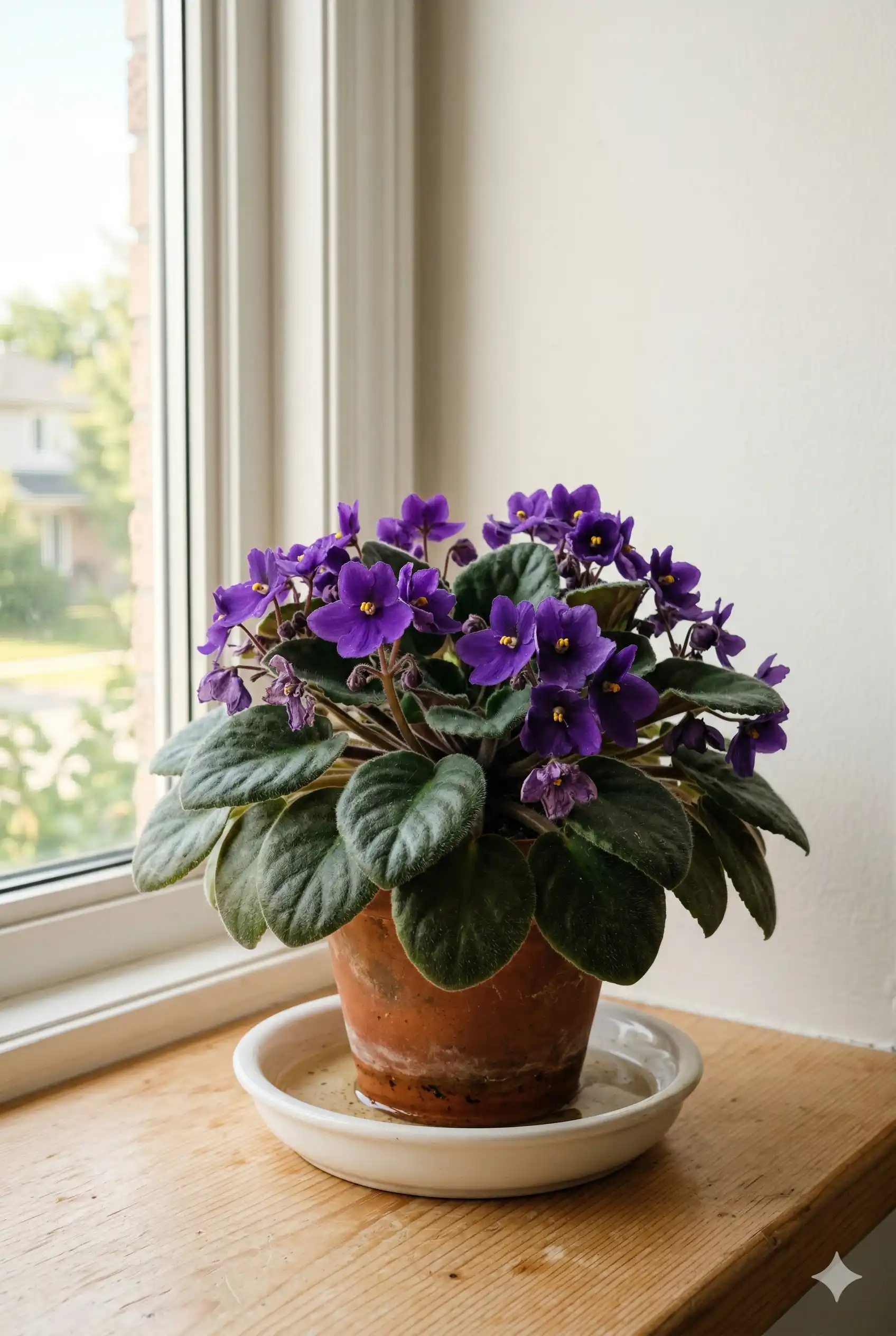
African violet (Saintpaulia ionantha) care in Canada is rewarding because unlike orchids or Christmas cactus, these plants can bloom continuously all year — not just seasonally. They are the most reliably flowering indoor plant for Canadian homes, appearing in garden centres, grocery stores, and hardware stores year-round for good reason. The care rules are simple but specific, and breaking one rule stops the blooming immediately.
This guide covers the three things that matter most: watering from below only, providing enough light through Canadian winters, and feeding the right fertiliser ratio to keep flowers coming.
African violet at a glance: Water — from below only, room-temperature, every 7–10 days. Light — east/west window or grow light 12–14 hrs. Never — wet the leaves or use cold water. Bloom — year-round in good light. Pet safe — non-toxic to cats and dogs ✅
Is your African Violet getting enough light this winter?
A Canadian winter cuts daylight roughly in half. See what your city actually gets this month, and whether a grow light is needed.
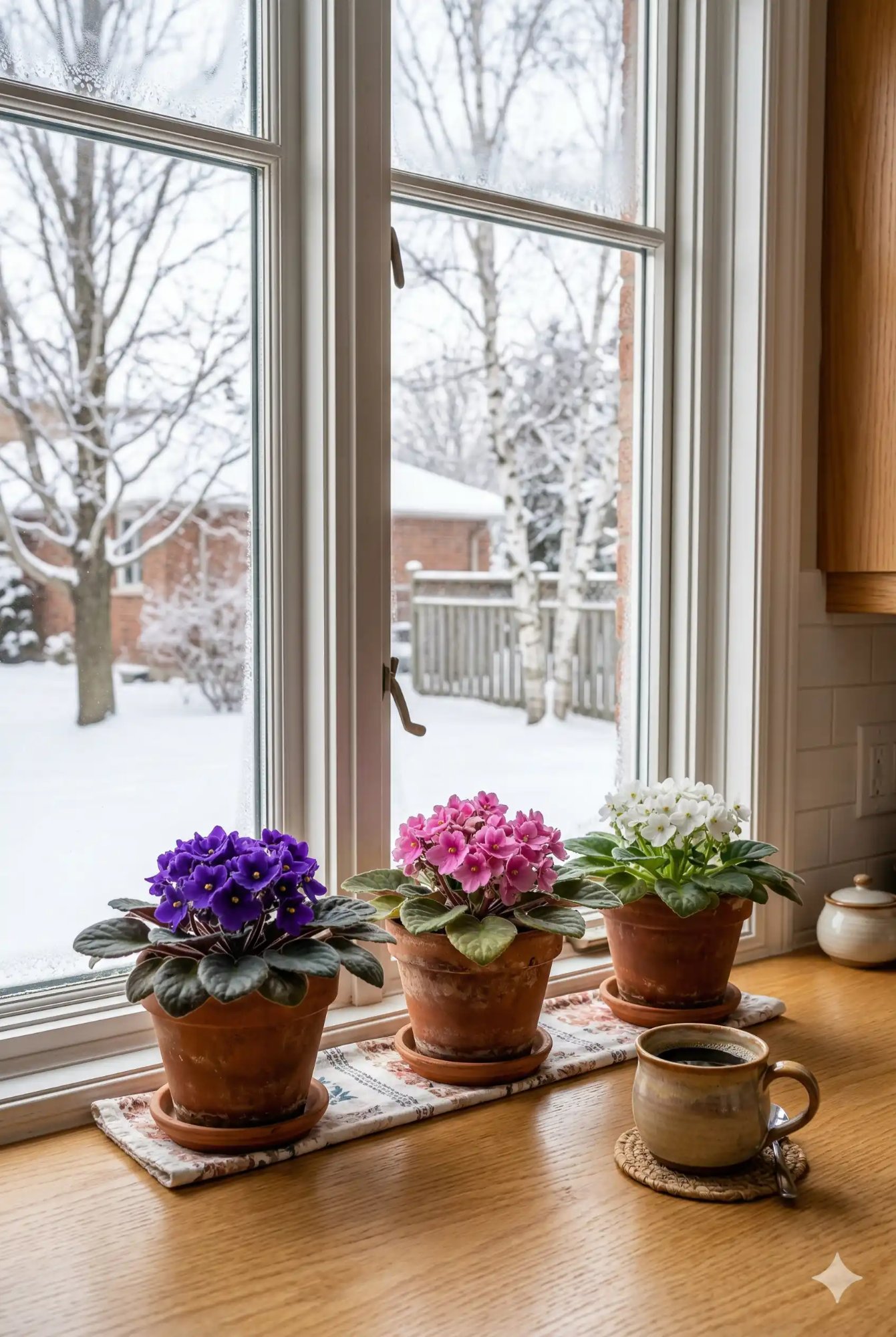
💐 African Violet Quick Care Card
Bottom Watering — The One Non-Negotiable Rule
African violet leaves are covered in fine hairs that trap water. Water on the leaves — especially cold Canadian tap water — causes permanent white spots and, if it sits in the crown (centre of the plant), causes rot that kills the plant. Bottom watering eliminates both risks entirely.
About 2–3 cm deep. Use water that has sat overnight to off-gas chlorine. Cold Canadian tap water causes immediate white spots on contact with the fuzzy leaves.
The soil absorbs water upward through the drainage holes. When the top of the soil feels slightly moist, it has absorbed enough. Do not leave soaking longer than 30 minutes.
Lift the pot out, let any excess drain, return to its spot. Empty the saucer — never let the pot sit in standing water. Repeat when the top centimetre of soil is dry, typically every 7–10 days.
If you accidentally get water on the leaves: blot gently with a soft cloth immediately and move the plant out of direct light until dry. Cold water spots are permanent — they do not disappear — but the plant will grow new leaves over time.
Overwatering kills more houseplants than anything else. A 3-in-1 soil meter shows you exactly when the root zone is dry — push the probe in for an instant moisture, light, and pH reading. No batteries needed.
Affiliate link — GrowersGuide.ca may earn a commission on qualifying purchases, at no extra cost to you. Learn more.
The other thing Canadian houseplants run short on all winter is light. From November to March most homes are too dim to keep plants growing — leaves stretch toward the window, variegation fades, and new growth stalls. A small full-spectrum LED grow light on a timer bridges the dark months, even for tough low-light plants that only survive (rather than grow) in a dim room.
Affiliate link — GrowersGuide.ca may earn a commission on qualifying purchases, at no extra cost to you. Learn more.
Why no fixed schedule works: How fast soil dries depends on temperature, light, pot material, room humidity, and plant size. An African violet under a grow light at 23°C in summer may need water every 6–7 days; the same plant in a cool dim winter room may go 12–14 days. The top 1 cm finger test automatically accounts for all of these. See what affects soil drying rate →
The Grow Light Solution for Canadian Winters
African violets are one of the best houseplants to grow under artificial light — they actually prefer the consistent intensity of a grow light over variable window light, especially in Canadian winters when natural light drops to 8–9 hours of low-intensity daylight.
Grow light setup for African violets: A full-spectrum LED bulb or T5 fluorescent tube, positioned 20–30 cm above the plant, on a timer set to 12–14 hours daily. This produces year-round continuous blooming regardless of season — the most reliable approach for Canadian growers. Any standard grow bulb in a clamp lamp works. The investment is minimal and the results are dramatic.
Fertilising for Continuous Blooms
Fertiliser ratio matters more for African violets than for most houseplants because nitrogen (N) promotes leaf growth and phosphorus (P) promotes flowering. A fertiliser high in nitrogen produces lush leaves with no flowers — exactly the wrong result.
✅ Use this
African violet fertiliser (high phosphorus middle number) or balanced 20-20-20 at quarter strength. Apply every 2–4 weeks during active growth. Stop if plant is resting (no new growth in winter).
✖ Avoid this
High-nitrogen general fertilisers (high first number). These produce beautiful leaves and zero flowers. Also avoid fertilising at full strength — African violets are sensitive to salt buildup. Always use half to quarter strength.
African Violet Troubleshooting
No flowers
Insufficient light is the #1 cause. Move to a brighter window or add a grow light. Also check fertiliser ratio (too much nitrogen), pot size (too large inhibits blooming), and temperature (below 15°C stops flowering).
White spots on leaves
Cold water on the fuzzy leaves — permanent damage, these spots won't disappear. Switch to bottom watering immediately. The plant will grow new undamaged leaves over time. In Canadian winter, cold tap water is especially problematic — always use overnight-settled room-temperature water.
Leggy stretched growth
Insufficient light — the plant is reaching toward the nearest light source. Move closer to the window or reduce the distance to the grow light. Rotate the pot a quarter turn weekly to keep growth even and compact.
Crown rot — centre is mushy
Water got into the crown. Remove all mushy growth with clean scissors. Allow to dry in a bright spot. Repot in fresh mix if roots are also affected. This is usually fatal if severe — prevention through bottom watering only is essential.
African Violet Varieties for Canadian Homes
African violets are grouped by size and growth habit. All share the same care rules — the differences are in size, flower form, and leaf pattern. All are Saintpaulia ionantha hybrids.
20–40 cm across. The most widely sold at Canadian garden centres and grocery stores. Single or double flowers in purple, pink, white, or bicolour. Best choice for beginners.
Under 8 cm across. Perfect for small windowsills. Blooms just as prolifically as standard varieties but fits in tight spaces. Increasingly available at Canadian specialty plant shops.
Fully ruffled blooms that resemble roses or peonies. Very popular in Canada — often sold around Valentine's Day and Mother's Day. Same care as single-flowered types.
Green-and-white or green-and-cream patterned foliage. Grown as much for the leaves as the flowers. Slightly slower growing. Available at specialty plant shops in Toronto, Vancouver, Montreal.
Produces multiple crowns and trails gracefully — suited to hanging baskets. Less common at general Canadian garden centres but available from African violet specialty suppliers online.
Frequently Asked Questions
How do I propagate African violets?
Leaf cuttings are the easiest method. Remove a healthy leaf with its stem, cut the stem to 3–4 cm, and insert at a 45-degree angle in moist African violet mix or perlite. Cover loosely with a clear bag to maintain humidity. New plantlets appear at the base of the stem in 6–8 weeks. Best done in spring or summer in Canada when light is better.
How often should I repot African violets?
Every 6–12 months into the same size pot with fresh African violet mix. African violets bloom better slightly root-bound — never move into a much larger pot. The pot diameter should be about one-third of the leaf span. Spring is the best time in Canada.
Are African violets safe for cats and dogs?
Yes — African violets are non-toxic to cats and dogs. They are one of the safest flowering houseplants for pet owners in Canada. The ASPCA lists them as non-toxic. Cats may be drawn to chew the fuzzy leaves — not harmful to the cat, but damaging to the plant.
How do I water African violets in Canada?
Water African violets from below, not from the top. Place the pot in a shallow saucer of room-temperature water for 20–30 minutes, allowing the soil to absorb moisture through the drainage holes, then remove and let drain. Never pour water on the leaves or crown — cold water on the fuzzy leaves causes permanent white spots and crown rot. Use room-temperature filtered or overnight-settled water. Canadian tap water chlorine and cold temperature are both problematic for African violets. Water when the top centimetre of soil is dry — typically every 7–10 days. Consistent moisture is more important than a fixed schedule.
How do I get African violets to bloom continuously in Canada?
African violets bloom continuously in the right conditions — unlike orchids, they don't need a rest period or temperature change. The key factors for continuous blooming are: adequate light (a bright east or west window, or a dedicated grow light on a 12–14 hour timer which is especially important in Canadian winters); consistent moisture from below watering; a phosphorus-rich fertiliser (look for a high middle number like 20-20-20 or African violet specific fertiliser) applied every 2–4 weeks; and removing spent flowers and yellowing leaves promptly. A grow light on a 12-hour timer is the single most reliable way to get year-round blooming in Canada regardless of season.
Why has my African violet stopped blooming?
African violets stop blooming for four main reasons in Canada: insufficient light (the most common cause — a north-facing room or position far from windows does not provide enough light, especially in winter); root bound conditions (plants bloom better when slightly root-bound, but severely cramped roots stop all growth); too much nitrogen in fertiliser (promotes leaves not flowers — switch to a fertiliser with higher phosphorus); or inconsistent watering (both drought and overwatering stop blooming). The most reliable fix for a non-blooming African violet in Canada is moving it to a brighter spot or adding a grow light.
How much light do African violets need in Canada?
African violets need bright indirect light — more than many people give them. An east or west facing window is ideal. They tolerate low light better than most flowering plants but will stop blooming if light is insufficient, particularly in Canadian winters. A north window does not provide enough light for consistent blooming from November through February. The best solution for year-round Canadian blooming is a dedicated grow light — a full-spectrum LED bulb 20–30 cm above the plant on a 12–14 hour timer produces continuous flowers regardless of season. This is a small investment (one grow bulb) with dramatic results.
How do I care for African violets in a Canadian winter?
African violets handle Canadian winters well with a few adjustments. Move to your brightest window — east or west facing — or set up a grow light on a 12–14 hour timer. Never let leaves touch cold window glass, which causes cold damage spots. Continue bottom watering with room-temperature water — cold tap water in winter causes white spots on leaves. Maintain temperature above 15°C — keep away from cold exterior walls and drafts. Stop fertilising if the plant has stopped active growth, but resume as soon as you see new leaf growth beginning. A humidifier helps as African violets prefer 40–60% humidity and Canadian furnace air drops to 25–30%.
Are African violets toxic to cats?
No — African violets (Saintpaulia) are non-toxic to cats and dogs according to the ASPCA. They are one of the few flowering houseplants that is completely pet-safe. This makes them an excellent choice for Canadian homes with pets, especially compared to many other popular flowering houseplants. However, cats may be attracted to the fuzzy leaves — if a cat chews the leaves it won't be harmed, but the plant may be damaged.
🐾 Have pets? See our Pet-Safe Houseplants guide — which common houseplants are toxic to cats and dogs, which are safe, and what to do if a pet eats one.
📖 More Houseplant Guides
Also Growing Vegetables?
Free planting calendars for 30+ vegetables across every major Canadian city.