
Bird of Paradise Care Guide — Canada
How to grow bird of paradise (Strelitzia reginae and nicolai) in Canadian homes — maximum light, split leaves, watering, and honest expectations about indoor flowering.
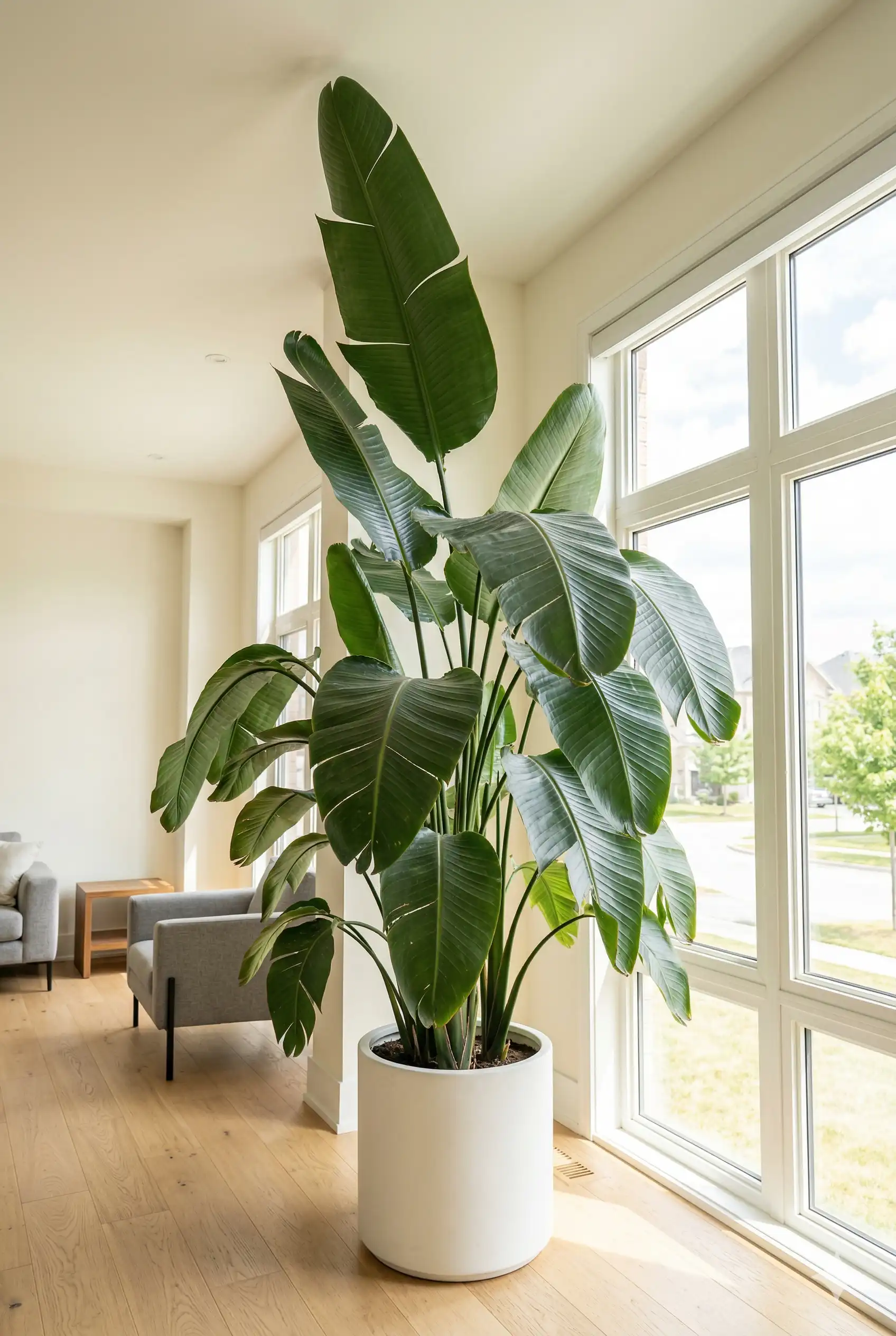
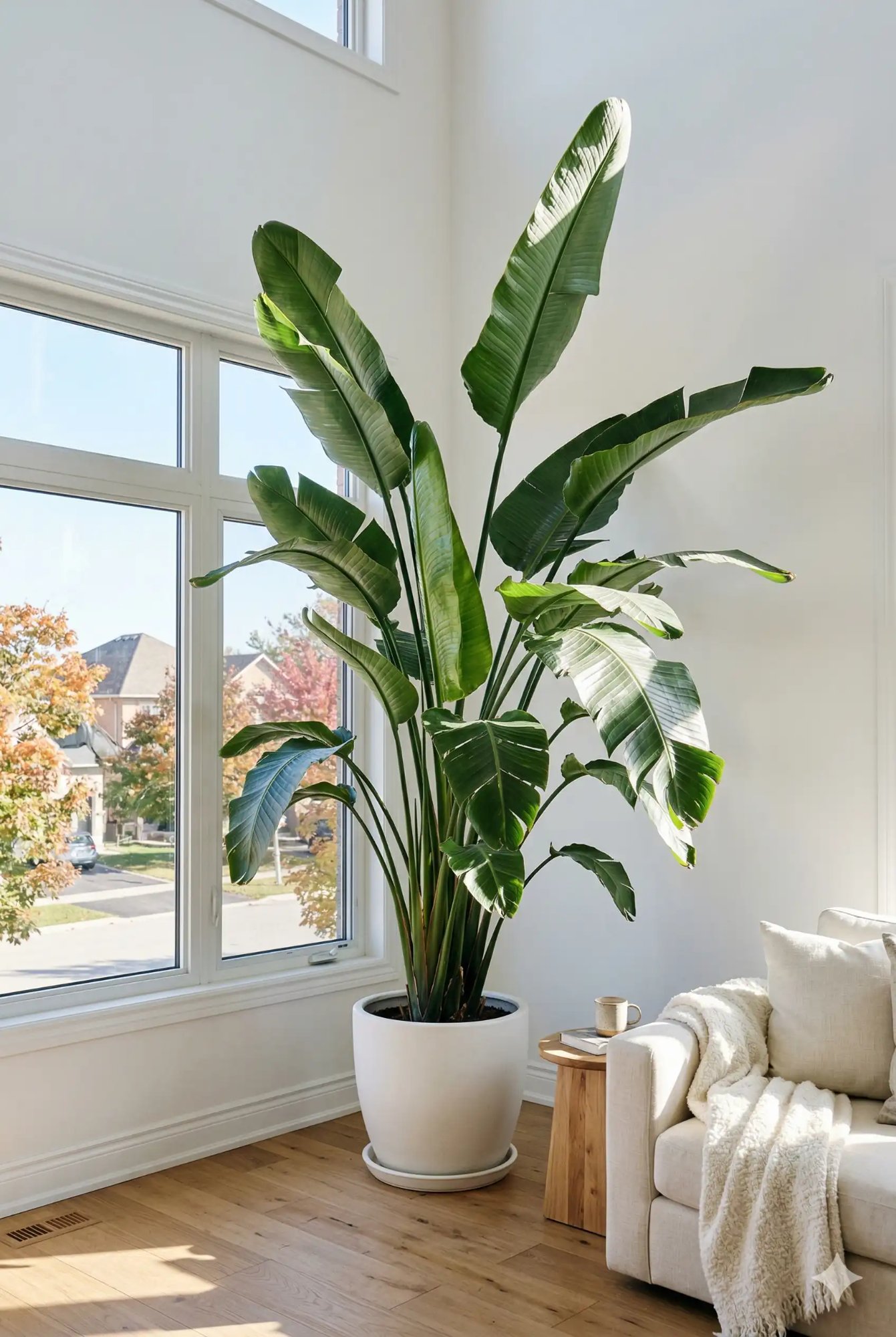
Bird of paradise care in Canada is about one thing: light. Strelitzia reginae (the flowering orange variety) and Strelitzia nicolai (the giant white variety with huge paddle leaves) are both among the most light-hungry houseplants you can grow indoors. Canadian winters are the hardest time — the plant needs more light than most Canadian homes can provide from November through February, and this is when problems develop.
On the question of indoor flowering: be honest with yourself. Bird of paradise rarely flowers indoors in Canada. The dramatic split leaves of Strelitzia nicolai are the real reason Canadians buy this plant — and for that, it delivers. This guide covers how to maximise light, understand the leaf splits, and keep a large architectural plant healthy through Canadian winters.
🌸 At a glance: Light — maximum available, south window essential. Water — when top 5cm dry, every 7–14 days. Split leaves — normal and healthy, caused by wind/growth. Flowering indoors — rare in Canada. Toxic to pets ⚠️
Is your Bird Of Paradise getting enough light this winter?
A Canadian winter cuts daylight roughly in half. See what your city actually gets this month, and whether a grow light is needed.
🌸 Quick Care Card
How to Water Bird of Paradise in Canada
Bird of paradise is more drought-tolerant than most tropical houseplants — its thick rhizome roots store moisture. The two biggest watering mistakes are overwatering in Canadian winter and using cold tap water straight from the tap.
Summer (May–September)
Water every 7–14 days when the top 5 cm is dry. The plant is actively growing and using water. Water deeply until it drains from the bottom, then let the pot dry before watering again. Fertilize every 2–4 weeks with a balanced liquid fertilizer.
Winter (November–March)
Cut back to every 14–21 days. Growth stops completely in the low light of Canadian winter — the plant uses very little water. The most common cause of root rot in Canada is watering on a summer schedule through winter. Stick your finger 5 cm deep: if any moisture remains, wait.
Water Quality
Use room-temperature water — cold tap water shocks the roots and can cause brown leaf edges. If your tap water is heavily chlorinated (common in Canadian cities), let it sit overnight before using or use filtered water. Bird of paradise is somewhat sensitive to fluoride in city water.
Overwatering kills more houseplants than anything else. A 3-in-1 soil meter shows you exactly when the root zone is dry — push the probe in for an instant moisture, light, and pH reading. No batteries needed.
Affiliate link — GrowersGuide.ca may earn a commission on qualifying purchases, at no extra cost to you. Learn more.
The other thing Canadian houseplants run short on all winter is light. From November to March most homes are too dim to keep plants growing — leaves stretch toward the window, variegation fades, and new growth stalls. A small full-spectrum LED grow light on a timer bridges the dark months, even for tough low-light plants that only survive (rather than grow) in a dim room.
Affiliate link — GrowersGuide.ca may earn a commission on qualifying purchases, at no extra cost to you. Learn more.
Why no fixed schedule works: How fast soil dries depends on temperature, light, pot material, room humidity, and plant size. Bird of paradise in a bright south window in summer dries in 7 days; the same plant in a dim corner in January may go 3 weeks. The top 5 cm finger test automatically accounts for all of these. See what affects soil drying rate →
Light Requirements — Maximum Sun for Canada
Bird of paradise needs more light than almost any other common Canadian houseplant. It is native to South Africa and evolved in intense direct sun. In Canada, the south window rule is non-negotiable for a plant that will actually thrive.
South Window — Ideal
Maximum direct sun. Place as close to the glass as possible. This is the only window type that supports the S. reginae flowering indoors. S. nicolai grows fastest here.
East or West — Surviving
Adequate for keeping a healthy S. nicolai alive but growth is very slow. S. reginae will not bloom in east or west light. Consider supplemental grow light in winter.
North Window — Avoid
Insufficient light. The plant will decline slowly, producing no new leaves. Canadian north windows have almost no direct sun, especially from October through February.
Canadian Winter Care — Managing Low Light
Canadian winters are the hardest season for bird of paradise. The low light from November to February causes the plant to stop growing entirely — this is normal and not a sign of a problem. The key is managing the plant through this period without triggering root rot or cold stress.
Move to Best Window
Reposition to the largest south-facing window in November. Keep the plant as close to the glass as possible without touching it. Even a 30 cm difference in distance from the window significantly changes light levels in Canadian winter.
Reduce Water Sharply
Cut watering to every 3 weeks or when the top half of the pot is dry. Do not fertilize from November through February. Root rot from winter overwatering is the most common way bird of paradise dies in Canadian homes.
Avoid Cold Drafts
Keep the plant away from exterior walls and cold window glass. Bird of paradise tolerates down to about 10°C but not sustained cold drafts. Avoid positioning near frequently opened exterior doors. Hot dry heating vents are equally damaging.
Strelitzia Varieties Available in Canada
Two species are sold in Canadian garden centres and plant shops. They look very different when mature and have different light tolerances. Knowing which you have changes care expectations significantly.
| Variety | Mature Size | Flower | Blooms Indoors? | Best For |
|---|---|---|---|---|
| S. reginae (Bird of Paradise) | 1–1.5 m tall | Orange & blue | Rarely — needs south sunroom | Smaller spaces, south windows |
| S. nicolai (Giant Bird of Paradise) | 2–3 m indoors | White & purple | Almost never | Dramatic architectural leaves |
| S. alba (White Bird of Paradise) | Rare, 3+ m | White | No | Specialty collectors only |
| 'Mandela's Gold' | 1–1.5 m | Yellow & blue | Very rarely | Collectors; rarely available in Canada |
How to Propagate a Bird of Paradise
Bird of paradise is propagated by division of its clump — it cannot be grown from a leaf or stem cutting. Division is best done in spring, ideally while repotting. Be patient: bird of paradise resents root disturbance and a freshly divided plant often sulks for months before it resumes growth.
Dividing the rhizome clump
A mature bird of paradise grows as several fans of leaves from a thick underground rhizome. Slide the plant out of its pot and find where the fans separate. Cut through the rhizome with a clean, sharp knife so each division has at least one strong fan of leaves and a substantial section of healthy roots. Do not divide into small pieces — large divisions establish far better than small ones.
Potting and aftercare
Pot each division into well-draining mix in a pot only slightly larger than its roots. Keep it warm and in bright light, water sparingly until new growth appears, and expect a slow recovery — it is normal for a division to stand still for a few months. Do not fertilise until it is clearly growing again.
A note on flowering
Bird of paradise blooms only once it is mature and somewhat pot-bound, and dividing it resets that clock — a division can take several years to reach flowering size again. If your goal is flowers rather than more plants, leave a healthy clump intact and undivided. Growing from seed is possible but slower still, often taking five years or more to bloom.
Bird of Paradise Troubleshooting
Leaves turn yellow or brown at edges
Most likely overwatering — especially if it developed in winter. Check root health by removing from pot: healthy roots are white to tan; rotted roots are brown and mushy. Other causes: fluoride in city tap water (use filtered), cold exterior wall, or dry heating vent air. Brown tips on otherwise green leaves usually mean low humidity or fluoride.
No new leaves for months
If it is Canadian winter (October–February), this is completely normal — the plant goes dormant in low light. If it is spring or summer, the problem is almost certainly insufficient light. Move to a south window. Bird of paradise is one of the slowest-growing houseplants even in ideal conditions — one or two new leaves per month in summer is normal growth.
Leaves won't split / leaves stay closed
On S. nicolai, new leaves emerge rolled up and unfurl over several weeks. Very low light slows this process significantly. The natural leaf splits develop as the leaf matures and moves — if your plant is in low light, leaves may take months to fully unfurl and may split less dramatically. Increase light to improve leaf development.
Plant not blooming after several years
For S. reginae: flowering indoors requires 4+ hours of direct south sun daily and a plant at least 4–6 years old. If you cannot provide a south sunroom, accept that your bird of paradise is an architectural foliage plant — which it does exceptionally well. For S. nicolai, blooming indoors is essentially impossible; it only flowers in outdoor tropical climates.
Roots circling or coming out of drainage holes
Bird of paradise is one of the few houseplants that actually prefers being slightly root-bound — this stresses the plant into blooming. Only repot when roots are completely filling the pot and drainage is affected. Repot in spring only, going up just one pot size. Repotting too large, too often, or in winter delays blooming significantly.
Frequently Asked Questions
How much light does a bird of paradise need in Canada?
Bird of paradise needs more light than almost any other common Canadian houseplant — it originates from South Africa and is adapted to intense direct sun. Indoors in Canada it needs a south-facing window with as much direct sun as possible, especially in winter. East or west windows are insufficient for the flowering Strelitzia reginae to bloom indoors. For the giant Strelitzia nicolai (grown for leaves, not flowers), a bright south or west window produces the best leaf growth. In Canadian winter, the reduced light causes growth to stop completely — this is normal. A large grow light helps but the plant's size makes supplemental lighting less practical than for smaller plants.
Why does my bird of paradise have split leaves?
Leaf splitting on Strelitzia nicolai (the giant white-flowered variety) is completely normal and intentional. In nature the large paddle leaves split along their ribs to allow wind to pass through without snapping the leaf or the plant — it is an evolutionary adaptation to windy coastal conditions. Indoors, the splits develop as leaves grow and move, or simply as the leaf matures. Split leaves are a sign of a healthy plant — not damage, not a problem, not a sign of anything wrong. The dramatic splits are considered a desirable aesthetic feature and are one of the main reasons this plant is so popular for Canadian interiors.
Will my bird of paradise flower indoors in Canada?
Honestly — it is unlikely. Strelitzia reginae (the smaller orange-flowered variety) requires intense direct sun, typically 4+ hours of direct light daily, and plants mature for at least 3–5 years before blooming. Most Canadian homes cannot provide the sustained direct light intensity needed indoors. If you have a south-facing sunroom or very large south windows, flowering is possible. Strelitzia nicolai (the giant variety) almost never flowers indoors anywhere. Most Canadians grow bird of paradise for its dramatic architectural leaves, not for flowers — and on that front it delivers beautifully.
How do I water bird of paradise in Canada?
Water when the top 5 cm of soil is dry — bird of paradise is more drought-tolerant than most tropical houseplants but not as drought-tolerant as succulents. Every 7–14 days in summer, every 14–21 days in Canadian winter. Water thoroughly and let drain. In winter when light is low and growth has stopped, the plant uses very little water — overwatering in winter is the most common mistake. Use room-temperature water — cold water can shock the roots.
How do I care for bird of paradise in a Canadian winter?
Winter is the most challenging season for bird of paradise in Canada. Move to the largest, brightest south-facing window available — the plant needs maximum available light. Reduce watering significantly as growth stops. Stop fertilising from November through February. The plant may drop a leaf or two in winter or simply stop producing new growth — this is normal dormancy behaviour. Keep away from cold exterior walls and heating vents. New growth resumes in March or April when light improves. Do not repot in winter — wait until spring when the plant has enough light to recover.
Is bird of paradise toxic to pets?
Yes — bird of paradise is toxic to cats and dogs. Ingestion causes nausea, vomiting, and drowsiness. The seeds are more toxic than the leaves and flowers. Keep out of reach of pets. Contact your vet if your pet ingests any part of the plant. Given the plant's large size and dramatic leaf spread, keeping it out of reach of determined pets can be challenging — factor this in when deciding placement in your Canadian home.
🐾 Have pets? See our Pet-Safe Houseplants guide — which common houseplants are toxic to cats and dogs, which are safe, and what to do if a pet eats one.
📖 More Houseplant Guides
Also Growing Vegetables?
Free planting calendars for 30+ vegetables across every major Canadian city.