
Calathea Care Guide — Canada
How to grow calathea in Canadian homes — filtered water, humidity in winter, light, and how to fix the brown leaf edges that affect almost every calathea in Canada. Non-toxic to pets.
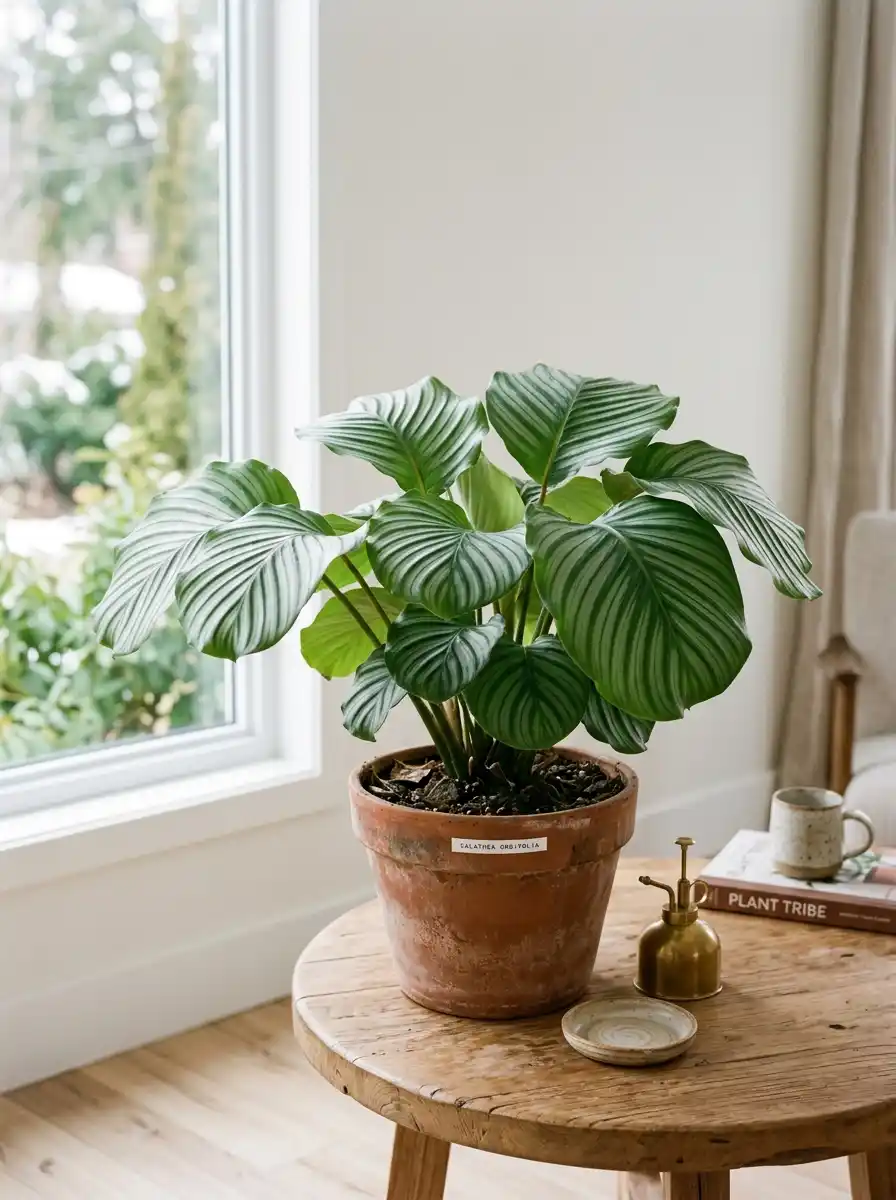
Calathea (Goeppertia spp., still widely sold as Calathea) is one of the most striking tropical foliage plants available in Canada — the graphic leaf patterns of Ornata, Orbifolia, and Lancifolia are unlike anything else at a garden centre. It is also one of the most complained-about houseplants, notorious for brown leaf edges that frustrate new owners. The good news: brown edges almost always come from two fixable causes — tap water fluoride and low winter humidity. Identify and fix both, and calathea becomes a genuinely manageable plant.
This guide covers the complete care routine for calatheas in Canada, how to permanently stop brown edges, variety differences, and winter care for Canadian homes where humidity is the primary challenge.
Calathea at a glance: Water — filtered or distilled only, when top 2cm dry. Light — medium indirect, no direct sun. Humidity — 60%+, humidifier essential in Canadian winter. Brown edges? — tap water fluoride + dry furnace air. Pet safe — non-toxic to cats and dogs ✅
Is your Calathea getting enough light this winter?
A Canadian winter cuts daylight roughly in half. See what your city actually gets this month, and whether a grow light is needed.
🌿 Calathea Quick Care Card
Why Calathea Gets Brown Edges in Canada — and the Fix
Brown leaf edges are the most common calathea problem in Canada. Almost every calathea owner encounters them. The cause is nearly always one or both of two things: tap water fluoride and low humidity from winter heating. Fix both and new leaves come in clean.
Cause 1 — Tap water fluoride and chlorine
Most Canadian municipal water contains added fluoride and chlorine. Calatheas accumulate fluoride in leaf tissue over repeated waterings — it can't be flushed out once it's there. The damage appears as brown tips that spread inward along the edges. Fix: Switch to filtered, distilled, or collected rainwater immediately. Chlorine dissipates if tap water sits uncovered 24 hours; fluoride does not. The damage already on existing leaves won't reverse, but new leaves will come in clean after 2–3 leaf cycles with clean water.
Cause 2 — Dry winter air from forced-air heating
Canadian homes drop to 25–30% relative humidity when forced-air heating runs in winter. Calatheas want 60%+. Dry air causes leaf margins to desiccate even when the soil is correctly watered. Fix: Run a small humidifier near the plant from November through March. A pebble tray (shallow dish, pebbles, water below the pot base) helps modestly. Grouping plants together also raises local humidity slightly. Misting doesn't meaningfully raise humidity and risks fungal issues in low-light winter conditions.
Other causes (less common)
Salt buildup from fertiliser — flush soil by watering thoroughly three times in succession. Cold window draft — keep calatheas 30+ cm from exterior glass in Canadian winter. Underwatering — soil too dry causes tip burn separate from fluoride damage. Direct sun — calathea leaves scorch quickly; ensure no direct light hits the leaves.
Calathea Varieties at Canadian Garden Centres
The calathea family (now reclassified as Goeppertia, though still sold as Calathea everywhere) has dozens of varieties with strikingly different leaf patterns. All require the same core care.
| Variety | Leaf Pattern | Notes |
|---|---|---|
| Ornata (G. ornata) | Dark green with pink-white pin stripes | Most striking; slightly less forgiving of low humidity than others |
| Orbifolia (G. orbifolia) | Large round leaves, silver-green stripes | Most forgiving of the group; tolerates slightly lower humidity |
| Medallion (G. veitchiana) | Dark green top, purple underside, oval pattern | Most widely available in Canada; good beginner choice |
| Lancifolia (G. lancifolia) | Long wavy leaves, dark spots on light green | More tolerant of lower humidity than Ornata; good choice for drier spaces |
| Zebrina (G. zebrina) | Velvet texture, dark and light green stripes | Needs consistent high humidity; best with a humidifier nearby |
| Musaica (G. musaica) | Fine mosaic network pattern, bright green | Tolerates slightly more light; one of the easier calatheas |
How to Water Calathea in Canada
Calatheas need consistent moisture — water when the top 2 cm of soil has dried. They are not drought-tolerant and show stress (curling, drooping) relatively quickly when too dry, but are equally sensitive to sitting in soggy soil.
Calathea watering schedule — Canada: Summer (May–Sept): every 7–10 days. Fall (Oct–Nov): every 10–14 days. Winter (Dec–Feb): every 10–14 days. Spring (Mar–Apr): every 7–10 days. Always use filtered or distilled water at room temperature. Water thoroughly until drainage; empty saucer after 30 minutes.
Overwatering kills more houseplants than anything else. A 3-in-1 soil meter shows you exactly when the root zone is dry — push the probe in for an instant moisture, light, and pH reading. No batteries needed.
Affiliate link — GrowersGuide.ca may earn a commission on qualifying purchases, at no extra cost to you. Learn more.
The other thing Canadian houseplants run short on all winter is light. From November to March most homes are too dim to keep plants growing — leaves stretch toward the window, variegation fades, and new growth stalls. A small full-spectrum LED grow light on a timer bridges the dark months, even for tough low-light plants that only survive (rather than grow) in a dim room.
Affiliate link — GrowersGuide.ca may earn a commission on qualifying purchases, at no extra cost to you. Learn more.
Why no fixed schedule works: How fast soil dries depends on temperature, light, pot material, room humidity, and plant size. Calathea in a bright room at 23°C dries faster than one in a shaded corner in winter — sometimes twice as fast. The top 2 cm finger test automatically accounts for all of these. See what affects soil drying rate →
Light Requirements for Calathea in Canada
Calatheas prefer medium indirect light — bright enough to maintain their vivid leaf patterns, but shielded from any direct sun which burns the thin leaves quickly. In Canada's short-day winters, they slow down but don't need supplemental light unless growth stalls completely.
Medium Indirect — Best
1–3 m from an east or north window. Bright enough to maintain leaf pattern colour. Most calatheas thrive here year-round in Canadian homes.
Bright Indirect — Acceptable
West window with no direct afternoon sun. Faster growth, better colour. Ensure no direct sun rays touch the leaves — use a sheer curtain on west and south windows.
Low Light — Survives, Slowly
North window or far from windows. Growth slows significantly; leaf patterns may fade. Acceptable long-term for Medallion and Lancifolia; less so for Ornata and Zebrina.
Canadian Winter Care
Run a humidifier November through March
This is the single most important thing you can do for a calathea in a Canadian winter. Forced-air heating dries indoor air to 25–30% humidity — well below the 60% calatheas need. A small ultrasonic humidifier placed within a metre of the plant, running daily, prevents the dry-air browning that defeats most Canadian calathea owners. If you don't have one, a pebble tray helps modestly. Grouping your calathea with other plants raises local humidity slightly.
Keep away from cold glass and heating vents
Two location hazards in Canadian winters: cold exterior window glass (leaves touching glass get cold damage or frost spots) and forced-air heating vents (blast of hot dry air causes immediate leaf curl and accelerated browning). Keep calatheas at least 30 cm from exterior glass and well away from floor vents. The ideal winter spot is a bright interior wall position near an east or north window but not touching the glass.
Reduce watering, stop fertilising
Growth slows significantly from November through February in Canadian homes. Allow slightly more drying between waterings — the top 2–3 cm dry rather than just the top 2 cm. Stop fertilising from October through February. Resume monthly feeding at half strength in March when new growth begins. Overwatering in winter is a common cause of calathea root rot in Canada.
Forced-air heat drops a Canadian home to 25–30% humidity all winter — far below the 50–60% these plants need, and the top cause of the brown, crispy edges most people fight from November on. A small cool-mist humidifier running near the plant fixes it at the source (a pebble tray only adds a few percent). This Levoit 2.5L easily covers a plant corner.
Affiliate link — GrowersGuide.ca may earn a commission on qualifying purchases, at no extra cost to you. Learn more.
How to Propagate a Calathea
Calatheas are propagated only by division — they grow as a clump of separate growth points, and there is no way to root a single leaf or a stem cutting. Division is best done in spring, while you are repotting, and calatheas are sensitive plants, so the aftercare matters as much as the cut.
Dividing the clump
Slide the whole plant out of its pot and gently loosen the soil from the roots. Look for natural clumps — sections of stems with their own roots attached. Carefully tease these apart by hand, separating only where they come away easily. Make sure each division keeps several leaves and a generous share of healthy roots; small, weak divisions struggle to recover.
Potting up
Pot each division into fresh, well-draining mix in a pot only slightly larger than its roots, and water it in with filtered or distilled water — calatheas are fluoride-sensitive. Don't bury the divisions deeper than they sat before.
Aftercare — extra humidity
A freshly divided calathea is easily shocked, especially in dry Canadian air. Keep the divisions warm, out of direct sun, and in high humidity for the first few weeks — a loose clear cover, a propagation box, or a humidifier and pebble tray all help. Expect some sulking; new growth is the sign the roots have taken hold. Hold off on fertiliser until then.
Calathea Troubleshooting
Brown leaf edges and tips
Switch to filtered or distilled water immediately, and add a humidifier. Damage on existing leaves won't reverse — trim brown edges with clean scissors cut at a slight angle to follow the leaf's natural shape. New leaves will come in clean once water quality and humidity are addressed.
Curling leaves
Check soil first — if dry, water thoroughly with filtered water; leaves should uncurl within hours. If soil is moist, the cause is dry air or a cold draft. Increase humidity and move away from cold windows or heating vents. Note: slight leaf curl in the evening is normal (nyctinastic movement) — calatheas fold their leaves toward vertical at night and open again in the morning.
Yellow leaves
Overwatering is the most common cause — reduce watering frequency and ensure the pot has drainage. Also check for root rot: unpot and inspect; trim any brown mushy roots and repot in fresh well-draining mix. Occasional yellowing of the oldest lowest leaves is natural ageing. If many leaves yellow at once, root rot is the likely cause.
Fading leaf patterns
Insufficient light — move closer to a window. Very common in Canadian winters as daylight shortens. Moving to a brighter position usually restores colour on new leaves within 4–6 weeks. Avoid direct sun — it bleaches the leaf pattern rather than intensifying it.
Frequently Asked Questions
Why does my calathea keep getting brown edges even after I switched to filtered water?
The second cause is likely dry air. Filtered water addresses the fluoride problem but doesn't fix low humidity. Canadian winter forced-air heating drops relative humidity well below what calatheas need. Add a humidifier — run it daily from November through March. If you've addressed both water quality and humidity and still see browning, check for cold draft from nearby windows, or salt buildup from fertiliser (flush the soil thoroughly).
Are calatheas safe for cats and dogs?
Yes — calatheas are non-toxic to cats and dogs (ASPCA). Unlike pothos, philodendron, peace lily, and ZZ plant (all toxic), calathea is genuinely safe for homes with pets.
Why are my calathea leaves moving?
This is normal — calatheas exhibit nyctinasty, raising their leaves toward vertical at night and lowering them during the day as they track light. The movement is powered by changes in water pressure in specialised cells at the base of each leaf. It's a healthy sign and entirely normal. Some owners use the movement as a light indicator: if leaves stay raised during the day, the plant isn't getting enough light and needs to move closer to a window.
What is the easiest calathea variety for a Canadian home?
Calathea Medallion and Calathea Lancifolia (rattlesnake plant) are the most forgiving of the commonly available varieties — they tolerate slightly lower humidity and are less sensitive to minor water quality lapses than Ornata or Zebrina. Calathea Orbifolia is also a good choice and has a distinctive large-leaf look. For all of them, filtered water and a humidifier in winter are the non-negotiables.
Why do my calathea leaves have brown edges?
Brown leaf edges on calathea in Canada are caused by two things, usually at once: fluoride and chlorine in tap water, and low humidity from forced-air heating. Calatheas are extremely sensitive to tap water minerals — the fluoride and chlorine salts accumulate in leaf tissue and cause brown crispy margins that start at the tips and spread inward. Switch to filtered water, distilled water, or rainwater. The second cause — dry winter air — is equally important. Canadian homes drop to 25–30% relative humidity in winter from forced-air heating; calatheas want 60%+. Run a humidifier or place on a pebble tray. Switching to filtered water alone often stops new browning within 2–3 leaf cycles.
What water should I use for calathea in Canada?
Use filtered, distilled, or rainwater. Calatheas are more sensitive to water quality than almost any other common houseplant — the fluoride added to most Canadian municipal water supplies, and the chlorine used for disinfection, both cause leaf tip and edge burn over time. Chlorine dissipates from tap water if left in an open container for 24 hours; fluoride does not. In cities with fluoridated water (most Canadian cities), filtered or distilled water is the most reliable fix. Collected rainwater is excellent. Well water can work but varies — test for mineral content. If you can only use tap water, let it sit overnight and use room-temperature water, but expect some ongoing browning.
How often should I water calathea in Canada?
Water calathea when the top 2 cm of soil has dried out — typically every 7–10 days in summer and every 10–14 days in winter. Calatheas like consistent moisture but are not drought-tolerant — they will droop and curl leaves noticeably when underwatered. They are also root rot-prone if kept constantly wet. The right balance is soil that stays lightly moist but never soggy. In Canadian winters, when light is low and growth slows, allow slightly more drying between waterings. Always use room-temperature water — cold water from the tap shocks tropical roots and can cause spotting.
How do I increase humidity for calathea in a Canadian winter?
The most effective option is a small ultrasonic humidifier placed near your calathea — run it daily from November through March to maintain 55–65% humidity. A pebble tray (shallow tray filled with pebbles and water just below the pot base) provides modest localised humidity and is better than nothing. Grouping tropical plants together creates a slightly more humid microclimate around the leaves. Misting is largely ineffective — it wets surfaces briefly but doesn't raise ambient humidity, and wet leaves in low-light Canadian winter conditions can encourage fungal issues. If you have a bathroom with a window and natural light, calatheas thrive there year-round from the shower humidity.
Why are my calathea leaves curling?
Leaf curling in calathea is almost always a water stress signal: either underwatering (soil too dry — check and water thoroughly) or low humidity (dry air causing the leaf to curl to reduce transpiration). Check the soil first — if dry, water with filtered water and the leaves should uncurl within a few hours. If soil is adequately moist, the cause is low humidity — add a humidifier or pebble tray. Cold drafts from Canadian windows in winter also cause leaf curl and cold damage spots. Keep calatheas at least 30 cm from exterior windows and away from forced-air heating vents. Note: slight downward leaf curl in the evening is normal — calatheas fold their leaves at night (nyctinasty) and open again in the morning.
Is calathea safe for cats and dogs?
Yes — calatheas are non-toxic to cats and dogs according to the ASPCA. This makes them one of the few tropical foliage plants that is genuinely pet-safe, unlike pothos, philodendron, peace lily, and ZZ plant (all toxic). Calatheas are an excellent choice for Canadian homes with curious cats or dogs who interact with houseplants.
🐾 Have pets? See our Pet-Safe Houseplants guide — which common houseplants are toxic to cats and dogs, which are safe, and what to do if a pet eats one.
📖 More Houseplant Guides
Care guides for popular Canadian houseplants.
Also Growing Vegetables?
Free planting calendars for 30+ vegetables across every major Canadian city.