
Indoor Lemon Tree Care in Canada: Pots, Seed, Winter
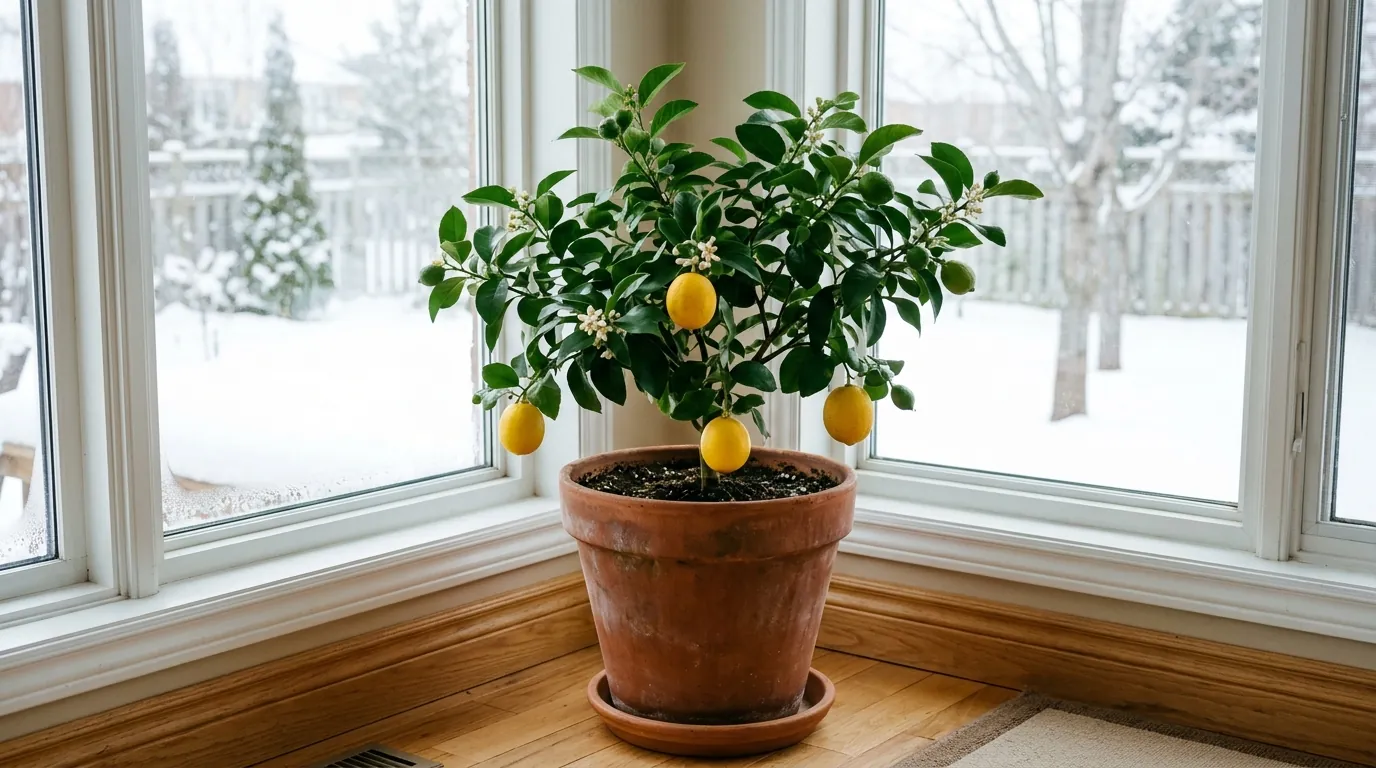
Indoor lemon tree care in Canada comes down to one fact: a lemon tree is a sun plant that has to spend our darkest months indoors. Grown in a pot, it can summer on a balcony and winter at a window, flower in the middle of February and, with a little help from you, set real lemons. What it cannot do is cope with a dim room, a sudden move or a cold night outside in September.
Quick answer: buy a grafted dwarf tree (a Meyer lemon is the usual choice). Keep it at your sunniest south or west window from fall to spring, and add a grow light if you want fruit. Water when the top few centimetres are dry, in a pot that drains. Put it outside once nights stay above about 10 °C and bring it back in before they drop below that. Indoors, pollinate the flowers by hand. A tree grown from a seed rarely fruits.
Which Lemon or Lime Tree to Grow Indoors
Iowa State Extension advises buying grafted plants, because they stay compact, under about 1.8 m, where full-sized trees would pass 6 m. These are the citrus it lists for indoor growing, and the ones you will see at Canadian garden centres:
| Tree | What to expect indoors |
|---|---|
| Meyer lemon | The usual indoor lemon. NC State Extension describes it as a cross of a citron and a mandarin-pomelo hybrid; the fruit is rounder and milder than a store lemon. |
| ‘Ponderosa’ lemon | Very large, thick-skinned fruit on a small tree. |
| Persian (Tahitian) lime | The common grocery lime, on a compact grafted tree. |
| Kaffir lime | Grown mostly for its leaves; Iowa State notes a thornless form. |
| Calamondin | Small, sour orange fruit; one of the easiest to keep fruiting indoors. |
Lemons and limes flower and fruit off and on through the year, which is part of their charm indoors; University of Wisconsin Extension notes they usually ripen six to nine months after flowering. Many are thorny. If you cut thorns off, cut the whole shoot instead if it grows from below the graft union.
Planting a Lemon Tree in a Pot
In Canada, planting a lemon tree means planting it in a container, because it has to come indoors every fall. A tree bought from a garden centre or by mail is usually in a small nursery pot and ready to move up. Do it in spring or summer if you can, when the tree is growing; a tree bought in winter can stay in its pot until spring if the roots are not circling.
- Pick a pot only a little larger than the root ball, with drainage holes. University of Wisconsin Extension says to start small and move up as the tree grows, because too much mix around a small root system stays wet and invites root rot. A deep pot is better than a shallow one: it balances the tree as it gets top-heavy.
- Use a slightly acidic, well-drained mix. Wisconsin suggests a porous potting mix with up to a third perlite or pumice, and warns against mixes made to hold moisture.
- Set the tree at the same depth it grew in its nursery pot, with the graft union (the bump low on the trunk) above the mix.
- Water it thoroughly until water runs out of the bottom, then empty the saucer.
- Put it in the brightest spot you have, and do not feed it for a few weeks while the roots settle.
How big a pot, eventually? Wisconsin says citrus can be kept in a 25–30 cm (10–12 inch) pot for several years and should be repotted every year or two. A bigger pot grows a bigger, more productive tree, but think about the fall: you will be carrying it indoors. A pot on a plant caddy with wheels makes the move much easier.
A Lemon Tree in a Pot: Summer Out, Winter In
A potted lemon does best outside for the summer, in more light than any window gives. Iowa State Extension says to move citrus out once night temperatures stay around 10 °C or above, and back in when they drop below that. University of Wisconsin Extension says to bring it in before nights fall into the single digits. In Canadian terms, it goes out after the frost risk has passed and comes in well before the first fall frost:
| City | Frost risk over (9 years in 10) | Average first fall frost |
|---|---|---|
| Vancouver | April 21 | November 4 |
| Victoria | April 30 | November 5 |
| Toronto | May 19 | October 9 |
| Montréal | May 15 | October 9 |
| Ottawa | May 20 | October 2 |
| Halifax | May 26 | October 17 |
| Winnipeg | June 7 | September 22 |
| Calgary | June 11 | September 10 |
| Edmonton | June 10 | September 11 |
Dates from Environment and Climate Change Canada’s 1991–2020 climate normals. They are frost dates, not the 10 °C nights citrus wants: go out a little after the first column, once nights are mild, and come in well before the second. Your own city’s dates are on our last frost and first frost pages.
- Going out: start in light shade and move it into full sun over one to two weeks, as University of Wisconsin Extension advises. Leaves straight from a window to full sun scorch.
- Coming in: check under the leaves for scale and mites first, then give it the sunniest window in the house. Expect some leaves to drop in the first weeks.
- Pick a spot without sprinklers or standing water outside; a pot that stays wet rots the roots.
Light in a Canadian Winter
Light is what decides whether an indoor lemon tree just survives or flowers and fruits. Iowa State Extension says a west- or south-facing window with at least 6 to 8 hours of direct light is often required in fall and winter, and that citrus can adapt to low light but will not flower and fruit without enough direct sun. On the shortest day, Toronto gets 8h55 of daylight and Edmonton 7h27, worked out from each city’s latitude. That is short of what a lemon wants even before clouds and a low sun angle.
So most Canadian lemon trees that fruit reliably have a grow light. Hang a panel above the tree, not beside it, about 30–45 cm over the top leaves, and set its timer so the tree gets at least 6 hours of strong light a day, and preferably 8 to 12, counting the window light. That is the range University of Maryland Extension gives for potted citrus, with a grow light added when the window falls short. Turn the pot a quarter turn every week or two so the tree grows evenly.
A lemon tree needs much more light than a houseplant clip light gives. The TS1000 is a full-spectrum panel made to hang over plants, which suits a single small potted citrus tree: hang it above the crown, raise it as the tree grows, and run it on a timer through the dark months. It does not replace the window; it tops up the short Canadian winter day.
Affiliate link — GrowersGuide.ca may earn a commission on qualifying purchases, at no extra cost to you. See our affiliate disclosure.
Citrus also flowers better with a cooler night. Iowa State Extension says citrus needs a drop of about 3 to 5 °C from day to night to flower. A spot near, but not touching, a window usually gives that on its own. Keep the tree away from heat vents, which dry it out, and from cold glass and draughty doors.
Winter Leaf Drop: What Is Normal
Almost every lemon tree brought in for a Canadian winter drops some leaves. It has gone from a patio in full sun to a window that gets a fraction of that light, in air that a furnace keeps dry, and University of Wisconsin Extension notes that drastic changes like that drop leaves, flowers and young fruit. A scattering of leaves in the first few weeks indoors is the tree shedding what it cannot support. It is not a reason to water more.
What is not normal is steady, heavy drop through January. Then check, in this order:
- Cold: Iowa State Extension says temperatures below about 10 °C cause leaf loss. Leaves touching frosty glass, a draughty patio door or a cold floor near the window are the usual culprits.
- Water: Iowa State says too little water drops leaves and too much rots roots. Push a finger into the mix before every watering; a tree using less water in short days dries out more slowly than it did in July.
- Light: the brightest window you have, plus a grow light (above).
- Dry air: Iowa State suggests a humidifier near citrus in winter.
Why Is My Lemon Tree Dropping Leaves?
Leaf drop is the most common indoor lemon tree problem, and it nearly always comes from a change. University of Wisconsin Extension notes drastic changes in conditions drop leaves, flowers and young fruit, and Iowa State Extension says both too little water and temperatures below about 10 °C cause leaf loss. Work through this table:
| What you see | Usual cause | What to do |
|---|---|---|
| Leaves dropping after coming inside | Less light, drier air, a sudden move | Sunniest window, a grow light, steady watering; it settles in a few weeks |
| Green leaves dropping, soil dry | Underwatering | Water thoroughly and check more often |
| Yellow leaves dropping, soil wet | Overwatering; roots short of air | Let the top few centimetres dry; check drainage |
| Leaves dropping after a cold night | Below about 10 °C: an open door, cold glass, a late night outside | Keep it warm; bring it in earlier next fall |
| Crisp leaves in midwinter | Dry heated air | A humidifier nearby, as Iowa State suggests |
| Pale leaves with green veins | Short of nutrients, often in old or alkaline mix | A citrus fertilizer in season; repot into fresh, slightly acidic mix |
| Sticky leaves, small bumps, fine webbing | Scale, whiteflies or spider mites | Wash the leaves; use only products labelled for edible fruit plants |
| Small fruit falling off | The tree set more than it can carry; Wisconsin calls this common | Normal; keep care steady |
A tree that has dropped most of its leaves is not necessarily dead. Scratch a twig with a thumbnail: green underneath means it is alive and will leaf out again once the cause is fixed and the days lengthen.
Watering, Pots and Soil
- Water when the top few centimetres are dry, then water until it runs out of the bottom. Empty the saucer. NC State Extension notes the Meyer lemon likes to dry a little and then get a good watering, with less water in winter.
- Use a pot with drainage holes; clay, plastic or decorative are all fine. Move up one size at a time as the tree grows rather than straight into a huge pot that stays wet.
- Use a slightly acidic, well-drained mix. University of Wisconsin Extension suggests a porous potting mix with up to a third perlite or pumice, and warns against mixes made to hold moisture.
- Feed in the growing season. Iowa State Extension suggests a slow-release fertilizer in April or May; NC State says to fertilize only while the tree is growing. A fertilizer made for citrus is the simplest choice.
- Prune when you need to. Iowa State says citrus can be pruned any time to keep its size and shape. Always remove shoots coming from below the graft union.
Pollinating an Indoor Lemon Tree by Hand
Outside, bees do this. Inside, Iowa State Extension says manual pollination is often needed for citrus to set fruit. Indoor citrus usually blooms in late winter or early spring, and lemons and limes add flowers off and on through the year.
- Wait until several flowers are fully open and the yellow pollen looks dusty.
- Touch a small, soft paintbrush or a cotton swab to the pollen-covered stamens of one flower.
- Brush it onto the sticky tip of the centre stalk (the stigma) of the same and other flowers.
- Repeat every day or two while the tree is in bloom. Gently shaking the branches, or a small fan, helps too.
A pollinated flower drops its petals and leaves a tiny green fruit at its base. Many of these fall off; that is the tree thinning itself. The ones that stay take six to nine months to ripen, so a flower in February is a lemon in the fall.
Growing a Lemon Tree From Seed
A lemon seed from the grocery store sprouts easily, and the seedling makes a pretty, glossy houseplant. Be honest with yourself about fruit, though: Iowa State Extension says seed-grown citrus seldom sets fruit, the fruit is usually poorer when it does, and seedlings often grow large thorns and get too big for indoors; it expects a seedling to make a good houseplant for a few years before it outgrows the house.
- Rinse fresh seeds from the fruit and plant them about 2.5 cm deep in moist potting soil, as Iowa State Extension advises.
- Keep the pot warm and evenly moist until they sprout; a clear cover helps hold moisture in dry winter air. Iowa State says germination can take two to three weeks, or as long as six to eight.
- Move seedlings into bright light, under a grow light in winter, once they come up.
- Pot them on as they grow, in the same well-drained mix as a bought tree.
If you want lemons in a few years rather than a decade or more, buy a grafted tree and grow the seedling for its leaves. The same goes for the other kitchen-scrap tree: growing avocado from seed gives a handsome plant and almost never fruit.
Pets and lemon trees
The ASPCA lists lemon and lime as toxic to dogs, cats and horses. The toxic principles are essential oils and psoralens, and the signs listed are vomiting, diarrhea and depression, with possible skin irritation. It has no separate entry for Meyer lemon, so treat it the same way. Keep fallen leaves and fruit off the floor, and if a pet eats part of the tree, call your vet or ASPCA Animal Poison Control.
Frequently Asked Questions
Can you grow a lemon tree indoors in Canada?
Yes, as a potted tree that lives at a sunny window in winter and, ideally, outside in summer. Buy a grafted dwarf tree such as a Meyer lemon; Iowa State Extension notes grafted plants stay much more compact. Give it the sunniest window you have, water when the top few centimetres are dry, and move it outdoors once nights stay above about 10 °C.
How do you plant a lemon tree in a pot?
Choose a pot only a little bigger than the root ball, with drainage holes, and fill it with a slightly acidic, well-drained potting mix with up to a third perlite or pumice, as University of Wisconsin Extension advises. Set the tree at the same depth it grew in the nursery pot, water it thoroughly and give it the sunniest spot you have. Wisconsin says citrus can stay in a 25 to 30 cm (10 to 12 inch) pot for several years, moving up a size every year or two.
Why is my lemon tree losing leaves in winter?
Most winter leaf drop is the tree adjusting to less light and drier air after coming indoors, and some is normal in the first weeks. Iowa State Extension adds that temperatures below about 10 °C cause leaf loss, so check for cold glass and draughts, and that both too little and too much water drop leaves. Give it the brightest window and a grow light, keep watering steady, and run a humidifier nearby.
Why is my lemon tree dropping leaves?
Usually a sudden change. A tree brought in from a bright patio to a dimmer house drops leaves as it adjusts, and University of Wisconsin Extension notes drastic changes drop leaves, flowers and young fruit. Iowa State Extension adds that temperatures below about 10 °C can cause leaf loss, too little water drops leaves and too much rots roots. Check the soil first, then the light, then draughts and cold glass.
How much light does an indoor lemon tree need?
A lot. Iowa State Extension says citrus indoors in fall and winter usually needs a south- or west-facing window with at least 6 to 8 hours of direct light, and University of Wisconsin Extension says supplemental light is needed for fruit without at least 6 hours of direct sun. In a Canadian winter that usually means a grow light as well as the window.
When should I bring my lemon tree inside?
Before nights drop below about 10 °C, which Iowa State Extension gives as the point to move citrus indoors. In most of Canada that comes several weeks before the first fall frost, so watch the night forecast in September rather than waiting for a frost warning.
Is a Meyer lemon a good indoor lemon tree?
It is the usual choice. NC State Extension describes it as a cross between a citron and a mandarin-pomelo hybrid, grown mostly as an ornamental in a container that comes inside for winter. It is smaller than a true lemon and flowers off and on through the year, but it still needs a very bright window and hand pollination to set fruit indoors.
Do I need to pollinate my indoor lemon tree?
Indoors, often yes. Iowa State Extension says manual pollination is often needed for citrus to set fruit indoors: move pollen from flower to flower with a small paintbrush or cotton swab, or shake the branches gently when the flowers are open. Fruit then takes about six to nine months to ripen.
Can you grow a lemon tree from seed?
You can grow the tree, but do not expect lemons. Iowa State Extension says to plant the seeds about 2.5 cm deep in moist potting soil, and that they can sprout in two to three weeks or take as long as six to eight. It also says seed-grown citrus seldom sets fruit, and when it does the fruit is usually poorer; seedlings tend to grow long thorns and get too big for indoors after a few years. Grow one as a houseplant for its glossy leaves and buy a grafted tree if you want fruit.
Can you grow a lime tree indoors in Canada?
Yes, the same way as a lemon. Iowa State Extension lists Persian (Tahitian) lime and the thornless kaffir lime among the citrus that suit indoor growing, along with Meyer lemon, calamondin and kumquat. Limes, like lemons, flower and fruit off and on through the year.
Is a lemon tree toxic to cats and dogs?
Yes. The ASPCA lists lemon and lime as toxic to dogs, cats and horses, because of essential oils and psoralens; the signs it lists are vomiting, diarrhea and depression, with possible skin irritation. It has no separate entry for Meyer lemon, so treat it the same way. Keep fallen leaves and fruit off the floor.
For the rest of the indoor collection through winter, see houseplant winter care in Canada and grow lights for indoor plants. Other plants that summer outside and winter at a window: the croton and the ponytail palm.
Sources
- Iowa State University Extension, Can I germinate the seeds from a grapefruit? — sowing depth and germination time for citrus seed.
- Iowa State University Extension, Growing Citrus Indoors — varieties, light, moving in and out, temperatures and leaf loss, watering, fertilizer, pruning, pests, hand pollination, seed-grown citrus.
- University of Wisconsin–Madison Extension, Indoor Citrus — potting mix, pot size and repotting, light for fruit, acclimating, leaf and fruit drop, ripening time.
- NC State Extension, Citrus x limon ‘Meyer’ — origin, watering, feeding, hand pollination, pests.
- ASPCA Animal Poison Control, Lemon and Lime.
- Environment and Climate Change Canada, Canadian Climate Normals 1991–2020 — frost dates.