
Growing Salvia in Canada
Two very different plants share the name. One comes back every spring; the other dies at the first frost. The tag tells you which.
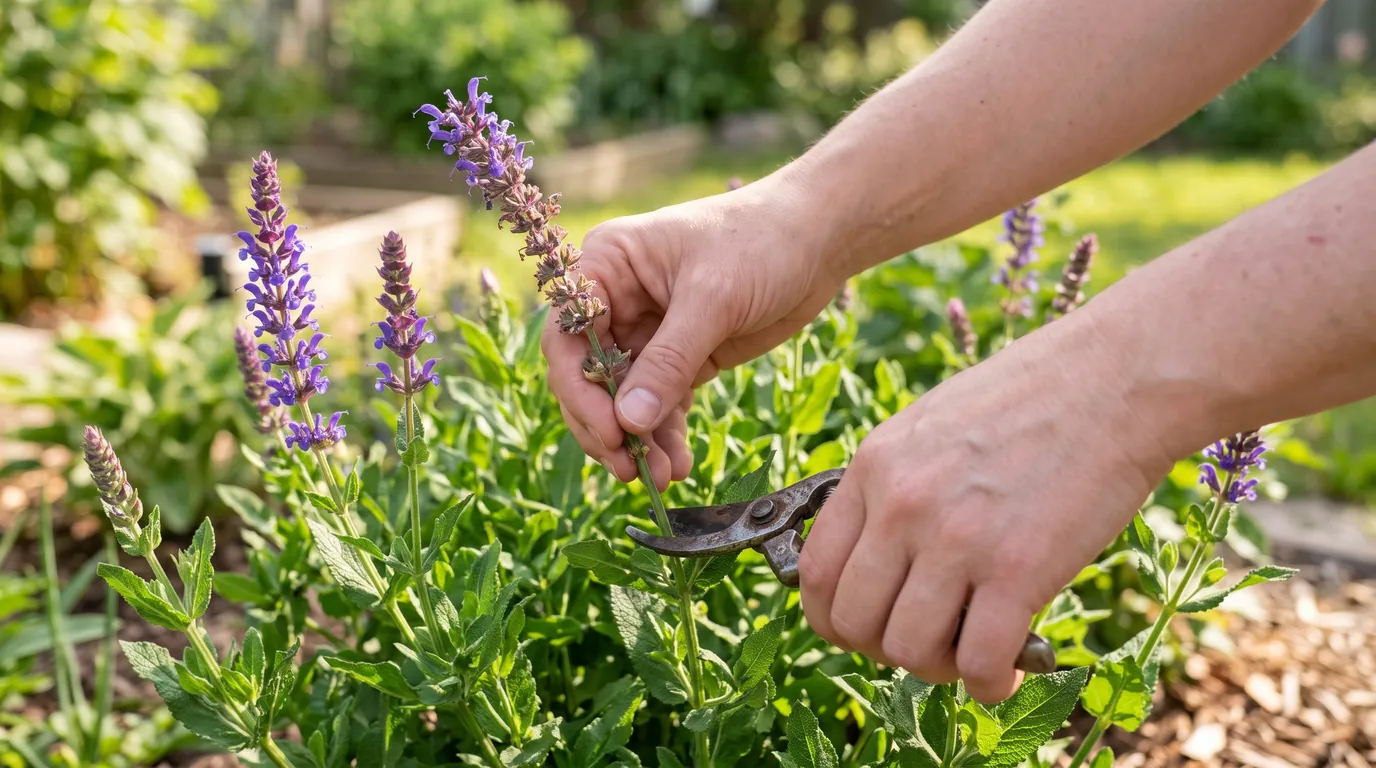
Growing salvia in Canada starts with knowing which salvia you have. Salvia is a huge genus in the mint family. In Canadian gardens, it usually means one of two groups: the perennial purple-blue spikes of woodland sage and meadow sage, or the annual red and blue bedding salvias sold in flats each spring.
They look alike in a garden centre and need different care. This guide covers both: hardiness, cutting back for more flowers, and when to plant or sow the annual kinds in your city.
Salvia at a glance: Salvia nemorosa and S. × sylvestris (May Night, Caradonna) are hardy perennials, rated to US Zone 4a by NC State. Scarlet sage (S. splendens) and mealycup sage (S. farinacea) are annuals here. All want sun and soil that drains. Cut perennial spikes back after bloom for a tidier plant. Start annual salvia indoors about 9 weeks before planting out after frost.
Perennial or Annual? Read the Botanical Name
| Plant | In Canada | Rated hardy to | Notes |
|---|---|---|---|
| Woodland sage (Salvia nemorosa) | Perennial | US Zone 4a (NC State) | Violet-blue spikes June to September; drought-tolerant |
| Meadow sage (S. × sylvestris), e.g. May Night | Perennial | Trialled in US Zone 5b (Chicago Botanic Garden) | Hybrid with woodland sage; names often overlap |
| Mealycup sage (S. farinacea) | Annual | US Zones 8–10 (NC State) | Blue spikes until frost; good cut flower |
| Scarlet sage (S. splendens) | Annual | US Zones 10–11 (NC State) | Red bedding salvia; not drought-tolerant |
The Chicago Botanic Garden's trial notes that reference books do not agree on which named cultivars belong to S. nemorosa, S. × sylvestris or S. × superba, and NC State says it is not always possible to tell. For a gardener the label matters less than the fact that all three are hardy perennials. The University of Minnesota adds two more annual species, S. coccinea and S. patens, which it says need the same care as the other annuals.
Perennial Salvia: Hardiness by Zone
NC State rates woodland sage to US Zone 4a. The Chicago Botanic Garden grew 15 perennial salvias for five years in US Zone 5b; May Night (Mainacht) came out on top among the meadow sages, rated highly for flowers, habit and winter hardiness. These are US (USDA) zones, calculated differently from Canadian zones; see USDA vs Canadian zones and look up yours with the zone finder.
Plant in full sun to part shade in soil that drains. NC State says woodland sage prefers sandy or gravelly soil, tolerates dry soil and is seldom damaged by deer or rabbits. It grows up to about 90 cm (3 feet) tall and 60 cm wide.
Annual Salvia: When to Start and Plant Out
The University of Minnesota says annual salvias can go outdoors once the soil is above about 13 °C (55 °F); they cannot take frost. To grow your own, it suggests sowing indoors about 9 weeks before planting out, at 21 to 24 °C (70 to 75 °F); seedlings appear in 7 to 14 days. Grow them on at 16 to 18 °C and let the mix dry slightly between waterings to avoid damping-off.
The table counts 9 weeks back from each city's average last frost, and gives the date frost has passed nine years in ten as a safer planting date.
| Region | City | Zone | Sow annual salvia indoors | Average last frost | Frost passed 9 years in 10 |
|---|---|---|---|---|---|
| BC coast | Victoria | 9a | Feb 10 | April 14 | April 30 |
| BC Interior | Kelowna | 7a | Mar 14 | May 16 | June 2 |
| Alberta | Lethbridge | 4b | Mar 16 | May 18 | May 31 |
| Alberta | Edmonton | 4a | Mar 20 | May 22 | June 10 |
| Saskatchewan | Saskatoon | 3a | Mar 20 | May 22 | June 7 |
| Manitoba | Brandon | 3a | Mar 21 | May 23 | June 7 |
| Southern Ontario | Windsor | 7b | Feb 18 | April 22 | May 9 |
| Southern Ontario | Toronto | 7a | Mar 2 | May 4 | May 19 |
| Northern Ontario | Sudbury | 4b | Mar 15 | May 17 | May 31 |
| Quebec | Montreal | 5b | Feb 25 | April 29 | May 15 |
| Atlantic | Fredericton | 5a | Mar 14 | May 16 | May 31 |
| Newfoundland | St. John's | 6a | Mar 30 | June 1 | June 16 |
Zones are NRCan 1991–2020; frost dates are Environment and Climate Change Canada 1991–2020 normals.
The sources differ on two details. On covering the seed, the University of Minnesota says to set seeds on the mix and cover them lightly with vermiculite, while NC State says scarlet sage seed needs light and should not be covered. On containers, Minnesota says annual salvias should not be grown in pots because of their size, but NC State says scarlet sage can be grown in containers and that its compact selections suit them. If you want salvia in a pot, choose a compact cultivar.
West Coast Seeds, a Canadian seed company in BC, sells flower seed by mail. Order early: annual salvia needs about 9 weeks indoors before it goes out.
🌼 Shop flower seeds at West Coast Seeds →Affiliate link — we may earn a commission on qualifying purchases, at no extra cost to you.
Cutting Back for More Flowers
For perennial salvia, NC State says that once a stem has bloomed and turned brown, you can cut it down to the basal leaves and new flowers will appear, and that cutting back spent blooms can bring several rounds of flowering. The Chicago Botanic Garden tested exactly this for five years, cutting half the plants of each type to the ground after the first bloom. It found that most salvias opened up after flowering, exposing the crown, and that cutting back made the plants healthier, tidier and more vigorous. But for several cultivars, including May Night, it found no difference in the amount of rebloom between cut and uncut plants: the uncut plants simply hid their new flowers behind the old stems.
So cut back for a better-looking plant, and treat any extra flowers as a bonus. For annual salvia, the University of Minnesota says to clip old flower spikes to promote new ones, and to cut overgrown or tired plants back in midsummer for fresh growth and flowers.
Cutting a clump of perennial salvia back to its basal leaves after the first bloom means dozens of stems at once. Sharp bypass pruners take a handful at a time cleanly, and the same tool clips the spent spikes off annual salvias through the summer.
Affiliate link — GrowersGuide.ca may earn a commission on qualifying purchases, at no extra cost to you. See our affiliate disclosure.
Water and Feeding
Salvias prefer to be on the dry side. The University of Minnesota says annual salvias are very drought-tolerant and do better in drier soil than in wet; water lightly when the top 5 cm (2 inches) is dry. It calls them light feeders: a balanced fertilizer at planting, with an optional monthly feed at half strength for more blooms. NC State is the exception for scarlet sage, which it says is not drought-tolerant. The perennial woodland sage tolerates dry soil once established, per NC State.
Pollinators
NC State says woodland sage and mealycup sage attract hummingbirds, bees and butterflies, and the University of Minnesota calls annual salvias pollinator magnets. NC State adds one caution: many scarlet sage cultivars bred for bedding have no nectar and are not a useful resource for pollinators. If feeding bees is the point, choose the perennial or the blue mealycup sage.
Troubleshooting Salvia
| What you see | Likely cause | What to do |
|---|---|---|
| "Perennial" salvia did not come back | It was an annual species, or the soil stayed wet (NC State, UMN) | Check the botanical name; plant perennials in soil that drains. |
| Clump splays open after flowering | Normal after the first bloom (Chicago Botanic Garden) | Cut stems back to the basal leaves. |
| Few new flowers after cutting back | Rebloom is often light (Chicago Botanic Garden) | Expect a tidier plant, not a second full show. |
| Annual salvia blackened after planting | Frost (NC State: Zones 10–11) | Plant out after frost, once the soil is above 13 °C. |
| Seedlings collapse at the base | Damping-off (UMN, NC State) | Let the mix dry slightly between waterings. |
| Bees ignore the red salvias | Bedding cultivars with no nectar (NC State) | Grow woodland sage or mealycup sage for pollinators. |
| White powder on leaves | Powdery mildew (NC State, mealycup sage) | Good drainage and air movement; water the soil, not the leaves. |
Pets
We do not make safety claims about plants and pets. Check the ASPCA list of toxic and non-toxic plants, and call your veterinarian if your pet eats part of a plant.
Frequently Asked Questions
Is salvia a perennial in Canada?
Some are. Woodland sage (Salvia nemorosa) and the closely related meadow sage (Salvia x sylvestris), sold as May Night, Caradonna and East Friesland, are hardy perennials; NC State rates Salvia nemorosa to US Zone 4a. The red scarlet sage (Salvia splendens) and blue mealycup sage (Salvia farinacea) are tender perennials grown as annuals here. Check the botanical name on the tag.
Should I cut back salvia after it flowers?
Cutting back tidies the plant, but the sources disagree on whether it brings more flowers. NC State says cutting spent stems down to the basal leaves brings new blooms. In a five-year trial, the Chicago Botanic Garden found no difference in rebloom between cut and uncut plants, though the cut plants looked better and grew more vigorously.
Which perennial salvia is best for cold zones?
In the Chicago Botanic Garden trial, May Night (Mainacht) was the top performer among the meadow sages, with high ratings for flowers, habit and winter hardiness. That garden is in US Zone 5b. In colder parts of Canada, choose a plant labelled for your zone and plant it in soil that drains well.
When can I plant annual salvia outside?
After frost, once the soil is above about 13 degrees C (55 F), according to the University of Minnesota. Scarlet sage is hardy only in US Zones 10 and 11, per NC State, so it cannot take frost.
When should I start salvia seeds indoors?
About 9 weeks before you plan to plant outside, according to the University of Minnesota, at 21 to 24 degrees C. Seedlings appear in 7 to 14 days. NC State notes that scarlet sage seed needs light to germinate, so do not bury it.
Is annual salvia good for pollinators?
It depends on the variety. NC State says many scarlet sage cultivars bred for bedding have no nectar and are not useful to pollinators. Mealycup sage and the perennial woodland sage attract bees, butterflies and hummingbirds, according to NC State.
Is salvia safe for cats and dogs?
We do not make safety claims about plants and pets. Check the ASPCA list of toxic and non-toxic plants, and ask your veterinarian if your pet has eaten part of a plant.
Sources
- NC State Extension Gardener Plant Toolbox — Salvia nemorosa
- NC State Extension Gardener Plant Toolbox — Salvia splendens
- NC State Extension Gardener Plant Toolbox — Salvia farinacea
- University of Minnesota Extension — Salvia
- Chicago Botanic Garden — Plant Evaluation Notes 14: A Performance Appraisal of Hardy Sages (2000)