
Growing Petunias in Canada
Easy, long-blooming and sold everywhere in May. The two decisions that matter are when to put them out and how much to feed them.
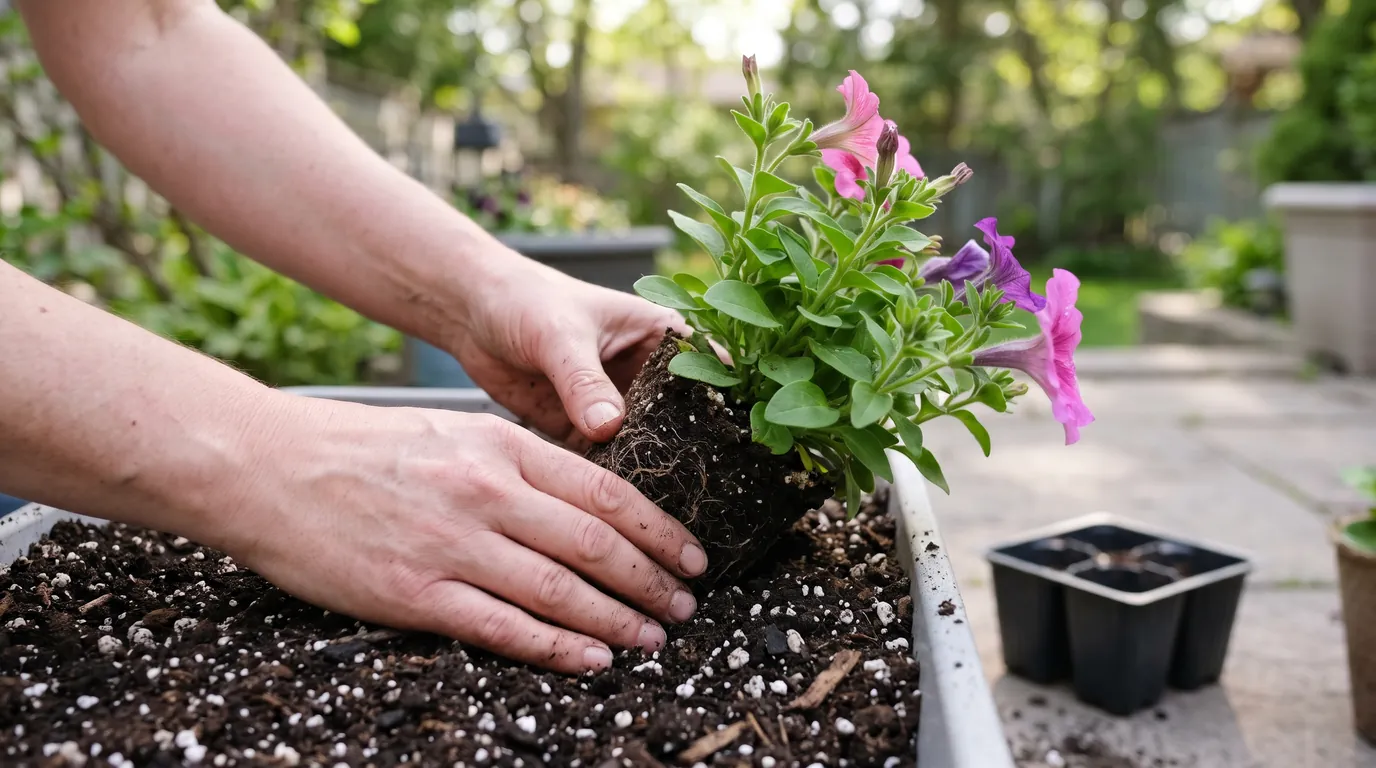
Growing petunias in Canada is mostly about timing and food. Garden petunia (Petunia × hybrida) is a tender perennial from warm climates; NC State Extension rates it hardy only in US Zones 10 and 11, so here it is an annual that dies at the first hard frost. It blooms from planting until fall and is one of the most popular bedding and basket plants in the country.
This guide covers when to plant out in your city, starting from seed, sun and soil, feeding (especially for Wave and other spreading types), pinching, deadheading, and keeping a plant over winter.
Petunias at a glance: plant out after your last frost, once the soil is about 16 °C (60 °F). Give them at least 5–6 hours of sun. Start seed indoors 10–12 weeks before planting out. Feed from early July: weekly for Wave and other spreading types. Deadhead containers. They will not survive frost, but a plant can be kept indoors in a bright, cool spot.
When to Plant Petunias Out, by City
The University of Minnesota says to wait until the soil has warmed to about 16 °C (60 °F) and frost danger has passed. Garden centres put petunias on sale well before that in much of Canada. A plant bought early can stay in its pot in a sheltered spot and come indoors on cold nights until your date.
The table gives three dates for each city: when to start seed indoors (10 to 12 weeks before the average last frost, per the University of Minnesota), the average last frost, and the date frost has passed nine years in ten. Planting on the later date costs a week or two of bloom and saves replanting.
| Region | City | Start seed indoors | Average last frost | Frost passed 9 years in 10 |
|---|---|---|---|---|
| BC coast | Vancouver | Jan 1–15 | March 26 | April 21 |
| BC Interior | Kamloops | Feb 5–19 | April 30 | May 14 |
| Alberta | Calgary | Mar 3–17 | May 26 | June 11 |
| Alberta | Edmonton | Feb 27–Mar 13 | May 22 | June 10 |
| Saskatchewan | Saskatoon | Feb 27–Mar 13 | May 22 | June 7 |
| Manitoba | Winnipeg | Mar 1–15 | May 24 | June 7 |
| Southern Ontario | Toronto | Feb 9–23 | May 4 | May 19 |
| Eastern Ontario | Ottawa | Feb 12–26 | May 7 | May 20 |
| Northern Ontario | Thunder Bay | Mar 11–25 | June 3 | June 21 |
| Quebec | Quebec City | Feb 16–Mar 2 | May 11 | May 26 |
| Atlantic | Moncton | Feb 28–Mar 14 | May 23 | June 8 |
| Newfoundland | St. John's | Mar 9–23 | June 1 | June 16 |
Frost dates are Environment and Climate Change Canada 1991–2020 normals. Find your own with the frost date calculator.
Starting Petunias from Seed
Most people buy transplants, and the University of Minnesota says seed is harder for beginners. If you want a variety you cannot find as a plant, here is its method. Petunia seed is very fine and needs light to germinate, so scatter it on top of damp mix and press it in or mist it in; do not bury it. Cover the tray with clear plastic and keep it bright and warm, about 21 to 29 °C (70 to 85 °F), out of direct sun. Seedlings appear in 7 to 10 days. NC State gives a germination temperature of 22 to 24 °C (72 to 75 °F).
Once they are up, move them somewhere cooler, around 18 °C by day and 13 to 18 °C at night, under lights for 16 to 18 hours a day kept 10 to 15 cm above the plants. Transplant at three true leaves, feed every two weeks (weekly for spreading types), and harden them off for several days before planting out. See our seed-starting guide for the general steps.
West Coast Seeds, a Canadian seed company in BC, sells flower seed by mail. Order in winter: petunias need a 10 to 12 week head start indoors.
🌼 Shop flower seeds at West Coast Seeds →Affiliate link — we may earn a commission on qualifying purchases, at no extra cost to you.
Sun, Soil and Spacing
Light matters most. The University of Minnesota asks for at least 5 or 6 hours of good sun, and says petunias do even better in full sun all day; the more shade, the fewer flowers. NC State allows part shade but says blooms suffer in heavy shade. For a shady balcony, Minnesota suggests impatiens instead.
The soil need not be rich, but it must drain. Minnesota suggests space by type: about 30 cm (12 inches) for grandifloras and multifloras, 10 to 15 cm for millifloras, and at least 45 cm (18 inches) for spreading types. In containers, plant much closer so the pot looks full from the start.
Watering and Feeding (Wave Petunias Are Hungry)
In the garden, the University of Minnesota says a thorough watering once a week is enough in most weather; petunias handle heat. Baskets and pots are different and may need water every day. Spreading types need frequent watering wherever they grow.
| Where | At planting | From early to mid-July |
|---|---|---|
| Garden bed | Balanced fertilizer worked into the soil | Liquid fertilizer every 3 weeks |
| Pots, baskets, window boxes | Timed-release fertilizer in the mix | Liquid flower fertilizer every 2 weeks |
| Spreading types (Wave and similar) | As above | Every week |
Schedule from the University of Minnesota Extension. For a recommendation fitted to your own soil, it suggests a soil test.
Pinching and Deadheading
The sources differ on pinching, and the difference is about plant type. The University of Minnesota says to pinch grandiflora and multiflora petunias when they are about 15 cm (6 inches) tall, to make them branch, but not to pinch millifloras or spreading types. NC State says to pinch purchased plants before transplanting and to pinch back leggy plants. Purdue says petunias benefit from pinching during the season, that you give up flowers for a short while, and that it is best done early in the season.
Deadheading is less debated. Minnesota says to remove faded flowers along with the part below each one where seed forms, that it may not be practical in a big bed, but that it is a must in containers. NC State says deadheading gives the best performance and more flower buds.
Petunia stems are soft, and pulling off old flowers by hand often tears the stem or leaves the seed pod behind. Small, sharp bypass pruners take the flower and the swelling below it in one clean cut, and they handle the midsummer cut-back of a leggy basket.
Affiliate link — GrowersGuide.ca may earn a commission on qualifying purchases, at no extra cost to you. See our affiliate disclosure.
Overwintering Petunias Indoors
Because petunias are perennials in their home climate, a favourite plant can be kept through a Canadian winter. NC State says petunias may be overwintered indoors in a bright spot away from heated air. Bring the pot in before your first fall frost and keep it in your brightest window, away from heat vents. Harden it off again before it goes back outside after your last frost.
Troubleshooting Petunias
| What you see | Likely cause | What to do |
|---|---|---|
| Plants black and limp after planting | Frost (NC State: tender) | Replant after your frost-passed date; cover plants on cold nights. |
| Long, bare stems with flowers only at the tips | Legginess, not enough sun (UMN, NC State) | Pinch back early in the season (Purdue); move pots to more sun. |
| Few flowers | Too much shade, or seed pods forming (UMN) | At least 5–6 hours of sun; deadhead. |
| Wave petunias pale and slowing in July | Underfed (UMN) | Liquid fertilizer every week from early July. |
| Basket wilting by afternoon | Dry mix (UMN) | Water daily in hot weather; a larger pot dries more slowly. |
| Stems collapsing at soil level | Root or stem rot (NC State) | Use a mix that drains; do not keep it soggy. |
| Small insects on new growth | Aphids (NC State) | Knock them off with a strong spray of water. |
| Holes chewed in low leaves | Slugs (NC State) | Hand-pick them. |
Pets
We do not make safety claims about plants and pets. Check the ASPCA list of toxic and non-toxic plants, and call your veterinarian if your pet eats part of a plant.
Frequently Asked Questions
When can I plant petunias outside in Canada?
After the danger of frost has passed and the soil has warmed to about 16 degrees C (60 F), according to the University of Minnesota. Petunias are frost-tender. The table on this page shows your city's average last frost and the later date by which frost has passed nine years in ten.
When should I start petunia seeds indoors?
About 10 to 12 weeks before you plant them out, says the University of Minnesota. The seed is tiny and needs light to germinate, so press it onto the surface of the mix rather than covering it. Many gardeners buy transplants instead.
Can petunias take frost?
No. NC State lists garden petunia as a tender perennial hardy only in US Zones 10 and 11, which is why it is grown as an annual everywhere in Canada. Bring containers in or cover plants if frost is forecast after you plant.
Can I overwinter petunias indoors?
NC State says petunias may be overwintered indoors in a bright spot away from heated air. Put it back outside after your last frost.
Should I pinch petunias?
It depends on the type. The University of Minnesota says to pinch grandiflora and multiflora petunias when they reach about 15 cm (6 inches), but not to pinch millifloras or spreading types such as Wave. NC State and Purdue say leggy plants can be pinched back; you lose some flowers for a few weeks and get a fuller plant.
How often should I fertilize Wave petunias?
The University of Minnesota says spreading types such as Wave need fertilizer every week, starting in early to mid-July. Other petunias get liquid fertilizer every two weeks in containers or every three weeks in the garden from the same date.
Are petunias safe for cats and dogs?
We do not make safety claims about plants and pets. Check the ASPCA list of toxic and non-toxic plants, and ask your veterinarian if your pet has eaten part of a plant.