
Cyclamen Care in Canada: Water, Rest and Rebloom
How to keep a holiday cyclamen (Cyclamen persicum) flowering in a Canadian house, what its leaves are telling you, and what to do when it seems to die in spring.
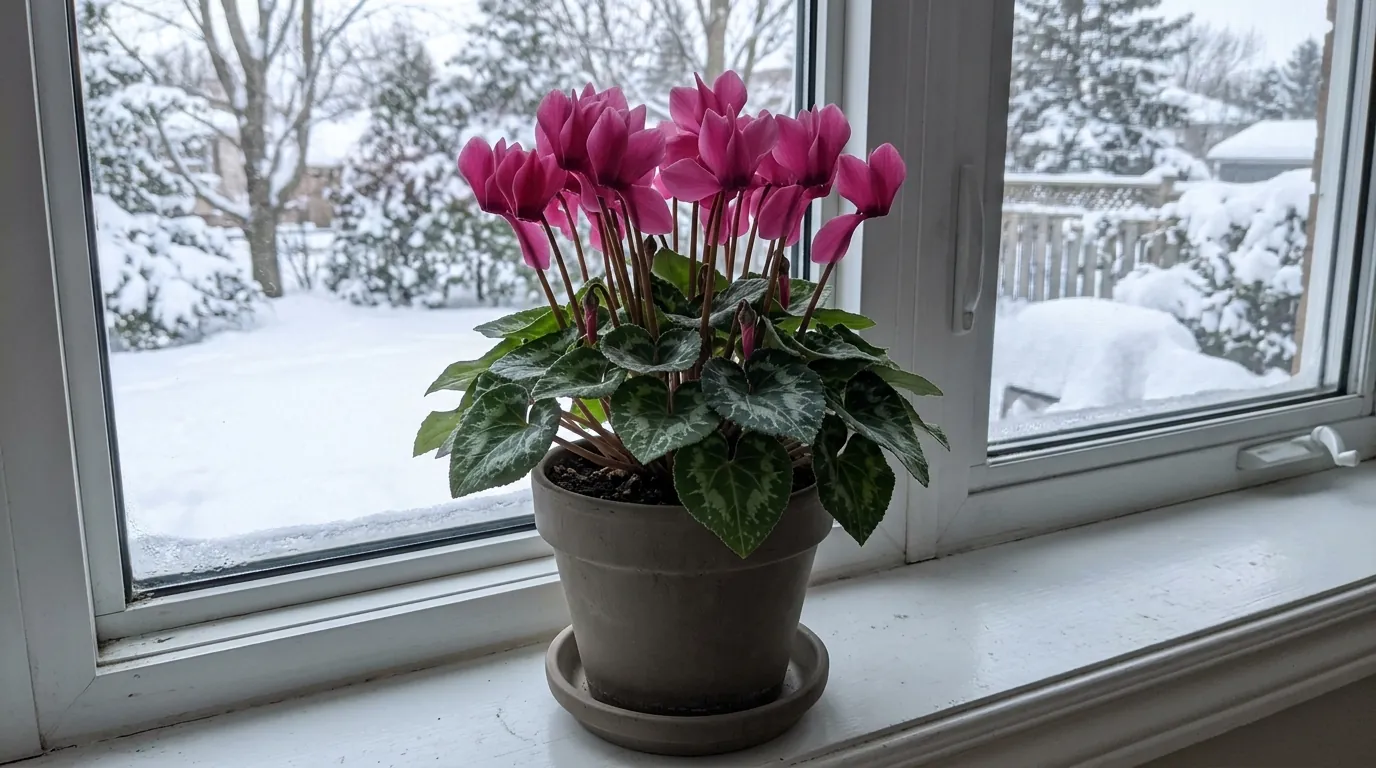
Cyclamen care in Canada starts with a surprise: this is a plant that likes it cool. The florist cyclamen sold in November and December, with its swept-back flowers and silver-marked leaves, comes from cool, wet winters and dry summers in the eastern Mediterranean. Put it in a warm living room beside a heat register and it collapses within weeks, which is why so many are thrown out by February.
The good news is that a Canadian house in winter has exactly the spot it wants: a bright, cool windowsill in a room you do not heat much. Give it that, water it the right way, and it flowers for months. It can even flower again next winter.
Cyclamen care in short: keep it cool, about 15–18 °C by day and near 10 °C at night · bright light without hot sun, away from heat registers · water from below when the surface is dry, never into the centre · feed lightly while it flowers · let it rest in summer and wake it in mid-September · toxic to cats and dogs, so keep it out of reach.
Is your Cyclamen getting enough light this winter?
A Canadian winter cuts daylight roughly in half. See what your city actually gets this month, and whether a grow light is needed.
Quick Care Card
Where to Put a Cyclamen in a Canadian House
Worried your cyclamen is drooping because you are doing something wrong? Usually it is simply too warm, and that is the easiest problem on this page to fix. Move it, and it often perks up within days.
Clemson Extension and UW-Madison Extension both give the same target: about 15–18 °C (60–65 °F) by day and around 10 °C (50 °F) at night. Clemson warns that above about 21 °C (70 °F), buds fail to develop, and cool conditions make each flower and the whole flowering season last longer.
- Best spots: a bright windowsill in a spare bedroom, a cool front hall, a sunporch that stays above freezing, a kitchen window away from the stove.
- Worst spots: above or beside a heat register or radiator, on top of the fridge, by the fireplace, in a warm TV room. Clemson points out that heat vents dry the soil out far too fast.
- Light: bright and indirect. UW-Madison Extension suggests an east window, and in the dark months of a northern winter a south window can be better, as long as the leaves do not touch the cold glass.
Bringing one home from the store in December? Ask for a sleeve and do not leave it in a cold car. Cyclamen likes cool, but it is not frost-hardy, and a few minutes at −15 °C can blacken the leaves. Dry furnace air shortens its season too; if your house runs very dry, see indoor humidity for plants.
How to Water a Cyclamen
Afraid of overwatering it, or underwatering it? Cyclamen is fussy about where the water goes more than how much, and once you know that it is straightforward.
The plant grows from a round tuber that sits at the soil surface, with all its leaf and flower stems rising from the top of it. That crown rots if it stays wet, so every extension source says the same thing: water at the edge of the pot or from below, never into the centre.
- Check the mix with a finger. Iowa State Extension suggests checking daily while it is in flower; water when the surface feels dry.
- Stand the pot in a bowl of room-temperature water for about 15 minutes, as UW-Madison Extension describes, so the mix soaks up from the bottom.
- Lift it out and let it drain completely. Never leave it standing in a foil sleeve or cachepot full of water.
- Let the mix become nearly dry before the next drink. Firm, upright leaves mean it is getting enough.
A plant that has wilted flat from thirst often recovers after a soak. A plant that wilts while the mix is still wet is a warning: the roots or the tuber may be rotting. Feel the top of the tuber. Firm is fine; soft and mushy means rot.
Keeping the Flowers Coming All Winter
A cyclamen bought in December can still be flowering in March. UW-Madison Extension says it can bloom for up to three months, and three habits make the difference:
- Start with the right plant. UW-Madison recommends a plant with lots of buds that are just starting to open and sturdy leaves. Iowa State Extension suggests lifting the leaves to count the unopened buds underneath. A plant in full bloom on the store shelf has already spent part of its season.
- Take off each finished flower. When a flower fades, follow its stem down to the tuber, twist it and pull sharply so it comes away cleanly at the base, as UW-Madison describes. A stub left on the tuber can rot. The same goes for yellow leaves.
- Keep it cool and evenly moist. UW-Madison notes that both individual flowers and the whole season last longer in cool conditions, and that a flowering cyclamen needs moist soil and high humidity. In a Canadian house in January, that usually means the coolest bright room you have, away from every heat register.
One Canadian detail: the windowsill is often the coolest spot in a heated house, which suits a cyclamen, but on a January night the pane itself is far colder than the room. Keep the leaves and flowers a few centimetres off the glass.
Cyclamen Yellow Leaves
Yellow leaves on a cyclamen can feel like the beginning of the end. Often it is not: sometimes it is the plant doing exactly what it should. Start with the time of year.
Late spring, after flowering
Normal. Clemson Extension notes that as the plant goes dormant, its leaves turn yellow and fall. It is resting, not dying. Skip to the summer rest.
Fall to early spring, while it should be flowering
UW-Madison Extension lists the causes: mix kept too wet or too dry, hot and dry conditions, or too little light. In a Canadian house in January the usual culprit is heat. Move it to a cooler, brighter spot, away from any register, and water only when the surface dries.
One or two old leaves at a time
Normal ageing. Twist the yellow leaf off at the base with a gentle tug so the stub does not rot on the tuber.
Cyclamen Leaves Curling
Curling leaves look alarming. The useful question is which leaves are curling, because the answer splits into two very different problems.
- The newest leaves in the centre are twisted, stiff and curled, and buds die before they open: suspect cyclamen mite or broad mite, pests about 0.3 mm long that you cannot see without a lens. UW-Madison Extension says their saliva causes twisting, curling, hardening and distortion of growing points, with crippled crowns and early bud and flower death. It advises isolating new plants for several weeks and discarding infested ones; Clemson Extension also says infested cyclamen are best thrown out. Bag it before the mites reach African violets and other houseplants.
- The whole plant is limp and older leaves droop and curl as the mix dries: this is thirst. UW-Madison says a flowering cyclamen needs moist soil and high humidity, and Clemson Extension warns that a heat vent dries the soil out far too fast. Soak it from below, move it away from the heat, and check the mix more often.
Aphids, mealybugs, spider mites and thrips can also turn up now and then; UW-Madison suggests insecticidal soap or a product labelled for houseplants.
Feeding a Cyclamen
Wondering whether more fertilizer means more flowers? It does not, and a light hand works better. Iowa State Extension suggests a diluted fertilizer about every two weeks while the plant is in bloom, and UW-Madison suggests a fertilizer for blooming plants every two weeks while it is growing actively, warning that too much makes soft, lush growth that is more prone to disease. Always feed onto moist mix, and stop once the leaves start to yellow in spring.
Cyclamen Summer Dormancy: It Is Resting, Not Dying
In April or May the flowers stop, the leaves yellow one after another, and it looks like you have killed it. You have not. UW-Madison Extension says the plant goes dormant for two to three months after blooming, the same summer rest it takes in the wild, where summers are hot and dry. Here is how to carry it through.
- Taper off. As the leaves yellow, water less and stop feeding. Remove leaves as they die back.
- Rest it cool and shaded. Iowa State suggests about six to eight weeks in a cool, shaded spot. In Canada that can be a basement shelf, a cool closet with a window nearby, or outdoors in full shade once nights are frost-free, under a deck or on a north porch.
- Water only to keep the tuber firm. Sources differ here: UW-Madison keeps a resting plant dry, Clemson says not to let the mix dry out completely. The middle path works: a little water every few weeks, enough that the tuber does not shrivel, never enough to make it soggy.
- Watch for new leaves. Small new leaves pushing up from the tuber mean the rest is over.
If you put it outside, bring it in before the first fall frost. The florist cyclamen is frost-tender. (The hardy cyclamen some Canadians grow in shady gardens are different species, sold as garden plants.)
How to Get a Cyclamen to Rebloom
Many people are told a cyclamen cannot flower twice. It can. Clemson Extension says a florist cyclamen will rebloom by mid-winter with proper light, moisture and cool temperatures. It takes a little patience, and it is honest to say it does not always work indoors.
- Mid-September: wake it up. Clemson advises moving the plant into bright light and watering thoroughly when new leaves appear in mid-September. In Canada, have it indoors by the date in the table below.
- Repot in fresh mix. UW-Madison advises repotting after the rest in well-drained potting mix with the upper half of the tuber above the surface. Use a pot only a little wider than the tuber.
- Bright, cool and lightly fed. Give it your brightest cool window, keep the mix moist but not soggy, and feed lightly every few weeks until buds appear.
- Keep it cool when the buds show. Above about 21 °C the buds fail. A cool sill in November and December is a Canadian advantage here.
Have it indoors by September 15, or a week before your average first fall frost if that comes sooner. The dates below come from each city’s average first frost (Environment and Climate Change Canada, 1991–2020 normals); the one-week margin is our rule of thumb.
| City | Average first frost | Indoors by |
|---|---|---|
| Victoria | Nov 5 | Sep 15 |
| Vancouver | Nov 4 | Sep 15 |
| Kelowna | Sep 23 | Sep 15 |
| Calgary | Sep 10 | Sep 3 * |
| Edmonton | Sep 11 | Sep 4 * |
| Saskatoon | Sep 15 | Sep 8 * |
| Winnipeg | Sep 22 | Sep 15 |
| Thunder Bay | Sep 15 | Sep 8 * |
| Toronto | Oct 9 | Sep 15 |
| Ottawa | Oct 2 | Sep 15 |
| Montréal | Oct 9 | Sep 15 |
| Quebec City | Oct 1 | Sep 15 |
| Halifax | Oct 17 | Sep 15 |
| St. John's | Oct 15 | Sep 15 |
* Frost arrives before mid-September here, so bring it in a week before the average first frost. For your own town, use the frost date calculator.
If it does not flower, it is not your fault. UW-Madison notes that rebloom is hard to bring about and that many people treat a florist cyclamen as a short-lived plant. A cyclamen that gave you three months of flowers has done its job.
Is Cyclamen Toxic to Cats and Dogs?
If you have a cat or a dog, this matters more than any care tip. It does not mean you cannot have one; it means it lives where pets cannot reach it.
The ASPCA lists cyclamen as toxic to dogs, cats and horses. It names terpenoid saponins as the toxic principle and lists drooling, vomiting and diarrhea as signs; after large amounts of the tuber are eaten, it lists heart rhythm problems, seizures and death. The tuber sits half out of the soil, which is exactly the part a digging dog or a curious cat gets to.
Put it on a high shelf or in a room pets do not use, and if a pet has eaten any of it, especially the tuber, call your veterinarian or an emergency animal hospital straight away with the plant label in hand. Looking for a flowering gift that the ASPCA lists as non-toxic? The Christmas cactus is the one to choose. More in holiday plants and pets.
For humidity-loving plants like calatheas and ferns, a cool-mist humidifier raises the moisture in dry winter air. Check a hygrometer first: at 45% you may not need one.
Affiliate link — GrowersGuide.ca may earn a commission on qualifying purchases, at no extra cost to you. See our affiliate disclosure.
Cyclamen Care FAQ
How do I care for a cyclamen in Canada?
Keep it cool and bright: about 15 to 18 °C by day and near 10 °C at night, in bright light without hot sun, and well away from heat registers. Water when the surface of the mix is dry, from below or at the edge of the pot so the tuber in the centre stays dry. Feed it lightly while it is in flower. A cool Canadian windowsill in winter suits it better than a warm living room.
Why are my cyclamen leaves turning yellow?
If it is late spring and the plant has finished flowering, yellow leaves are the start of its normal summer rest. During the flowering season, yellow leaves usually mean the mix is too wet or too dry, the room is too warm and dry, or the light is too low. A plant beside a heat register yellows quickly. Move it somewhere cooler and brighter and water only when the surface is dry.
Why are my cyclamen leaves curling?
Look first at where the curling is. If the newest leaves at the centre are twisted, stiff and curled and the flower buds die before they open, the likely cause is cyclamen mite or broad mite: UW-Madison Extension says their saliva causes twisting, curling, hardening and distortion of growing points, and advises discarding infested plants. If instead the whole plant is limp and the older leaves curl as the mix dries out, it is short of water: UW-Madison says a cyclamen in flower needs moist soil and high humidity, and Clemson Extension warns that heat vents dry the soil far too fast. Soak it from below and move it away from the heat.
How do I keep my cyclamen blooming longer?
Keep it cool, keep the mix evenly moist, and take off each finished flower. UW-Madison Extension says individual flowers and the whole flowering season last longer when the plant is kept cool, and that spent blossoms should be removed by twisting the stem and pulling sharply so it comes away cleanly from the base. When buying one, it recommends a plant with lots of buds that are just starting to open.
How do you water a cyclamen?
From below or at the edge of the pot, never into the centre where the tuber and the leaf and flower stems meet, because that crown rots if it stays wet. Stand the pot in a bowl of room-temperature water for about 15 minutes, let it drain, and water again when the surface of the mix feels dry.
What do I do with my cyclamen in summer?
Let it rest. In late spring the leaves yellow and fade. Water less and stop feeding, remove the dead leaves, and keep the pot in a cool, shaded place for the summer, indoors or outdoors in shade. Give it just enough water that the tuber does not shrivel. In mid-September bring it into bright light indoors and start watering again when new leaves appear.
How do I get my cyclamen to rebloom?
After its summer rest, repot the tuber in fresh, well-drained mix with the top half above the surface, give it bright light, cool temperatures and moist but not soggy mix, and feed it lightly. With that, a florist cyclamen can flower again by mid-winter. It is not easy indoors, mainly because of low winter light and warm rooms, so treat a rebloom as a bonus.
Is cyclamen toxic to cats and dogs?
Yes. The ASPCA lists cyclamen as toxic to dogs, cats and horses. It can cause drooling, vomiting and diarrhea, and after large amounts of the tuber are eaten, heart rhythm problems, seizures and death. Keep it out of reach, and call your veterinarian straight away if a pet has eaten any of it, especially the tuber.
Can a cyclamen go outside in Canada?
Only in summer, in shade, while it is resting, and back indoors before the first frost. The florist cyclamen sold at Christmas is frost-tender. The hardy cyclamen grown in some Canadian gardens are different species.
Sources
- Clemson Cooperative Extension, Home & Garden Information Center, Florist Cyclamen — temperatures, buds failing above 21 °C, heat vents, watering, dormancy, mid-September rebloom, cyclamen mite.
- University of Wisconsin–Madison Extension, Cyclamen — light, watering from below, causes of yellow leaves, fertilizer, dormancy, repotting the tuber, pests.
- University of Wisconsin–Madison Extension, Cyclamen and Broad Mites — leaf twisting and curling, bud death, isolating new plants, discarding infested ones.
- Iowa State University Extension, All About Cyclamen — daily checks, warm water, feeding in bloom, the six-to-eight-week rest.
- ASPCA Animal Poison Control, Cyclamen — toxicity to dogs, cats and horses.
- Environment and Climate Change Canada, climate normals 1991–2020 — average first fall frost by city.