
Prayer Plant Care Guide — Canada
How to grow a prayer plant (Maranta) in Canadian homes — filtered water to stop brown tips, the humidity it needs, light, the praying leaf movement, and easy propagation. Non-toxic to pets.
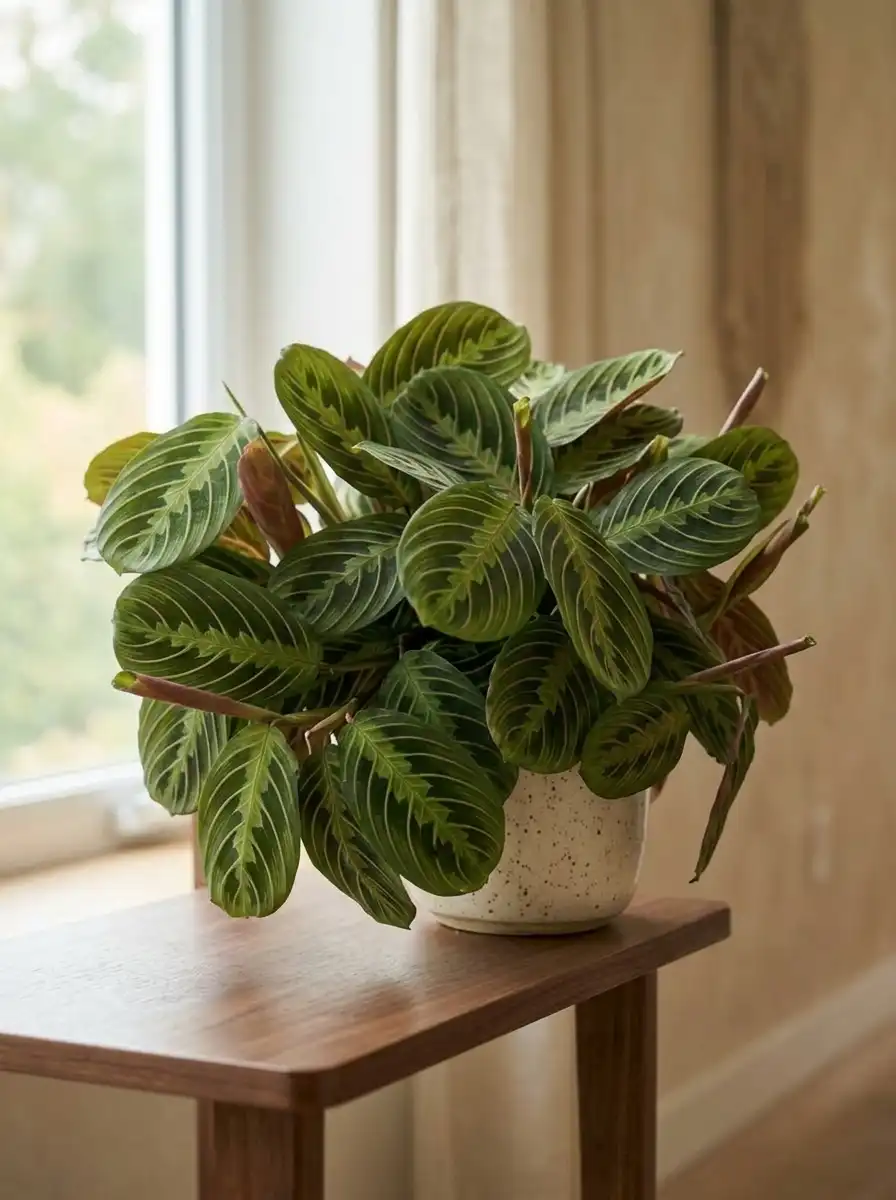
The prayer plant (Maranta leuconeura) is one of the most charming tropical foliage plants you can grow in Canada — low, spreading, and patterned with bold veins and blotches, with the captivating habit of folding its leaves upward each night, like a pair of praying hands. It is a close cousin of the calathea, and shares the calathea's two demands: clean water and humidity. Get those right, and the prayer plant is actually a little more forgiving and easier than its famous relative.
This guide covers the complete prayer plant care routine for Canada — watering with filtered water, the humidity it needs through a dry Canadian winter, light, the praying leaf movement, variety differences, and propagation.
Prayer plant at a glance: Water — filtered or distilled, keep soil evenly moist. Light — medium to bright indirect, no direct sun. Humidity — 50%+, humidifier helps in Canadian winter. Brown tips? — tap water fluoride + dry furnace air. Pet safe — non-toxic to cats and dogs ✅
Is your Prayer Plant getting enough light this winter?
A Canadian winter cuts daylight roughly in half. See what your city actually gets this month, and whether a grow light is needed.
🌿 Prayer Plant Quick Care Card
The Praying Leaves — What the Movement Means
The prayer plant gets its name from its most endearing trait: every evening its leaves fold upward to vertical, like hands pressed together in prayer, then lower flat again in the morning. Understanding this movement helps you read the plant's health.
Why the leaves fold (nyctinasty)
The folding is called nyctinasty. It is driven by changes in water pressure in a swollen joint (the pulvinus) at the base of each leaf, and it tracks the day–night cycle. Leaves rise at dusk and lower at dawn. It is completely normal and a sign of a healthy, well-hydrated plant — many growers find it the best part of owning a prayer plant.
If it stops folding
The most common reason a prayer plant stops folding is artificial light at night — a lamp, TV, or screen keeping it lit after dark confuses its cycle. Give it real darkness overnight. Stress from underwatering, low humidity, or a recent move can also pause the movement; it resumes once the plant settles in.
Leaves stuck upright in the day
If the leaves stay folded up during daytime, the plant may be asking for more light or reacting to dryness. Check the soil and the light: leaves that stay raised are a mild distress signal, much like a calathea's. Adjust conditions and the daily rhythm returns.
Why Prayer Plants Get Brown Tips in Canada — and the Fix
Brown leaf tips and edges are the most common prayer plant complaint in Canada. As with the related calathea, the cause is almost always tap water, dry air, or both. Fix them and new leaves come in clean.
Cause 1 — Tap water fluoride and chlorine
Most Canadian municipal water is fluoridated and chlorinated, and prayer plants accumulate those minerals in their leaf tissue, where they burn the margins brown. Fix: switch to filtered, distilled, or collected rainwater. Chlorine dissipates if water sits out 24 hours; fluoride does not, so filtered or distilled is the reliable answer.
Cause 2 — Dry winter air from forced-air heating
Canadian homes drop to 25–30% relative humidity when heating runs; prayer plants want 50%+. Dry air crisps the leaf edges even when the soil is correctly watered. Fix: run a humidifier near the plant from November through March, or use a pebble tray and group plants together. A bright bathroom is an ideal winter home.
Other causes
Fertiliser salt buildup also burns tips — feed lightly and flush the soil a few times a year. Letting the soil dry out completely crisps the edges too. And keep the plant off cold winter glass and away from heating vents. Trim badly browned edges with clean scissors, following the leaf's natural shape.
Prayer Plant Varieties at Canadian Garden Centres
Maranta leuconeura comes in several strikingly different varieties, and the wider “prayer plant” family (Marantaceae) includes some close relatives sold the same way. All share the same core care.
| Variety | Leaf Pattern | Notes |
|---|---|---|
| Red Prayer Plant (M. l. 'Erythroneura') | Dark green leaves with bright red veins, herringbone pattern | The most popular; also called Herringbone Plant |
| Green Prayer Plant (M. l. 'Kerchoveana') | Light green leaves with dark blotches either side of the midrib | Called Rabbit's Foot or Rabbit Tracks; very forgiving |
| Lemon Lime Maranta | Bright lime veins on green leaves | Vivid colour; wants reliably bright indirect light |
| Maranta 'Marisela' | Soft green leaves with a pale silvery feathered midrib | Subtle, elegant pattern; same easy care |
| Stromanthe (Stromanthe sanguinea) | Pink, cream and green variegation, magenta undersides | A prayer-plant relative; wants higher humidity |
| Ctenanthe (Ctenanthe spp.) | Long leaves with bold brushstroke markings | Another Marantaceae cousin; upright, similar care |
How to Water a Prayer Plant in Canada
Keep the soil consistently, evenly moist — water when the top 1–2 cm has dried. Prayer plants are moisture-loving tropicals: never let the soil dry out completely, but never leave it soggy either. Always use filtered or distilled water at room temperature to avoid the tap-water tip burn.
Prayer plant watering schedule — Canada: Summer (May–Sept): every 5–7 days. Fall (Oct–Nov): every 7–10 days. Winter (Dec–Feb): every 10–14 days. Spring (Mar–Apr): every 5–7 days. Always use filtered or distilled water at room temperature, and water when the top 1–2 cm is dry. Water thoroughly until drainage; empty the saucer after 30 minutes.
Prayer plants want soil that stays evenly moist — never dry, never soggy. A 3-in-1 soil meter shows you exactly what the root zone is doing — push the probe in for an instant moisture, light, and pH reading. No batteries needed.
Affiliate link — GrowersGuide.ca may earn a commission on qualifying purchases, at no extra cost to you. Learn more.
The other thing Canadian houseplants run short on all winter is light. From November to March most homes are too dim to keep plants growing — leaves stretch toward the window, variegation fades, and new growth stalls. A small full-spectrum LED grow light on a timer bridges the dark months, even for tough low-light plants that only survive (rather than grow) in a dim room.
Affiliate link — GrowersGuide.ca may earn a commission on qualifying purchases, at no extra cost to you. Learn more.
Why no fixed schedule works: How fast soil dries depends on temperature, light, pot material, room humidity, and plant size. A prayer plant in a bright, warm summer room dries far faster than one in a cool winter corner. The top 1–2 cm finger test automatically accounts for all of these. See what affects soil drying rate →
Light Requirements for Prayer Plants in Canada
Prayer plants want medium to bright indirect light — enough to keep their bold leaf patterns vivid, but no direct sun, which scorches the leaves and fades the markings. They tolerate lower light better than calatheas, but the patterns dull in dim spots.
Bright Indirect — Best
An east or north window, or set back from a south/west window with a sheer curtain. Strong leaf colour and steady growth.
Medium — Fine
Further from a window. The plant stays healthy; growth slows and patterns soften a little. Move it brighter in winter.
Low Light / Direct Sun — Avoid
Deep shade fades the markings and slows growth; direct sun scorches and bleaches the leaves. Avoid both extremes.
Canadian Winter Care
Run a humidifier through the heating season
Dry forced-air heating is the prayer plant's main winter enemy in Canada, crisping the leaf edges. A small humidifier running near the plant from November through March keeps humidity in the 50%+ range it wants. A pebble tray and grouping plants together help; a bright bathroom is an ideal winter spot.
Keep soil moist but water a little less often
The plant still needs evenly moist soil in winter — never let it dry out — but growth slows and the soil holds water longer in low light, so the interval stretches to every 10–14 days. Check by touch. Stop fertilising from October through February and resume a diluted feed in spring.
Keep it warm and off cold glass
Prayer plants are warmth-loving and dislike temperatures below about 15°C. Keep the plant away from cold, drafty Canadian windows and exterior doors, and clear of forced-air heating vents, whose hot dry blast crisps the leaves. A bright spot on an interior wall near a window is ideal.
Forced-air heat drops a Canadian home to 25–30% humidity all winter — far below the 50–60% these plants need, and the top cause of the brown, crispy edges most people fight from November on. A small cool-mist humidifier running near the plant fixes it at the source (a pebble tray only adds a few percent). This Levoit 2.5L easily covers a plant corner.
Affiliate link — GrowersGuide.ca may earn a commission on qualifying purchases, at no extra cost to you. Learn more.
Prayer Plant Troubleshooting
Brown leaf tips and edges
Switch to filtered or distilled water and add humidity — the two main causes. Flush the soil to clear fertiliser salts. Damage on existing leaves won't reverse; trim the brown edges with clean scissors. New growth comes in clean once water and humidity are addressed.
Curling leaves
Usually underwatering or low humidity. Check the soil first — if dry, water with filtered water and the leaves should relax within hours. If the soil is moist, raise the humidity and move the plant away from cold drafts and heating vents.
Yellowing leaves
Most often overwatering — reduce watering and make sure the pot drains, since soggy soil rots the roots. Occasional yellowing of the oldest lowest leaves is natural ageing. Many leaves yellowing at once points to root rot.
Faded leaf patterns or leggy growth
Too little light — common in Canadian winters. Move the plant closer to a bright window. Prayer plants can also get leggy with age; pinch back long stems to encourage bushier growth, and root the cuttings to fill out the pot.
Frequently Asked Questions
Is a prayer plant the same as a calathea?
They are close cousins, not the same plant. Both belong to the Marantaceae family and both fold their leaves at night, but the prayer plant is Maranta, while calatheas are Calathea (now Goeppertia). In practice the prayer plant has a low, spreading habit and is a little more forgiving — slightly more low-light tolerant and easier to propagate — while calatheas are generally more upright and fussier about humidity. The care is broadly the same: clean water, even moisture, humidity, and no direct sun.
Can I grow a prayer plant in a hanging basket?
Yes — prayer plants have a naturally low, trailing, spreading habit that suits a hanging basket or a high shelf well, with the stems cascading over the edge. Just remember the basket still needs the same care: filtered water, evenly moist soil, and humidity. Hanging baskets dry out faster than pots on a surface, so check the soil more often, and keep the basket out of direct sun.
Does a prayer plant flower?
It can — a healthy prayer plant sometimes produces small, delicate white or pale-purple flowers on thin stalks. They are modest compared with the bold foliage, and the plant is grown almost entirely for its leaves. Some growers pinch off the flower stalks so the plant puts its energy into foliage instead. Flowering or not, it is the leaves and the nightly praying movement that are the real attraction.
Which prayer plant is easiest for a beginner?
The Green Prayer Plant (M. leuconeura 'Kerchoveana'), also sold as Rabbit's Foot or Rabbit Tracks, is the most forgiving variety — it tolerates slightly lower light and minor care lapses better than the more colourful types. The Red Prayer Plant ('Erythroneura') is the most popular and only marginally fussier. For any of them, filtered water and winter humidity are the things that matter most.
How often should I water a prayer plant in Canada?
Keep a prayer plant's soil consistently, evenly moist — never soggy, but never allowed to dry out fully. In practice that means watering roughly every 5–7 days in summer and every 10–14 days in a Canadian winter, checking by touch: water when the top 1–2 cm of soil has dried. Maranta is a moisture-loving tropical, not a succulent — if the soil dries out completely the leaf edges go crispy and the plant sulks. At the same time, waterlogged soil rots the roots. Always use filtered, distilled, or rainwater at room temperature: prayer plants are sensitive to the fluoride and chlorine in most Canadian tap water, which burns the leaf tips brown.
Why does my prayer plant have brown leaf tips?
Brown leaf tips and edges on a prayer plant in Canada come from two things, usually together: tap water and dry air. Maranta is sensitive to the fluoride and chlorine added to most Canadian municipal water — those minerals build up in the leaf tissue and burn the margins brown. Switch to filtered, distilled, or collected rainwater. The second cause is low humidity: Canadian forced-air heating drops indoor air to 25–30% in winter, while prayer plants want 50%+ — dry air crisps the edges even when the soil is correctly watered. Run a humidifier or use a pebble tray. Salt buildup from over-fertilising contributes too; flush the soil a few times a year. Damage already on a leaf will not heal, but new growth comes in clean once water and humidity are fixed.
Why isn't my prayer plant folding its leaves at night?
Prayer plants are named for nyctinasty — the way their leaves fold upward to vertical at night, like a pair of praying hands, and lower flat again in the morning. It is powered by changes in water pressure in cells at the base of each leaf, and it tracks the day–night light cycle. A healthy prayer plant in a normal lit room does this every day. If yours has stopped folding, the usual cause is artificial light at night confusing its cycle — a lamp or screen keeping the plant lit after dark — so give it true darkness overnight. Stress from underwatering, low humidity, or a recent move can also pause the movement; it resumes once the plant settles. The folding itself is a healthy sign, not a problem.
Are prayer plants safe for cats and dogs?
Yes — prayer plants (Maranta leuconeura) are non-toxic to both cats and dogs according to the ASPCA. Like their close cousin the calathea, they are one of the genuinely pet-safe choices among tropical foliage houseplants, unlike pothos, philodendron, dracaena, and ZZ plant, which are all toxic. The prayer plant's low, spreading habit makes it a good pet-safe choice for a shelf or hanging basket in a Canadian home with curious cats or dogs.
How much light does a prayer plant need in Canada?
Prayer plants want medium to bright indirect light — bright enough to keep their vivid leaf markings, but with no direct sun, which scorches the leaves and fades the colours. An east or north window, or a spot set back from a south or west window behind a sheer curtain, is ideal. Prayer plants tolerate lower light better than calatheas, but in dim conditions the leaf patterns fade and growth slows. In a dark Canadian winter, move the plant closer to your brightest window. Avoid any direct sunbeam landing on the leaves.
How do I propagate a prayer plant?
Prayer plants are easy to propagate — easier than calatheas. Two methods both work well. Stem cuttings: cut a stem just below a node (the small joint where leaves and roots emerge), with one or two leaves attached, and place it in a glass of filtered water in bright indirect light; roots appear in 2–4 weeks, after which you pot it up. Division: when repotting a mature, full plant in spring, gently pull the root ball into two or three sections, each with healthy stems and roots, and pot each up separately. Keep new plants warm, humid, and lightly moist while they establish. Spring and summer are the best times to propagate.
🐾 Have pets? See our Pet-Safe Houseplants guide — which common houseplants are toxic to cats and dogs, which are safe, and what to do if a pet eats one.
📖 More Houseplant Guides
Care guides for popular Canadian houseplants.
Also Growing Vegetables?
Free planting calendars for 30+ vegetables across every major Canadian city.