
Norfolk Island Pine Care: Indoor Guide for Canada
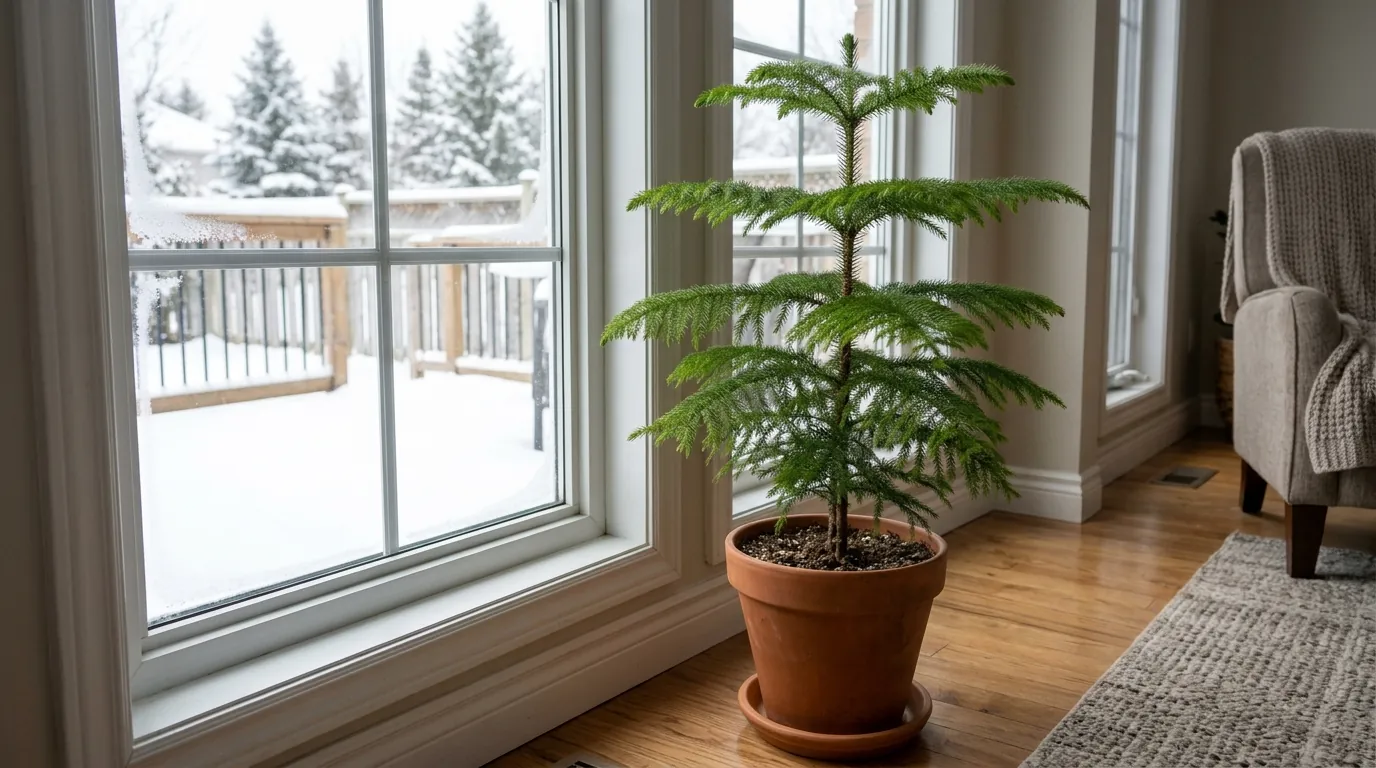
Norfolk Island pine care indoors comes down to light and humidity, the two things a Canadian winter takes away. The tree you buy in December as a small living Christmas tree is not a pine at all: it is Araucaria heterophylla, from a small island in the South Pacific, a cousin of the monkey puzzle tree. It has never met frost, and it will not survive one, but with a bright window and moist air it lives for years as a houseplant. You will also see it labelled or searched as “Northfolk pine”; it is the same tree.
This guide covers light through the short days, watering, the dry air from forced-air heat, why branches turn brown or drop, repotting, pets, and how to decorate it without harming it.
Quick answer: Norfolk Island pine wants the brightest east, west or south window you have, turned a quarter turn every week. Water thoroughly when the surface of the soil is dry and empty the saucer. Keep it at about 13–21 °C, away from heat registers, and run a humidifier nearby in winter — dry air, low light and dry soil are what brown its branches. The ASPCA lists it as non-toxic to cats and dogs.
Norfolk Island Pine at a Glance
Light: the brightest window you have
Iowa State University Extension recommends a brightly lit spot near an east, west or south window. University of Missouri Extension goes further: it grows best with several hours of direct sun a day, though bright indirect light can be enough. That is a real demand in a Canadian December. On the shortest day of the year, Edmonton gets 7h27 of daylight and Toronto 8h55, worked out from each city’s latitude. A tree from a sub-tropical island has never had days that short.
Two habits help. Turn the pot a quarter turn every week, because the tree leans hard towards the light and grows lopsided otherwise. And keep it close to the glass in winter, but not touching it: needles against cold glass on a January night are damaged. Low light shows as long, thin gaps between the tiers of branches and lower branches that thin out.
Is your Norfolk Island Pine getting enough light this winter?
A Canadian winter cuts daylight roughly in half. See what your city actually gets this month, and whether a grow light is needed.
Watering
Water thoroughly when the surface of the soil feels dry, until water runs out of the drainage hole, then empty the saucer so the roots never sit in water. In a bright, warm room that may be weekly; in a cooler winter room, less often. Check with a finger rather than a calendar.
Both mistakes show in the branches. Soil that dries out completely browns the tips and costs lower branches. Soil that stays wet turns new growth yellow and limp and can rot the roots. The December tree usually arrives in a foil sleeve: take it off, or punch holes in the bottom, because water pools inside it where you cannot see.
Humidity in a Canadian winter
Forced-air heat dries a Canadian house more than any other season, and dry air is the first cause Iowa State gives for browning branch tips. A humidifier near the tree is the fix that works. Misting wets the needles for a few minutes and changes nothing, and a pebble tray adds only a little moisture right above it. Keep the tree out of the path of a heat register as well: hot moving air dries it from one side. For the whole winter routine across your plants, see houseplant winter care in Canada.
Heaters deserve their own warning. A forced-air register, a baseboard heater, a radiator or a fireplace sends the warmest, driest air in the house across whatever sits nearest, and dry air is the first cause Iowa State University Extension gives for brown branch tips. So the side of the tree facing the heat browns first. Before you pick its holiday spot, check which way the register blows and keep the tree well out of that path.
You cannot see how dry the air is, and a Canadian house in January is usually drier than it feels. A small digital hygrometer set beside the tree shows the humidity and temperature at a glance, so you know whether the humidifier is earning its keep or the room is simply too warm.
Affiliate link — GrowersGuide.ca may earn a commission on qualifying purchases, at no extra cost to you. See our affiliate disclosure.
Forced-air heat dries a Canadian home through the whole winter, and dry air is the first thing that browns a Norfolk Island pine’s branch tips. A small cool-mist humidifier running near the tree treats the cause. This Levoit 2.5 L covers a plant corner; put it a little away from the tree so the mist does not settle on the needles.
Affiliate link — GrowersGuide.ca may earn a commission on qualifying purchases, at no extra cost to you. See our affiliate disclosure.
Temperature, and summer outdoors
Indoors it does well at about 13–21 °C, the range Iowa State gives, so a cooler room in winter suits it. It is not frost hardy at all; care guides put its lower limit at about 4 °C. Keep it away from doors that open onto winter air and from cold glass.
It can spend the summer outside, in bright shade or dappled light rather than full sun, moved out gradually over a week or two so the needles do not scorch. The dates below are each city’s frost dates on this site: the first is when frost has passed in 9 years out of 10, the second is when fall frost has arrived in only 1 year in 10. As a rule of thumb, move the tree out a couple of weeks after the first date and bring it in a couple of weeks before the second, because nights near 4 °C come before the frost does. We have no per-city date for those cool nights, so we do not invent one.
| City | Spring frost behind you | Fall frost possible from |
|---|---|---|
| Victoria | April 30 | October 17 |
| Vancouver | April 21 | October 15 |
| Toronto | May 19 | September 22 |
| Halifax | May 26 | October 3 |
| Montreal | May 15 | September 28 |
| Ottawa | May 20 | September 24 |
| Winnipeg | June 7 | September 12 |
| Calgary | June 11 | August 27 |
| Edmonton | June 10 | August 21 |
| Saskatoon | June 7 | September 1 |
Environment and Climate Change Canada 1991–2020 frost probabilities, as used across this site. Your own city: frost dates calculator.
Brown or dropping branches
Iowa State lists the causes in one sentence: low humidity, too little light, or soil that is too dry will brown the branch tips and cost the tree its lower branches. Read the pattern:
One thing to know before you fix it: the tree only makes new branches at the top, so a lower branch that dies is not replaced. Cut dead branches off cleanly where they meet the trunk; the tree will look better, but the gap stays. Never cut the top off to control height — the tree grows from that single tip and does not make another.
Feeding and repotting
Feed with a dilute houseplant fertilizer every two to four weeks from spring to early fall, as Iowa State advises, and not at all in winter, when the short days stop growth anyway.
Repot every two to three years, in spring, into a pot only one size larger with a drainage hole and a free-draining potting mix. Many trees are sold as several seedlings planted together to look fuller. Leave them together: pulling them apart tears the roots, and a single seedling looks thin for years.
Decorating it as a living Christmas tree
A Norfolk Island pine makes a good small living Christmas tree as long as the decorating does not undo the care. Its branches are soft, so keep everything light:
Looking after a cut tree or a live outdoor tree as well? See Christmas tree care in Canada.
Is Norfolk Island pine safe for pets?
The ASPCA lists it, under the name Australian pine, as non-toxic to dogs, cats and horses. You will find websites that say the opposite, sometimes claiming the ASPCA as their source; the ASPCA entry itself says non-toxic. Chewing any plant can still upset a pet’s stomach, and on a decorated tree the real hazards are tinsel, which cats swallow, hooks, and light cords. A cat that climbs needs a heavy pot that will not tip. See holiday plants and pets.
Frequently Asked Questions
How do you care for a Norfolk Island pine indoors?
Give it the brightest window you have, east, west or south, and turn it a quarter turn every week so it grows straight. Water thoroughly when the surface of the soil is dry and empty the saucer. Keep the room between about 13 and 21 °C, away from heat registers and cold drafts, and run a humidifier nearby in winter. Feed with a dilute fertilizer only from spring to early fall.
Why are the branches on my Norfolk pine turning brown?
Iowa State University Extension names three causes: dry air, too little light, and soil that dries out too far. In a Canadian winter it is often all three at once, from forced-air heat and short days. Brown tips on many branches point to dry air or dry soil; yellow, limp growth with wet soil points to overwatering instead.
Why is my Norfolk Island pine losing its lower branches?
The same causes as brown tips: low humidity, low light or dry soil. The tree only grows new branches at the top, so a lower branch that dies is not replaced. Losing the odd bottom branch on an older tree is normal; losing several in one winter means it needs more light and more humid air.
Why are the branches on my Norfolk Island pine drooping?
University of Missouri Extension gives two causes. If the soil has gone too dry, the lower branches droop, turn brown and eventually fall off. In poor light, the branch tips weaken and droop, and the top slows while the side branches keep growing, so the tree turns squat. Check the soil first, then move the tree to your brightest window. Heavy ornaments can also bend branches down for good.
Is Norfolk Island pine toxic to cats and dogs?
The ASPCA lists Norfolk Island pine (under the name Australian pine) as non-toxic to dogs, cats and horses. Some websites say otherwise, but the ASPCA entry is the reference. Chewing any plant can still upset a pet's stomach, and on a decorated tree the bigger risks are tinsel, hooks and lights.
Can a Norfolk Island pine go outside in Canada?
Only in summer. It is not frost hardy, and care guides put its lower limit at about 4 °C. Move it out a couple of weeks after your last spring frost, into bright shade rather than full sun, and bring it back in a couple of weeks before your first fall frost.
Can I decorate a Norfolk Island pine as a Christmas tree?
Yes, lightly. Use LED lights, which stay cool, and small light ornaments the soft branches can carry without bending. Skip spray snow and glitter, which coat the needles. Keep it in its bright spot while it is decorated, and take the decorations off after the holidays.
When should I repot a Norfolk Island pine?
Every two to three years, in spring, into a pot only one size larger with a drainage hole and a free-draining potting mix. Many are sold as several seedlings in one pot to look fuller; leave them together, because pulling them apart tears the roots.
Should I cut the top off a Norfolk Island pine that is too tall?
No. The tree grows upward from that single tip and does not make a new one, so cutting it leaves a flat-topped tree that stops getting taller. If it outgrows the room, the honest options are a brighter, taller spot or a new tree.