
Hoya Carnosa Care in Canada
Hoya carnosa — the wax plant — is easy to keep alive and hard to make flower, and almost everyone arrives here for the second problem. This guide starts with blooming, then covers the winter conditions that decide it in a Canadian home. Non-toxic to cats and dogs.
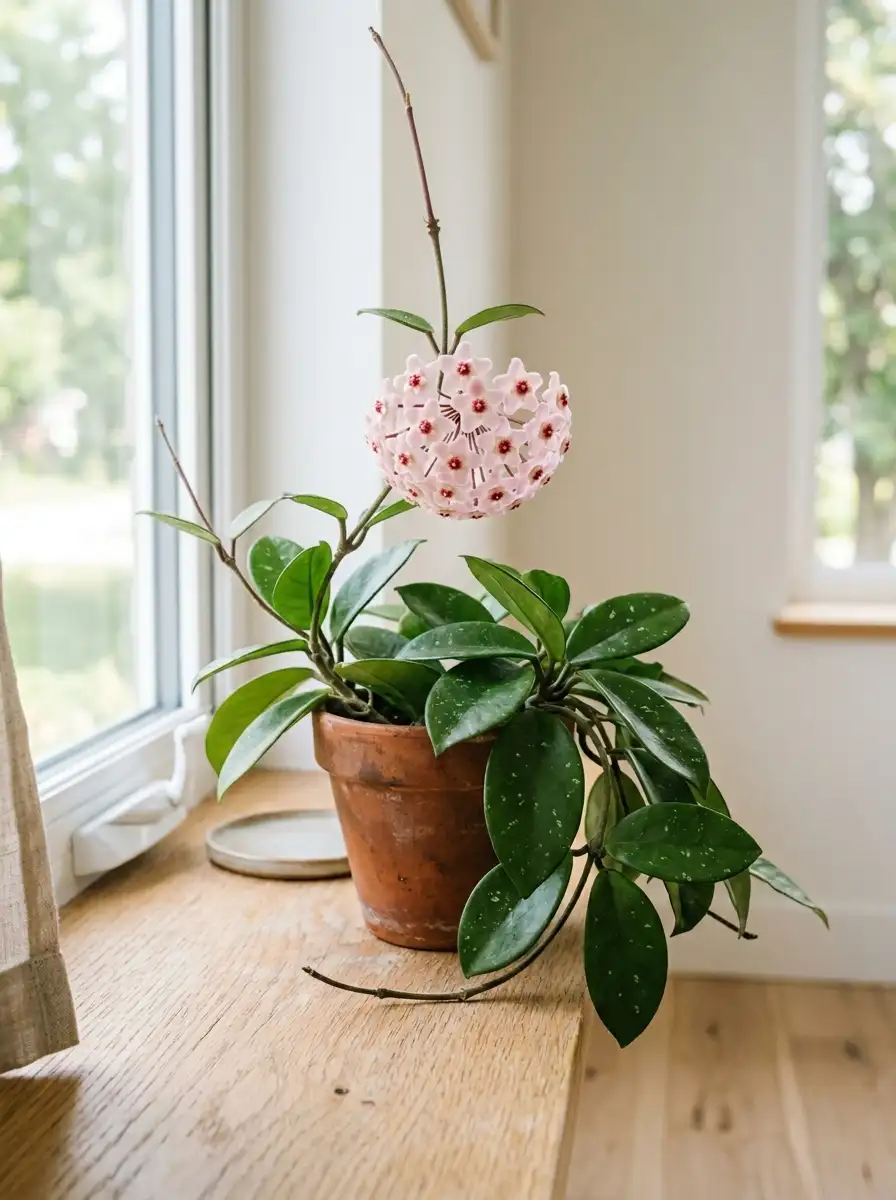
Short answer: a Hoya that won't bloom is usually too young, too dim, too generously potted, or missing its flower spurs. Give it the brightest indirect light you have, keep it slightly pot-bound, let it dry out hard between waterings, and never cut the peduncle. In Canada the binding constraint is winter light — daylight halves between June and December, so buds set as it returns and flowering lands far later here than most care guides promise.
Is your plant getting enough light this winter?
A Canadian winter cuts daylight roughly in half. See what your city actually gets this month, and whether a grow light is needed.
Why Your Hoya Isn't Blooming
A Hoya can grow happily for years and never produce a flower. That is not bad luck and it is rarely a single cause — it is normally two of the following four at once.
1. It is too young
Hoyas need roughly 2–3 years of growth before they flower at all, and nothing accelerates that. A cutting rooted last spring will not bloom this year no matter how well you treat it. If your plant is small and recently propagated, the honest answer is to wait.
2. Not enough light — the big one in Canada
Light is the largest single lever, and in a Canadian home it is the constraint for most of the year. A Hoya in medium light grows perfectly well and simply never flowers, which is why the problem is so easy to miss: the plant looks healthy. Bright indirect light with some gentle morning sun is what sets buds.
3. The pot is too big
Hoyas flower best slightly pot-bound — it suits their epiphytic roots, and a snug pot also dries faster, which the plant likes. Moving one up two sizes typically buys a season or two of leaf growth instead of flowers. Repot every 2 years or so, one size at a time, and only when roots are genuinely crowded.
4. Someone cut the spurs off
If the plant came from someone else, or you tidied it up last year, this may already have happened. It is the one cause on this list you cannot undo quickly — see the section below, because it matters more than anything else here.
The spring dry spell — a trigger that genuinely works
Letting a Hoya dry out hard for several weeks in spring and then watering normally will often push a reluctant plant into bud. It reads the dry-then-wet sequence as the start of a season. Two honest caveats: it works only on a plant that is already mature and already getting enough light — drought is not a substitute for either — and the time to try it is March or April, as the days lengthen, not in January when the plant is dry and dormant anyway.
Bud Blast — When Buds Drop Before They Open
You get buds, they swell for a week or two, and then the whole umbel drops. This is bud blast, and the cause is almost always change. A Hoya in bud is committed to one exact set of conditions and reacts badly to any of them moving.
- Moving or rotating the pot. Even a quarter turn toward the window can do it. If you routinely rotate your plants, stop the moment you see a bud.
- A cold draught. A winter window, an exterior door, an unheated entryway.
- A forced-air vent. Hot, dry and intermittent — the worst combination for a plant in bud.
- Irregular watering. Bone dry and then soaked is a bigger shock than either extreme on its own.
There is no rescue once buds start dropping — the only real treatment is prevention. When you see the first bud, decide where the plant lives, put it there, and do not touch it again until the flowers open. That includes not repotting, not pruning and not moving it somewhere you can see it better.
Peduncle or Spur — and the One Rule
Worth getting the vocabulary straight, because both words appear constantly in Hoya writing and people assume they mean different things. The peduncle is the short bare woody stalk left behind when a flower cluster fades. The spur is properly the knobby tip of that peduncle, the point the flowers actually emerge from. In practice the two are used interchangeably, and it does not matter, because the rule is identical for both.
Never cut it off. A Hoya reblooms from that same structure year after year, and one peduncle can carry dozens of clusters over its life, growing slightly longer each season. Removing it — almost always because it looks dead, which it does — destroys the blooming site and forces the plant to build a new one from scratch. That costs one to two seasons of flowers. Let spent blooms fall on their own rather than cutting the stalk, and when you prune a long bare vine, check it for spurs first: they form along old growth, which is exactly the growth that looks most disposable.
When a Hoya Actually Blooms in Canada
This is where most Hoya advice stops being useful here. Guides written in the US, the UK or New Zealand put flowering in spring. In a Canadian home the plant is still recovering from the dark half of the year at that point. Daylight roughly halves between June and December, and buds set once it comes back — so the flowering window shifts months later.
| City | Dec 21 | Jan 21 | Feb 21 | Mar 21 |
|---|---|---|---|---|
| Vancouver | 8h11 | 8h51 | 10h28 | 12h09 |
| Toronto | 8h55 | 9h27 | 10h45 | 12h09 |
| Halifax | 8h48 | 9h21 | 10h42 | 12h09 |
| Ottawa | 8h43 | 9h17 | 10h40 | 12h09 |
| Winnipeg | 8h05 | 8h46 | 10h26 | 12h10 |
| Calgary | 7h54 | 8h37 | 10h21 | 12h10 |
| Edmonton | 7h27 | 8h16 | 10h11 | 12h10 |
Daylight climbs back through 10 hours around 5 February in Toronto and not until 19 February in Edmonton, and a Hoya needs several weeks of real growth after that before a peduncle forms and buds swell. In practice, expect flowers from late May through August, peaking in July, and later in the north and on the Prairies than on the south coast. The daylight figures are computed; the flowering window is a rule of thumb drawn from that light and from horticultural convention, not a measurement.
Canadian Winter Care
Dry air is not the problem it is for other tropicals
Outdoor air at −20 °C is near saturation at 70% relative humidity, but warmed to 21 °C indoors it carries only about 4% — the moisture did not change, the air's capacity did. What a lived-in house generates back brings it to around 25–30% in deep winter, well under the 50–65% most tropical foliage wants. Hoya carnosa is one of the few that genuinely doesn't mind — the thick waxy leaves are built to hold water. No humidifier, no pebble tray. The exception is the fine fuzzy-leaved H. linearis, which does want more.
Brightest window, back from the glass
From November through February move it to the brightest south or west window you have — winter light is what sets up the following summer's flowers. But keep it a few centimetres off the pane: the air trapped against single glazing drops below the 13 °C floor even in a room at 21 °C. Keep it out of the direct blast of forced-air vents too.
A cool, dry rest is a feature
Stretch watering right out to every three or four weeks, and stop fertilising entirely from October to February. If you can give it 13–16 °C for part of the winter, do — a cool dry rest is one of the more reliable ways to trigger spring flowering. Winter overwatering is the leading cause of Hoya root rot in Canada.
Watering — Read the Leaves, Not the Calendar
A Hoya tells you when it is thirsty: the leaves pucker very slightly, losing their taut gloss. That is the cue to water, and it is far more reliable than any schedule, because drying speed depends on light, temperature, pot material and plant size — and the chunky mix Hoyas want dries faster than ordinary potting soil to begin with. Water thoroughly until it runs from the drainage holes, empty the saucer, and then wait.
| Season | Roughly |
|---|---|
| May–September | every 10–14 days |
| October–November | every 2–3 weeks |
| December–February | every 3–4 weeks |
| March–April | every 10–14 days |
Overwatering kills more Hoyas than anything else, and in winter the soil stays damp far longer than it looks. A 3-in-1 meter confirms the root zone is actually dry before you water — push the probe in for an instant moisture, light and pH reading. No batteries needed.
Affiliate link — GrowersGuide.ca may earn a commission on qualifying purchases, at no extra cost to you. Learn more.
Soil and Pot
Most Hoyas are epiphytes in the wild — they grow on trees, with their roots in open air rather than in ground. That is why ordinary dense potting soil holds too much water for them. Cut regular potting mix generously with orchid bark and perlite so it drains fast and stays airy. Pair that with a snug pot that has real drainage: it suits the roots, it dries at the right speed, and being slightly pot-bound is one of the conditions that pushes a Hoya into flower. Repot every 2–3 years, one size up, in spring, and never while the plant is in bud.
Cultivars at Canadian Garden Centres
There are hundreds of Hoya species and cultivars, and Hoya collecting is a deep hobby in its own right — but a handful account for almost everything sold here. All share the same core care.
| Cultivar | Look | Notes |
|---|---|---|
| Hoya carnosa | Thick, glossy, deep-green oval leaves on long vines | The classic wax plant; vigorous, reliable, the easiest to bloom |
| Hoya carnosa 'Krimson Queen' | Leaves edged cream-white, new growth flushed pink | Margin variegation; needs bright light to hold its colour |
| Hoya carnosa 'Krimson Princess' | Variegation in the leaf centre, green margins | The mirror image of Krimson Queen; same light demand |
| Hoya carnosa 'Compacta' | Tightly curled, twisted leaves on rope-like vines | Sold as Hindu Rope. Slow; water carefully — the crevices trap moisture and hide pests |
| Hoya kerrii | Thick heart-shaped leaves | Usually sold as a single rooted leaf, which never grows on — see the FAQ |
| Hoya pubicalyx | Slender speckled leaves, dusky-pink flowers | Fast and one of the easiest to flower; a good first Hoya if you want blooms soon |
| Hoya linearis | Soft, fuzzy, needle-like leaves in cascading strands | The one exception on this list: genuinely wants more humidity than a Canadian winter gives |
| Hoya bella | Compact trailing habit, small neat leaves | Excellent in a hanging pot; less forgiving of cold and drought than carnosa |
Troubleshooting
Yellow, soft leaves that drop
Overwatering, often with root rot already underway — the most common way Hoyas die in Canada, and nearly always in winter. Let the soil dry much further between waterings, check the pot drains and the mix is chunky enough, and cut back sharply from December. If leaves are dropping in numbers, unpot and look: brown mushy roots need trimming and a fresh dry mix.
Wrinkled, shrivelled leaves
Usually thirst, and they plump back up within a day or two of watering. If the soil is already moist and the leaves stay shrivelled, it is the opposite problem: damaged roots can no longer take water up. Unpot, trim what is rotten, repot dry.
White cottony spots — mealybugs
The classic Hoya pest, hiding in leaf joints and, on Hindu Rope, deep in the curled crevices where they are very easy to miss. Dab each cluster with a cotton swab dipped in rubbing alcohol and repeat every three or four days until they stop reappearing — one pass never clears them. Isolate the plant while you treat it, and check it again after any summer spent outdoors.
Sticky liquid on the leaves or floor
Nectar, not a pest. Hoya flowers produce enough sweet liquid that it drips. Slide a saucer or cloth underneath while the plant is in bloom. The scent strengthens in the evening, which is when most people first notice a Hoya is flowering at all.
Frequently Asked Questions
Should I let it trail or train it to climb?
Either. Hoyas are vines and look good trailing from a shelf or trained up a small trellis or hoop; a trellis keeps the plant compact and shows the flower clusters off better. Whichever you pick, don't re-train it while it is in bud, and don't prune away long bare vines — spurs form along them.
How do I propagate one?
Stem cuttings, in water or damp sphagnum. Take a piece of vine with two or three leaves and at least one node — the bump where a leaf meets the stem — and cut just below it. Roots appear in 3–6 weeks in bright indirect light. Spring and summer work; a December cutting mostly sits there.
Can it go outside for the summer?
Yes, in bright shade, and it often responds well to the stronger light. Bring it back in when nights drop toward 13 °C — not at first frost, which is far too late for a tropical vine. Check the foliage carefully before it rejoins your other plants; this is the classic route by which mealybugs get indoors.
Why won't my Hoya bloom?
Almost always one of four things, and usually two at once. The plant is too young — Hoyas need roughly 2 to 3 years before they flower at all, and nothing hurries that. It is not getting enough light, which is the limiting factor in a Canadian home for most of the year. It has been over-potted: Hoyas bloom best slightly pot-bound, and moving one into a big pot buys you a season or two of leaves instead of flowers. Or a previous owner cut off the flower spurs, in which case the plant has to grow entirely new ones before it can bloom again. A fifth cause is rarer but worth knowing: a plant that never dries out and never gets a cool winter rest has no trigger to flower.
Why are my Hoya buds falling off before they open?
This is bud blast, and the usual cause is change. Once buds have formed, a Hoya wants nothing to alter — not its position, not its rotation relative to the window, not the temperature. Moving the pot or turning it a quarter turn is enough to drop a whole umbel, and so is a cold draught from a winter window or the hot dry blast of a forced-air vent. Irregular watering does it too: a plant that goes bone dry and is then soaked while in bud will often abandon the flowers. The fix is prevention rather than rescue — once you see a bud, put the plant where it will stay and leave it entirely alone until the flowers open.
Should I cut off the flower spur after my Hoya blooms?
No — never. When a Hoya finishes flowering it leaves behind a short bare woody stalk. That is the peduncle, and the small knobby tip it flowers from is properly the spur; in practice the two words are used interchangeably and the rule is the same for both. The plant reblooms from that exact structure, year after year, and a single peduncle can carry dozens of flower clusters over its life, lengthening slightly each time. Cutting it off — almost always out of tidiness, because it looks dead — destroys the blooming site and forces the plant to build a new one, costing one to two seasons of flowers. Let spent flowers drop on their own rather than cutting the stalk they hang from.
Can I force a Hoya to bloom by withholding water?
Up to a point, and it is a real technique rather than folklore: a Hoya that is allowed to dry out hard for several weeks in spring, then watered normally, will often set buds. It works because the plant is semi-succulent and reads a dry spell followed by water as the start of a growing season. Two cautions. It only works on a mature, well-lit plant — drought will not substitute for either age or light, which are the actual limiting factors. And it works far less reliably in a Canadian winter, when the plant is already dry and slow; the time to try it is March or April, as the light returns, not January.
How often should I water a Hoya carnosa in Canada?
Read the leaves rather than a calendar. A Hoya is semi-succulent and stores water in its thick waxy foliage, so the leaves pucker very slightly when it is genuinely thirsty — that is your cue, and it is a much safer signal than a fixed schedule. As a rough guide, that lands around every 10 to 14 days from May to September, and only every three to four weeks from December to February, when short days slow the plant right down and the soil holds water far longer. Water thoroughly until it drains, empty the saucer, and wait. Overwatering is what kills Hoyas here; drought almost never does.
How much light does a Hoya need in Canada?
Bright indirect light, with some gentle direct morning sun welcome. An east window is close to ideal, or a spot about a metre back from a south or west window behind a sheer curtain. Harsh midday sun through glass bleaches and marks the waxy leaves. A north window is the one to avoid here: at Canadian latitudes it receives no direct sun at all between October and March, so a Hoya there will survive indefinitely and never flower. Light is the single biggest lever on blooming, and from November to February it is the constraint — a plant that spends the winter in a dim corner will not set buds in spring.
Are Hoyas safe for cats and dogs?
Yes. Hoyas are not on the ASPCA toxic plant list and are among the very few genuinely pet-safe trailing houseplants — unlike pothos, philodendron, dracaena and ZZ plant, all of which are toxic. A pet that ate a large amount of foliage might get a mild stomach upset, as with almost any plant, but there is no toxic risk. One practical note for pet households: the flowers drip a sweet sticky nectar, which is harmless but attracts interest and leaves marks on floors and furniture.
Why does my single Hoya kerrii leaf never grow?
Because it has no node. The Sweetheart Hoya sold as a single rooted heart-shaped leaf — usually around Valentine's Day — was cut without any piece of stem, so it has no growing point from which a vine can emerge. It will root, and it can live happily for years as exactly what it is, but it will never become a plant. If you want a real Hoya kerrii, buy one propagated from a cutting that includes stem and at least one node, and expect it to look nothing like the single leaf.
📖 More Houseplant Guides
Trailing and pet-safe plants alongside the Hoya.
Also Growing Vegetables?
Free planting calendars for 30+ vegetables across every major Canadian city.