
Guide d'entretien de l'Anthurium — Canada
Comment cultiver et entretenir l'anthurium (Anthurium andraeanum) dans les foyers canadiens — gardez votre plante en fleurs rouges ou roses toute l'année, arrosage, humidité, refloraison et soins hivernaux.
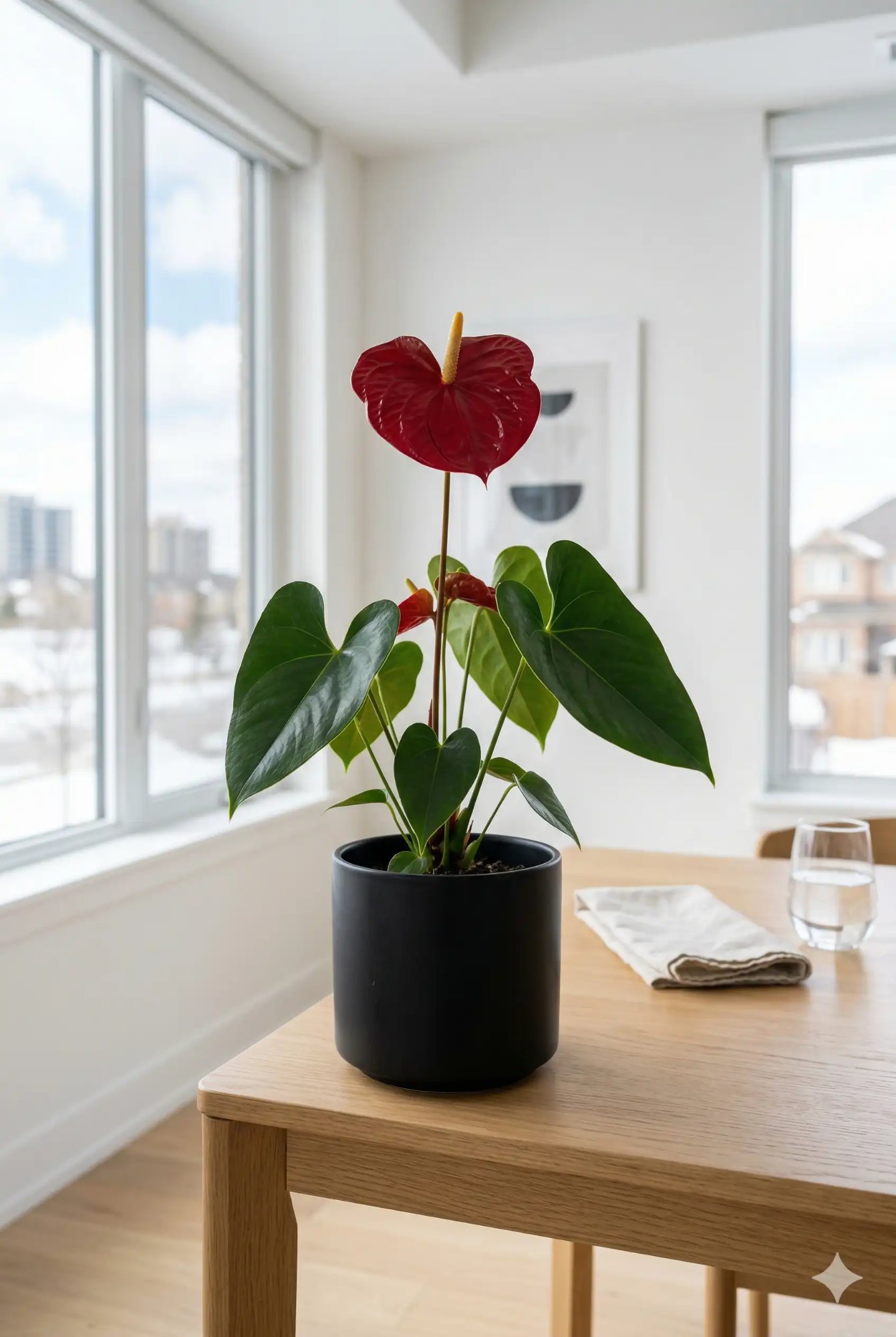
L'anthurium (Anthurium andraeanum, aussi appelé fleur flamant rose) est l'une des plantes d'intérieur à fleurs les plus colorées disponibles au Canada — et l'une des plus difficiles à faire refleurir en hiver canadien sans efforts supplémentaires. Le secret n'est pas compliqué : humidité. L'air sec du chauffage canadien est l'ennemi #1 de la floraison.
Ce guide couvre tout ce qui est spécifique à la culture de l'anthurium dans un foyer canadien — pourquoi les fleurs deviennent vertes (normal!), comment maintenir 60-80 % d'humidité l'hiver canadien (humidificateur obligatoire), arrosage, et diagnostic des problèmes courants.
Votre plante reçoit-elle assez de lumière cet hiver ?
Un hiver canadien coupe les heures d'ensoleillement de moitié. Voyez ce que votre ville reçoit ce mois-ci et si une lampe de croissance est nécessaire.
🌿 Fiche d'entretien rapide
Anthurium en bref : Humidité 60-80 % = critique pour la floraison; humidificateur obligatoire en hiver canadien. Lumière — vive indirecte, fenêtre est ou ouest. Arrosage — quand les 3-5 cm supérieurs sont secs, tous les 7-14 jours. Spathe devient verte = normal, cycle qui se termine. Toxique aux chats, chiens et humains.
Humidité — le facteur make-or-break au Canada
L'anthurium vient des forêts tropicales humides d'Amérique du Sud. Il a besoin de 60-80 % d'humidité pour fleurir régulièrement. L'air canadien chauffé à la fournaise en hiver chute à 25-30 % — c'est pourquoi tant d'anthuriums au Canada cessent de fleurir d'octobre à mars.
Solution #1 : Humidificateur (le seul vraiment efficace)
Un petit humidificateur près de la plante maintient 50-60 % d'humidité ambiante. C'est la SEULE solution qui fait une différence mesurable pour la floraison. Les modèles à ultrasons silencieux sont idéaux. Investissement de 30-60 $ qui transforme la santé et la floraison de l'anthurium.
Solution #2 : Plateau à galets (modeste)
Pot placé sur des galets dans un plateau d'eau (sans toucher l'eau). Augmente l'humidité localisée de 10-15 %. Pas suffisant seul en hiver canadien mais utile en complément. La plante doit être directement au-dessus.
Ce qui NE FONCTIONNE PAS : brumiser
La brumisation augmente l'humidité pour quelques minutes seulement avant que l'eau s'évapore. Sans effet mesurable sur la floraison. De plus, l'eau qui reste sur les feuilles peut causer des taches fongiques. Achetez un humidificateur, pas un vaporisateur.
Comment arroser l'anthurium au Canada
Arrosez quand les 3-5 cm supérieurs de terreau sont secs. L'anthurium aime une humidité du sol constante mais déteste les racines mouillées en permanence — c'est une plante épiphyte dans la nature (pousse sur les arbres) qui n'est pas adaptée aux sols détrempés.
Horaire d'arrosage : Été (mai-sept) : tous les 7-10 jours. Automne (oct-nov) : tous les 10-12 jours. Hiver (déc-fév) : tous les 10-14 jours. Printemps (mars-avril) : tous les 7-10 jours. Utilisez de l'eau filtrée ou laissée reposer 24 h pour éviter les pointes brunes au fluor.
L'arrosage excessif est la cause #1 de mort de l'anthurium au Canada. Un humidimètre 3-en-1 confirme que le terreau est sec — enfoncez la sonde pour une lecture instantanée d'humidité, lumière et pH. Aucune pile requise.
Lien affilié — GrowersGuide.ca peut toucher une commission sur les achats admissibles, sans frais supplémentaires pour vous. En savoir plus.
Comment faire fleurir toute l'année
Avec les bonnes conditions, un anthurium peut fleurir presque continuellement — nouvelles spathes émergeant tous les 2-3 mois. Cinq facteurs pour la floraison maximale :
- Lumière vive indirecte — fenêtre est ou ouest, 1 m de distance. Sans lumière suffisante, aucune fleur.
- Humidité 60-80 % — humidificateur essentiel en hiver canadien. C'est le facteur clé que la plupart des gens ignorent.
- Engrais riche en phosphore à demi-force, mensuel d'avril à septembre. Le phosphore (le P de NPK) supporte la floraison.
- Températures 18-30 °C constantes, jamais sous 16 °C la nuit. Évitez les pièces froides et les courants d'air.
- Pot juste assez grand — un pot trop grand encourage les racines au lieu des fleurs. Rempotez seulement quand les racines sortent des trous.
Pourquoi la spathe devient verte (normal!)
La "fleur" rouge ou rose vif que vous voyez n'est pas réellement la fleur — c'est une spathe (bractée modifiée) qui entoure le véritable spadice (la petite tige jaune). Les spathes durent 2-3 mois puis passent naturellement du rouge/rose au vert avant de tomber. Ce n'est PAS un problème.
Quand couper la spathe : quand elle devient vert pâle puis vert plus foncé (signe que le cycle est terminé), coupez-la à la base de la tige avec des ciseaux propres. La plante redirigera l'énergie vers la production de la prochaine fleur. Si les NOUVELLES spathes émergent vertes dès le départ, ce n'est pas normal — la plante a besoin de plus de lumière.
Soins hivernaux canadiens
L'hiver canadien est la saison la plus difficile pour l'anthurium. Cinq ajustements critiques :
Humidificateur OBLIGATOIRE
Sans humidificateur, votre anthurium cessera de fleurir et développera des bords bruns chroniques de novembre à mars. C'est l'investissement #1 pour la santé de l'anthurium en hiver canadien.
Déplacez vers fenêtre la plus lumineuse
En hiver, déplacez vers une fenêtre sud (avec léger filtrage si soleil direct intense) ou la fenêtre est/ouest la plus lumineuse. Gardez 30 cm de la vitre — les vitres canadiennes à 0-5 °C endommagent l'anthurium tropical.
Réduisez arrosage et arrêtez fertilisation
Passez à toutes les 10-14 jours en hiver. Arrêtez complètement la fertilisation de novembre à février. La plante ne fleurira probablement pas en hiver — c'est normal. Reprise possible mars-avril avec retour de la lumière.
Évitez les bouches de chauffage
L'air chaud sec direct des sorties de fournaise dessèche les feuilles en quelques jours. Pointes brunes et bords brûlés. Si possible, placez la plante dans une pièce sans bouche de chauffage à proximité directe.
Diagnostic — problèmes courants
Pointes ou bords bruns
Cause #1 au Canada : faible humidité du chauffage. Solution : humidificateur. Causes secondaires : fluor de l'eau du robinet (passez à l'eau filtrée), trop de soleil direct, ou accumulation de sels d'engrais (rincez le terreau).
Feuilles jaunes
Cause la plus probable : arrosage excessif. Vérifiez le terreau et inspectez les racines pour pourriture. Une ou deux feuilles jaunes sur les plus vieilles = vieillissement normal.
Ne fleurit plus depuis l'achat
Causes possibles : faible humidité (le plus probable au Canada — humidificateur), manque de lumière (déplacez vers est/ouest), ou plante en récupération de transport hivernal. Patience + amélioration des conditions = nouvelle floraison en 2-4 mois.
Nouvelles spathes vertes dès le départ
Cause : manque de lumière. Sans assez de lumière, la plante ne peut pas produire les pigments rouges/roses dans la spathe. Déplacez vers une fenêtre est ou ouest, ou ajoutez une lampe horticole.
Racines aériennes qui sortent du pot
Normal — pas un problème. L'anthurium est épiphyte dans la nature et produit des racines aériennes. Laissez-les ou recouvrez-les délicatement de mousse pour l'esthétique. Indique souvent une plante en santé et active.
Questions fréquentes
Pourquoi mon anthurium ne fleurit-il plus ?
Au Canada, presque toujours faible humidité (chauffage à air pulsé à 25 %). Achetez un humidificateur — c'est l'investissement #1 pour la floraison. Aussi vérifiez la lumière (fenêtre est ou ouest minimum) et la fertilisation au phosphore en saison.
Les spathes vertes sont-elles normales ?
Oui — les spathes deviennent vertes naturellement après 2-3 mois quand le cycle est terminé. Coupez à la base. Si les NOUVELLES spathes émergent vertes, c'est un problème de lumière insuffisante.
L'anthurium est-il toxique pour les chats ?
Oui — l'anthurium est toxique aux chats, chiens et humains. Cristaux d'oxalate de calcium causent irritation buccale, salivation et vomissements. Gardez hors de portée des animaux.
Brumiser remplace-t-il un humidificateur ?
Non — la brumisation augmente l'humidité pendant minutes seulement avant évaporation. Sans effet mesurable sur la floraison. Un petit humidificateur de 30-60 $ est la solution correcte pour l'anthurium en hiver canadien.
À quelle fréquence arroser un anthurium au Canada ?
Arrosez les anthuriums quand les 3-5 cm supérieurs de terreau sont secs — typiquement tous les 7-10 jours en été et tous les 10-14 jours en hiver canadien. Les anthuriums ont besoin d'une humidité constante mais ne tolèrent pas de rester dans un terreau mouillé. Utilisez de l'eau à température ambiante et arrosez à fond jusqu'au drainage, puis videz la soucoupe. En hiver canadien avec faible lumière, la fréquence d'arrosage devrait diminuer car l'absorption d'eau de la plante ralentit considérablement. L'arrosage excessif en hiver est le problème le plus fréquent dans les foyers canadiens — la combinaison faible lumière + terreau mouillé cause la pourriture des racines rapidement.
Pourquoi la spathe de mon anthurium devient-elle verte ?
La spathe (la partie cireuse colorée communément appelée la fleur) devient naturellement verte avec l'âge — c'est normal et indique que le cycle de floraison se termine, pas un problème. La spathe dure typiquement 2-3 mois avant de passer du rouge ou rose au vert. Coupez-la à la base quand elle devient verte et la plante redirigera son énergie vers la production de la prochaine fleur. Si les nouvelles spathes émergent vertes dès le début plutôt que rouges, la plante a besoin de plus de lumière — déplacez près d'une fenêtre est ou ouest.
Comment faire fleurir plus mon anthurium au Canada ?
Les anthuriums fleurissent en réponse à une lumière adéquate combinée à une haute humidité. Au Canada, les deux principales barrières sont la lumière hivernale insuffisante et l'air sec du chauffage. Pour plus de fleurs : déplacez à moins d'un mètre d'une fenêtre est ou ouest; utilisez un humidificateur près pour maintenir 60-80 % d'humidité (l'air de fournaise canadien à 25-30 % est trop sec pour la floraison); fertilisez mensuellement avec un engrais riche en phosphore à demi-force de mars à septembre; et assurez-vous que les températures restent au-dessus de 16 °C constamment. Une lampe horticole sur minuterie 12 h combinée à un humidificateur est la configuration la plus fiable pour fleurir toute l'année au Canada.
Comment prendre soin d'un anthurium en hiver canadien ?
Les anthuriums sont plus sensibles aux hivers canadiens que la plupart des plantes tropicales d'intérieur parce qu'ils ont besoin à la fois de bonne lumière ET de haute humidité pour fleurir — et le Canada ne fournit ni l'un ni l'autre en hiver. Ajustements clés : utilisez un humidificateur près (l'ajustement le plus important — l'air de fournaise à 25-30 % arrête la floraison et cause des bords bruns); déplacez vers votre fenêtre la plus lumineuse; réduisez l'arrosage à tous les 10-14 jours; arrêtez la fertilisation de novembre à février; et gardez loin des vitres froides et des bouches de chauffage. Un plateau à galets seul est insuffisant — un petit humidificateur est la solution correcte.
L'anthurium est-il toxique pour les animaux ?
Oui — les anthuriums sont toxiques pour les chats, chiens et humains. Ils contiennent des cristaux d'oxalate de calcium qui causent irritation buccale, salivation, vomissements et difficulté à avaler si mâchouillés. Gardez hors de portée des animaux et enfants. Portez des gants lors du rempotage car la sève peut irriter la peau. Contactez votre vétérinaire immédiatement si votre animal ingère une partie de la plante.
Pourquoi mon anthurium a-t-il des pointes brunes ?
Les pointes brunes sur les anthuriums au Canada sont presque toujours causées par la faible humidité du chauffage à air pulsé. Les foyers canadiens en hiver chutent à 25-30 % d'humidité — les anthuriums préfèrent 60-80 %. Un humidificateur près est la solution correcte. Causes secondaires : fluor dans l'eau du robinet (passez à de l'eau filtrée), trop de soleil direct (éloignez de la fenêtre), ou accumulation de sels d'engrais (rincez le terreau et réduisez la fertilisation).
📖 Autres guides de plantes d'intérieur
Plantes à fleurs et tropicales aux côtés de l'anthurium dans les foyers canadiens.
Vous cultivez aussi des légumes ?
Calendriers de plantation gratuits pour 30+ légumes dans toutes les grandes villes canadiennes.