
When to Plant Peppers in Canada — 2026 Guide
Indoor start dates and transplant dates by region (BC, Ontario, Quebec, Prairies, Maritimes), the heat rules that decide whether Canadian peppers succeed, best varieties by zone, and why peppers are harder than tomatoes everywhere in Canada.
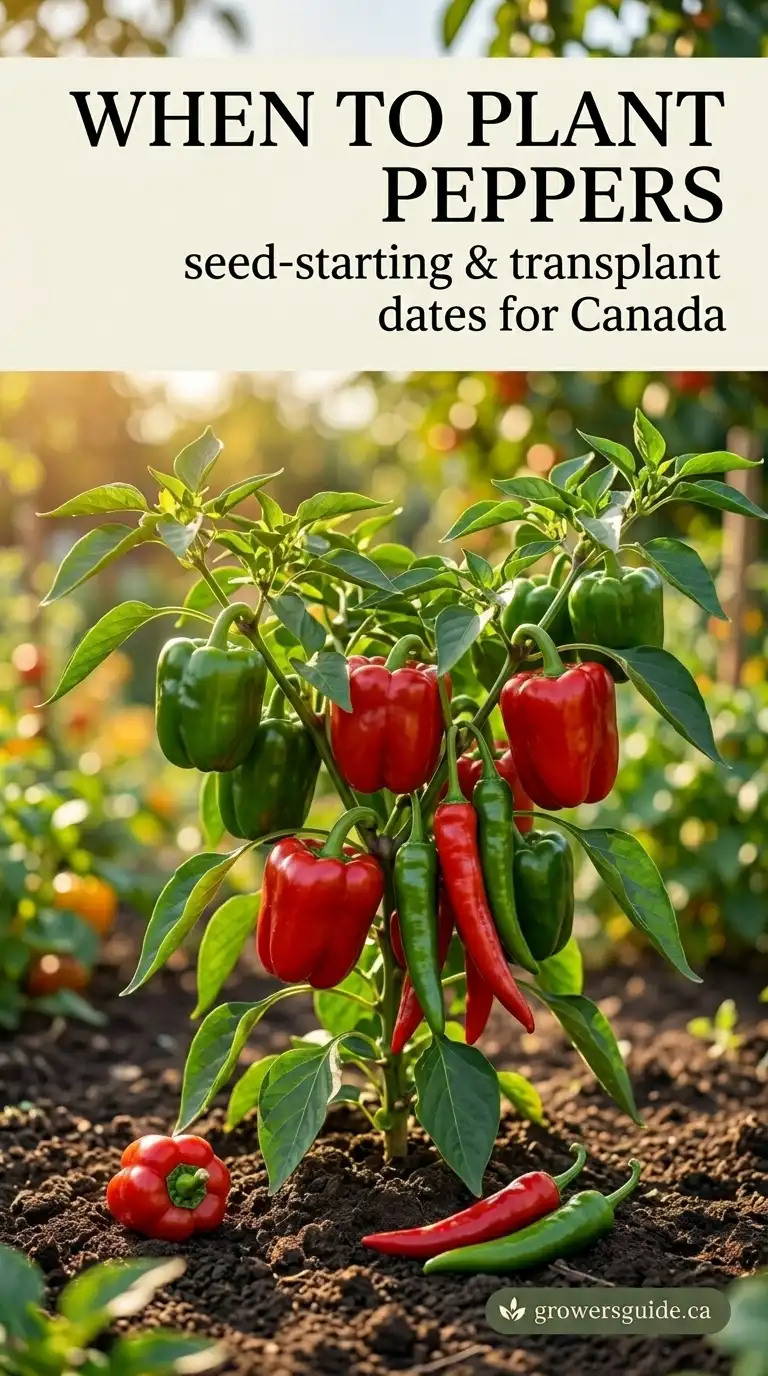
Peppers are the most heat-demanding vegetable most Canadian gardeners attempt to grow. They need to be started indoors earlier than tomatoes, transplanted into warmer soil, and coddled through spring cold snaps that tomatoes would shrug off. When it comes together, a pepper plant in full production in August is one of the most productive things in the garden. But the timing window is narrower than almost any other crop.
The single variable that explains most Canadian pepper failures is cold soil at transplant time. Gardeners who move peppers outdoors on the last frost date — as they might with tomatoes — are putting them into soil that's 10–12°C when peppers need 15°C. The plants stall, sometimes for weeks, and never fully recover their momentum. Waiting an extra week or two for genuinely warm soil produces peppers that outperform plants set out earlier by June.
Peppers in Canada at a glance: Start indoors 8–10 weeks before transplant (use a heat mat at 27–30°C). Transplant only when soil is above 15°C and nights above 12°C. Vancouver: May 10–25. Windsor: May 15–25. Toronto: May 20–Jun 1. Ottawa/Montreal: Jun 1–15. Calgary/Winnipeg: Jun 5–15. Halifax: May 25–Jun 5. Match variety days-to-maturity to your frost-free window.
When should you plant peppers where you garden?
Get your city's frost dates, indoor seed-starting dates, and this week's planting jobs — three free tools.
🌱 Need seeds? West Coast Seeds (a BC company) sells untreated, Canadian-grown vegetable & herb seed — steadier than a random Amazon listing that sells out or varies by region.
🥦 Shop vegetable seeds at West Coast Seeds →Affiliate link — we may earn a commission on qualifying purchases, at no extra cost to you.
🌶 Want the full growing canonical? See Growing Peppers in Canada for sweet vs hot variety selection (King of the North, Carmen, Jalapeño M, Hungarian Hot Wax), Wall-O-Water + black plastic for cold-spring soil warming, blossom drop diagnosis, green-vs-ripe harvest decision, indoor pepper overwintering, and 5 common Canadian problems.
Pepper Planting Dates Across Canada — 2026
"Start indoors" dates are 8–10 weeks before safe transplant. "Safe transplant" is when soil reaches 15°C and nights are reliably above 12°C — typically 2–3 weeks later than the calendar last frost date. "Max variety days" is the longest days-to-maturity that will ripen before first fall frost.
| Region (City) | Zone | Last Frost | Start Indoors | Safe Transplant | Max Days |
|---|---|---|---|---|---|
| Coastal BC (Vancouver) | 8a | Mar 15 | Feb 20–Mar 10 | May 10–25 | 65 days* |
| Vancouver Island (Victoria) | 8b | Mar 10 | Feb 15–Mar 1 | May 1–15 | 70 days* |
| BC Interior (Kelowna) | 6b | May 5 | Mar 1–15 | May 10–20 | 80 days |
| Southern Ontario (Toronto) | 6b | Apr 20 | Mar 1–15 | May 20–Jun 1 | 80 days |
| SW Ontario (Windsor) | 7a | Apr 15 | Feb 20–Mar 5 | May 15–25 | 90 days |
| Eastern Ontario (Ottawa) | 5a | May 9 | Mar 10–24 | Jun 1–15 | 70 days |
| Quebec (Montreal) | 5b | May 9 | Mar 10–24 | Jun 1–10 | 70 days |
| Prairies (Calgary) | 3b | May 23 | Apr 1–15 | Jun 5–15 | 65 days |
| Prairies (Edmonton) | 4a | May 14 | Mar 25–Apr 10 | Jun 1–10 | 65 days |
| Prairies (Winnipeg) | 3a | May 19 | Apr 1–15 | Jun 5–15 | 65 days |
| Maritimes (Halifax) | 6a | May 10 | Mar 1–15 | May 25–Jun 5 | 75 days |
* Coastal BC max days are lower due to cool July–August temperatures (22°C avg high), not season length. Bell peppers often don't ripen fully in Vancouver — choose frying and cherry types.
Get Your Exact Pepper Start Date
100+ Canadian cities — enter yours for indoor start dates for peppers and 20+ vegetables
🌿 Free Seed Starting CalculatorPepper Germination Temperature & Days to Harvest
Peppers are warm-soil germinators — the opposite of spinach — and the #1 reason Canadian seed-starting fails is sowing into soil that's too cold. Seed needs a soil temperature of about 26–29°C to sprout quickly and evenly; below 21°C germination is slow and patchy, and below 15°C seed simply rots. A heat mat under the tray — not a warm windowsill — is what makes the difference.
| Soil temperature | Germination |
|---|---|
| Below 15°C | Seed rots before sprouting — too cold |
| 18–21°C | Slow & erratic — 3 weeks or more |
| 26–29°C | Optimal — sprouts in 7–10 days (use a heat mat) |
| Above 35°C | Germination drops off again |
Days to harvest is the other half of why peppers are tight in Canada. From transplant, sweet and bell peppers take about 60–70 days to reach full size while still green, plus another 2–3 weeks to ripen red, yellow, or orange; hot peppers often need 90–100+ days. That long clock is exactly why you start indoors 8–10 weeks before last frost and lean on short-season varieties — see the variety table below.
The Universal Rules for Peppers (Apply Everywhere)
Peppers have a reputation in Canada as a difficult crop — and most of that difficulty comes down to ignoring these five rules. Get them right and peppers are among the most productive vegetables in the August garden.
Start 8–10 weeks indoors — earlier than tomatoes
Peppers need 2–4 more weeks of indoor growing time than tomatoes before they're ready to transplant. A tomato started 6 weeks before transplant is a strong seedling; a pepper started 6 weeks out is still small and underdeveloped. The extra weeks allow peppers to build the root system and stem strength they need to produce heavily once the season warms. Starting at 8 weeks is safe for every Canadian region; 10 weeks produces larger seedlings with earlier harvests. Don't start more than 10 weeks ahead — overcrowded root-bound pepper seedlings transplant poorly.
Use a heat mat — germination without one is unreliable
Pepper seeds need 27–30°C soil to germinate quickly and reliably. At average Canadian room temperature (20–22°C), germination takes 3–4 weeks with poor rates — many seeds simply don't sprout, and those that do produce weak seedlings. With a heat mat maintaining 27–30°C, germination happens in 7–14 days with dramatically better germination rates. Once seedlings have their first true leaves, remove the heat mat — they no longer need it. Heat mats are available at any Canadian garden centre for $30–50 and last for years. They are the single highest-ROI piece of equipment for Canadian pepper growers.
Wait for 15°C soil before transplanting — regardless of the calendar
This is the most violated rule in Canadian pepper growing. Last frost dates fall in April and May — but soil at those dates is typically 10–12°C. Peppers transplanted into 10°C soil stop growing, often for 2–3 weeks, and never fully recover their momentum. Plants set out two weeks later into 16°C soil will catch up within a week and outproduce the early-transplanted plants all season. Measure soil temperature with a thermometer at 10 cm depth. Also verify that nights are consistently above 12°C — cold nights below this cause flower drop even if soil is warm enough. In most Canadian regions this combination arrives 2–3 weeks after the last frost date.
Harden off for 7–10 days before transplanting
Peppers grown under grow lights indoors have no tolerance for outdoor sun, wind, or temperature swings. Moving them directly outside — even into warm conditions — causes sunscald and transplant shock that sets plants back 2–3 weeks. Hardening off means gradually increasing outdoor exposure: start with 1–2 hours of filtered shade, increase to 4 hours, then full sun over 7–10 days. Always bring plants in if temperatures drop below 10°C during hardening. This process is even more important for peppers than tomatoes because pepper cells are more sensitive to UV exposure. Properly hardened-off transplants establish and begin flowering within 2 weeks of going in the ground.
Match variety days-to-maturity to your season — not to a seed catalogue description
Seed catalogues list days-to-maturity from transplant in ideal growing conditions — typically a southern US climate with sustained heat above 25°C. In Canada, add 10–20% to those numbers for cool-summer regions (Vancouver, Ottawa, Prairies). A "65-day" pepper in the catalogue might be 75–80 days in your Ottawa garden. This means a Calgary or Winnipeg gardener should treat 65 days as the hard maximum, not the target. In Vancouver, even 65-day varieties may not ripen fully before September declines in temperature. Use the Max Days column in the table above as your guide, not the seed packet number.
Best Pepper Varieties for Canadian Gardens
Canadian pepper variety selection is dominated by one question: how many frost-free days does your region have, and is summer hot enough to ripen fruit? Short-season Prairie and northern gardens need the fastest varieties available. Cool coastal BC needs short-season varieties regardless of the long season.
| Variety | Type | Days | Best Regions | Why It Works |
|---|---|---|---|---|
| Lipstick | Sweet pimento | 53 | All Canada | The fastest-ripening sweet pepper available. Reliable producer in every Canadian climate including coastal Vancouver and Prairie cities. Small conical fruit, very sweet. The default recommendation for short-season and cool-summer gardens. |
| Gypsy | Sweet frying | 65 | All Canada | Heavy producer of elongated sweet frying peppers. Works reliably across all Canadian zones. Thin-walled, sweet, ideal for roasting or eating fresh. Among the most productive sweet peppers for Canadian season lengths. |
| Early Jalapeño | Hot | 65 | All Canada | The right jalapeño for Canadian gardens — specifically bred for short seasons. Prolific producer, works in Calgary and Winnipeg. Classic jalapeño heat and flavour. The standard hot pepper for every Canadian region. |
| Carmen | Sweet Italian frying | 60 | Zones 5+ | Long red Italian-style frying pepper, very sweet when ripe. Ripens to red reliably in Toronto, Halifax, and Kelowna. One of the best-flavoured peppers for Canadian conditions. Not suited to Prairie or Vancouver. |
| Ace Bell | Bell | 70 | Zones 5+ | The best bell pepper for shorter Canadian seasons — Ottawa, Montreal, Halifax. Green in 70 days, fully red in 85. Thick walls, classic bell flavour. Use black plastic mulch and south-facing position for Ottawa and Montreal. |
| California Wonder | Bell | 75 | Zones 6+ (not Prairies) | Classic thick-walled bell pepper. Reliable in Toronto, Hamilton, Windsor, and Kelowna. Too slow for Ottawa or any Prairie city. The standard bell for gardeners in Canada's warmest zones. |
| Hungarian Wax | Hot / sweet | 65 | Zones 5+ | Yellow banana-style wax pepper with mild-medium heat. Very productive in Ontario, BC Interior, and the Maritimes. Harvest yellow for mild flavour, leave to turn red for more heat. One of the most reliable producers in Canadian conditions. |
| Serrano | Hot | 75 | Zones 6+ (not Prairies) | Hotter than jalapeño, prolific producer when heat conditions are right. Works in Windsor, Toronto, Kelowna. Too slow for Ottawa or any Prairie city. Great for salsas and hot sauces where jalapeño heat isn't enough. |
Common Pepper Problems Across Canada
Poor or slow germination
Almost always caused by cold germination medium — the most common pepper problem in Canada. Pepper seeds need 27–30°C soil to germinate reliably; at room temperature (20–22°C), germination takes 3–4 weeks with 30–50% germination rates. A heat mat is the complete solution. Second cause: old seed — pepper seeds lose viability quickly and should be no older than 2–3 years. Third cause: planting too deep — seeds should be 6 mm deep, no deeper. Start fresh seed with a heat mat and expect 7–14 days to germination.
Plants stunted and purple-tinged after transplanting
Purple or reddish discoloration on pepper leaves and stems after transplanting signals phosphorus deficiency caused by cold soil. When soil is below 15°C, pepper roots cannot absorb phosphorus even when it's present in adequate amounts — the plants effectively starve for a nutrient that's right there. The fix is waiting for warm soil before transplanting, not adding phosphorus fertiliser. Plants usually recover and resume normal green growth once soil warms above 15°C, but the stall costs several weeks of the growing season. This is the most visible consequence of transplanting too early in Canadian conditions.
Flower drop without fruit setting
Cold nights (below 10–12°C) are the primary cause across Canada — flowers abort before they can be pollinated. This is especially common in June during cold snaps in Ontario, Quebec, and the Prairies. Production resumes when nights warm; no intervention needed. Second cause: heat above 32°C causes temporary flower drop during Southern Ontario and Quebec heat waves. Also temporary. Third cause: inconsistent watering — pepper plants under water stress drop flowers as a survival mechanism. Deep, consistent watering (not frequent shallow watering) prevents this. Mulching around plants retains moisture and moderates soil temperature.
Peppers not ripening to red before fall frost
The most common end-of-season problem in short-season and cool-summer regions (Prairies, Ottawa, coastal BC, Quebec). Peppers ripen from green to red (or yellow/orange) — the colour change requires sustained warm temperatures and happens much slower in cool summers. Three approaches: (1) Choose varieties that ripen quickly — Lipstick (53 days), Gypsy (65 days), Carmen (60 days). (2) Harvest green — green peppers are fully mature and edible; the colour change is cosmetic. (3) Bring unripe peppers indoors in early September and ripen at room temperature before first frost. Most peppers will colour up indoors over 1–2 weeks.
Sunscald — pale patches on fruit
White or pale tan patches on pepper fruit are sunscald — overexposure to intense direct sun combined with heat. Common in the Okanagan and Southern Ontario during August heat waves. The damaged tissue dries and may become papery. Prevention: adequate leaf cover on plants (don't over-prune), consistent watering during heat waves, light-coloured mulch to reflect heat. Affected areas are safe to eat but the tissue is softened. Sunscald is cosmetic when minor; severe cases create entry points for rot. Unlike blossom end rot, sunscald is not nutrient-related and does not respond to calcium applications.
Frequently Asked Questions
When should I plant peppers in Canada?
Start indoors 8–10 weeks before transplant. Transplant outdoors once soil is above 15°C and nights are consistently above 12°C — typically 2–3 weeks after last frost. Vancouver/Victoria: transplant mid-May. Windsor: May 15–25. Toronto: May 20–Jun 1. Ottawa/Montreal: Jun 1–15. Calgary/Winnipeg: Jun 5–15. Halifax: May 25–Jun 5.
When do I start pepper seeds indoors?
Count back 8–10 weeks from your transplant date. Vancouver: February 20–March 10. Toronto: March 1–15. Windsor: February 20–March 5. Ottawa/Montreal: March 10–24. Calgary/Winnipeg: April 1–15. Halifax: March 1–15. Use a heat mat at 27–30°C — essential for reliable germination.
Do I need a heat mat for peppers?
Yes. Pepper seeds germinate poorly at room temperature (20–22°C) — taking 3–4 weeks with low success rates. With a heat mat maintaining 27–30°C, germination happens in 7–14 days with much higher rates. A heat mat is the single most impactful piece of equipment for Canadian pepper growers. Remove once seedlings have their first true leaves.
Can I grow bell peppers in Canada?
In most regions yes, with the right variety. Windsor (90 days max) and Toronto/Kelowna (80 days) have no issues. Ottawa and Montreal: use Ace bell (70 days) and black plastic mulch. Prairies: very difficult — only Ace (70 days) has a realistic chance. Vancouver: bell peppers often don't ripen fully due to cool summers (22°C July highs) — frying and cherry types are far more productive in coastal BC.
Why are my pepper flowers dropping?
Cold nights below 10–12°C are the most common cause — production resumes when nights warm. Heat above 32°C causes temporary drop too (Southern Ontario/Quebec heat waves). Both are temporary. Inconsistent watering is a third cause. If flowers drop after transplanting, the plants were likely moved into cold soil or cold air — be patient.
Are peppers harder to grow than tomatoes in Canada?
Yes. Peppers need to start indoors earlier (8–10 weeks vs 6–8), require warmer soil to transplant (15°C vs 10°C), are more sensitive to cold nights, need a heat mat for germination, and ripen more slowly. The gap closes in warm regions — Windsor and Kelowna grow peppers easily. In cool-summer or short-season regions, peppers need more attention than tomatoes at every stage.
What's the best pepper variety for short Canadian seasons?
Lipstick (53 days sweet pimento) and Gypsy (65 days sweet frying) are the two most reliable options for every Canadian region including the Prairies and coastal BC. Early Jalapeño (65 days) is the standard for hot pepper growers. All three work everywhere in Canada with no special techniques required beyond a heat mat and warm soil at transplant.