
CANADA PLANTING GUIDE
When to Plant Cucumbers in Canada — 2026 Guide
When to plant cucumbers in Canada, plant outdoors after last frost when soil reaches 18°C — cucumbers are warm-season vegetables that won't tolerate cold soil. Unlike potatoes or spinach that can push their timing, cucumbers planted in cold ground rot or sit dormant until soil warms anyway. The 18°C threshold is the real start line, not the last frost date.
For short-season zones — Calgary, Edmonton, Winnipeg, Ottawa — a 3–4 week indoor start in biodegradable pots gives cucumbers enough runway to produce before September frost. In longer-season zones like Vancouver, Toronto, and Windsor, direct sowing after the soil warms is simpler and nearly as productive. The one universal rule: never disturb cucumber roots at transplanting. Always use biodegradable pots and plant pot and all.
Quick Answer
Direct sow or transplant cucumbers after last frost when soil reaches 18°C: mid-May in Vancouver, late April to early May in Victoria, May 10–20 in Toronto and Windsor, late May to early June in Ottawa, Montreal, and Halifax, early June in Calgary, Edmonton, and Winnipeg. Start indoors 3–4 weeks before transplant date in short-season zones using biodegradable pots only. Grow vertically on a trellis and harvest every 2 days to maximize yield.
When should you plant cucumbers where you garden?
Get your city's frost dates, indoor seed-starting dates, and this week's planting jobs — three free tools.
🌱 Need seeds? West Coast Seeds (a BC company) sells untreated, Canadian-grown vegetable & herb seed — steadier than a random Amazon listing that sells out or varies by region.
🥦 Shop vegetable seeds at West Coast Seeds →Affiliate link — we may earn a commission on qualifying purchases, at no extra cost to you.
🥦 Want the full growing canonical? See Growing Cucumbers in Canada for slicing vs pickling vs English type selection, the best Canadian varieties (Marketmore 76, Diva, National Pickling, Tasty Green), vertical trellising that doubles yield, fixing bitterness, cucumber beetle + powdery mildew defence, parthenocarpic varieties for low-bee gardens, and the harvest-daily rule.
Cucumber Planting Dates Across Canada — 2026
| Region (City) | Zone | Last Frost | Direct Sow | Indoor Start | Transplant | First Harvest |
|---|---|---|---|---|---|---|
| Coastal BC (Vancouver) | 8a | Mar 15 | May 10–20 | Apr 20–May 1 | May 10–20 | Late Jun–Jul |
| Vancouver Island (Victoria) | 8b | Mar 10 | Apr 25–May 5 | Apr 5–15 | Apr 15–25 | Mid Jun |
| BC Interior (Kelowna) | 6b | May 5 | May 1–15 | Apr 10–20 | May 1–10 | Late Jun–Jul |
| Southern Ontario (Toronto) | 6b | Apr 20 | May 10–20 | Apr 20–30 | May 10–20 | Mid–Late Jul |
| SW Ontario (Windsor) | 7a | Apr 15 | May 5–15 | Apr 15–25 | May 5–15 | Early–Mid Jul |
| Eastern Ontario (Ottawa) | 5a | May 9 | May 24–Jun 1 | May 1–10 | May 24–Jun 1 | Late Jul |
| Quebec (Montreal) | 5b | May 9 | May 24–Jun 1 | May 1–10 | May 24–Jun 1 | Late Jul |
| Prairies (Calgary) | 3b | May 23 | Jun 1–10 | May 10–20 | Jun 1–10 | Late Jul |
| Prairies (Edmonton) | 4a | May 14 | Jun 1–10 | May 10–20 | Jun 1–10 | Late Jul |
| Prairies (Winnipeg) | 3a | May 19 | Jun 1–5 | May 10–15 | Jun 1–5 | Late Jul |
| Maritimes (Halifax) | 6a | May 10 | May 20–Jun 1 | Apr 30–May 10 | May 20–Jun 1 | Mid–Late Jul |
Find exact frost dates for your city
Frost Date Calculator
Check My City →Direct Sow vs Transplant — Which Makes Sense in Your Zone
✅ Direct Sow — Zones 6b and Warmer
Vancouver, Victoria, Kelowna, Toronto, Windsor — these zones have enough frost-free season for cucumbers to mature comfortably from direct sowing. Sow 2–3 seeds per hole at 2.5 cm depth, 45–60 cm apart. Thin to the strongest plant after germination.
Direct-sown plants avoid transplant shock entirely and often catch up to transplants within 2 weeks. In warm soil (21°C+), cucumbers germinate in 3–5 days.
⏱ Indoor Start — Short-Season Zones
Calgary, Edmonton, Winnipeg, Ottawa, Montreal, Halifax — start cucumbers indoors 3–4 weeks before your transplant date using biodegradable peat or coir pots. This is critical: cucumbers have a sensitive taproot and must not be bare-root transplanted. Plant the entire pot without disturbing roots.
Never start more than 4 weeks early — oversized, root-bound transplants perform worse than smaller ones. Pot up if needed but transplant before roots circle the container.
Slicing vs Pickling Cucumbers — Varieties for Canada
Slicing cucumbers are bred for fresh eating — long, thin-skinned, mild flavour, 20–30 cm fruit. Pickling cucumbers are shorter (8–12 cm), thicker-skinned, crisper, and faster-maturing, making them a better fit for short-season Canadian zones. For the Prairies, focus on varieties under 60 days regardless of type.
| Variety | Days | Type | Best For | Notes |
|---|---|---|---|---|
| English/Telegraph | 55–65 | Slicing | All zones | Long, thin-skinned, mild; the greenhouse classic |
| Marketmore 76 | 65 | Slicing | All zones, coastal BC | Disease-resistant; most reliable all-Canada slicer |
| Straight Eight | 65 | Slicing | Ontario, BC Interior | Classic American slicer; long season preferred |
| National Pickling | 52 | Pickling | All zones, Prairies | Fast and very productive; excellent for short seasons |
| Calypso | 52 | Pickling | All zones, coastal BC | Disease-resistant; good in cool wet BC summers |
| Bush Pickle | 45 | Pickling | Containers, Prairies | Compact bush habit; fastest to harvest |
| Spacemaster | 60 | Slicing | Containers, small beds | Compact vines; good flavour for a bush type |
How to Get More Cucumbers Per Plant
Two practices have the biggest impact on cucumber yield in Canadian gardens: growing vertically and harvesting relentlessly.
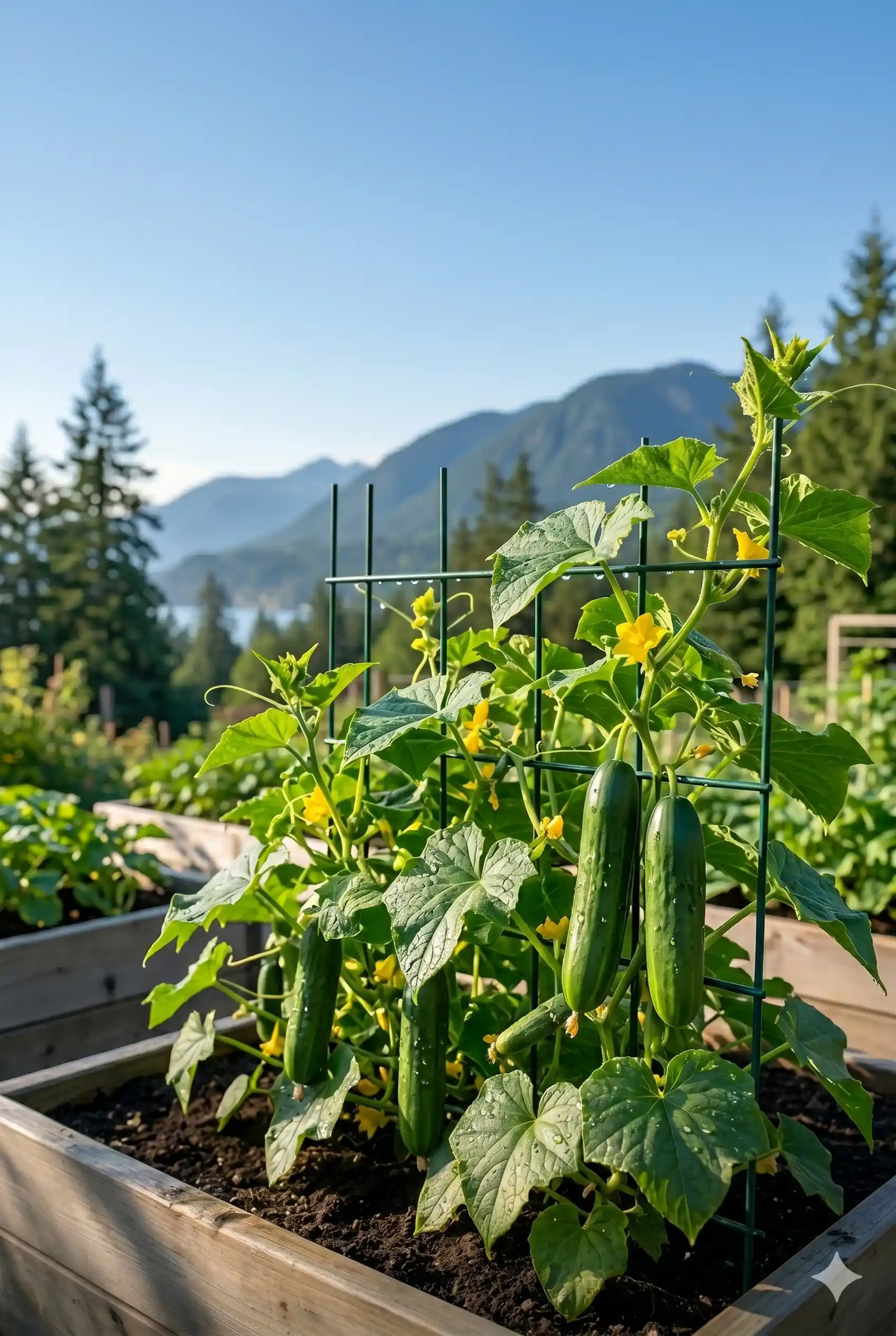
A vining cucumber trained up a 1.5–2 m trellis produces significantly more fruit than the same plant sprawling on the ground. Vertical growth improves airflow (reducing mildew), exposes more leaf surface to sunlight, and makes it nearly impossible to miss a hidden cucumber. In coastal BC and Ontario where space is limited, trellising is essentially mandatory for productive cucumber growing.
Harvesting frequency matters equally. A cucumber left on the vine to overripen signals the plant to divert energy to seed development and slow or stop producing new fruit. At peak season — July and August in most Canadian regions — check plants every 2 days and harvest anything over 15 cm. Remove yellowing or bloated cucumbers immediately even if you can't eat them. The plant doesn't know the difference between a harvested cucumber and one you've thrown in the compost.
Coastal BC tip
Vancouver summers are cool enough to limit cucumber yields compared to Toronto or Ottawa. Grow cucumbers in a cold frame, against a south-facing fence, or under a plastic tunnel to raise ambient temperature. Even a south-facing wall adds 2–3°C of warmth and meaningfully improves yield on the coast.
Container Growing Across Canada
Bush cucumber varieties — Bush Pickle (48 days) and Spacemaster (60 days) — are genuinely productive in containers and work well on balconies and patios across Canada. Use a minimum 20-litre container per plant; 30+ litres is better. Water daily — containers dry out faster than garden beds, and inconsistent watering is the primary cause of bitter cucumbers.
Feed every 2 weeks with a balanced liquid fertilizer (10-10-10 or similar) once flowering begins. Train vining varieties up a stake or small trellis inside the container. Full sun is non-negotiable — cucumbers in partial shade produce poorly and are more prone to mildew. In Vancouver, a south-facing balcony with 6+ hours of direct sun will produce well; a shaded north-facing balcony will not.
Universal Rules for Growing Cucumbers in Canada
Wait for 18°C soil
Cucumbers planted in cold soil rot or sit inert until it warms — you gain nothing by planting early. Use a soil thermometer at 5 cm depth. Don't go by calendar date or air temperature. In Vancouver this means mid-May, not late March when last frost passes.
Biodegradable pots only
Cucumber taproots are extremely sensitive to disturbance. Never bare-root transplant. Always use peat or coir pots and plant the entire pot at transplant time without pulling the plant out. Roots damaged at transplanting stunt the plant for 2–3 weeks — erasing the head start entirely.
Consistent watering
Irregular watering is the primary cause of bitter cucumbers in Canada. Cucumbers need steady moisture through flowering and fruit development. Water deeply 2–3 times per week in beds, daily in containers. Mulch the base to maintain even soil moisture between waterings.
Grow vertically on a trellis
Vining cucumbers on a 1.5–2 m trellis yield more, get better airflow (reducing mildew), and stay easier to harvest. Set up the trellis at planting — retrofitting it later risks disturbing roots. Tie loosely with soft twine as vines develop.
Common Cucumber Problems in Canada
Bitter cucumbers
Caused by cucurbitacin under stress — most often irregular watering. Water consistently and deeply. Mulch to retain moisture. Avoid root disturbance at transplanting. Grow in full sun. Most bitter cucumber complaints in Canada trace back to inconsistent July watering during hot dry spells in Ontario and Quebec.
Poor fruit set
Male flowers appear first and drop off — this is normal. If female flowers (with tiny cucumber at base) appear but don't set fruit, hand pollinate using a brush or by rubbing a male flower into a female. Common in cool, rainy Canadian summers when bees stay home. Particularly frequent in coastal BC in June.
Powdery mildew
White powdery coating appears on older leaves in late summer. Prevention: trellis for airflow, water at the base, full sun, space plants 45–60 cm apart. Treatment: diluted milk spray (1:9) weekly. Remove and bag affected leaves. In coastal BC, choose mildew-resistant varieties (Marketmore 76, Calypso) from the start.
Cucumber beetles
Striped or spotted yellow-and-black beetles that chew leaves and transmit bacterial wilt. Most common in Ontario and Quebec. Prevention: row cover until flowering (remove when flowers appear for pollination), yellow sticky traps, neem oil spray. Inspect undersides of leaves for egg clusters and crush them.
Frequently Asked Questions
When should I plant cucumbers in Canada?
Plant cucumbers outdoors after last frost when soil reaches 18\u00b0C. Victoria: direct sow late April\u2013early May, or transplant from mid-April. Vancouver: direct sow mid-May, or transplant after May 10. Kelowna: direct sow May 1\u201315. Toronto/Windsor: direct sow or transplant May 10\u201320. Ottawa/Montreal: May 24\u2013June 1. Calgary/Edmonton: June 1\u201310. Winnipeg: June 1\u20135. Halifax: May 20\u2013June 1. Cucumbers can be started indoors 3\u20134 weeks before transplant date \u2014 use biodegradable pots as they dislike root disturbance.
Should I direct sow or transplant cucumbers in Canada?
Both work \u2014 choice depends on your zone. Direct sowing is easiest and works well in zones 6b and warmer (Toronto, Vancouver, Kelowna, Windsor) where the season is long enough. Indoor starting (3\u20134 weeks before transplant) gives a head start in short-season zones: Ottawa, Montreal, Calgary, Edmonton, Winnipeg, Halifax, and Prince George. Always use biodegradable pots or soil blocks \u2014 cucumbers have a sensitive taproot that does poorly when disturbed. Transplant pot and all. Never start more than 4 weeks early \u2014 overgrown transplants do poorly.
What are the best cucumber varieties for Canada?
Slicing (for eating fresh): English/Telegraph (55\u201365 days) \u2014 long, thin-skinned, mild; Marketmore 76 (58 days) \u2014 reliable for all Canadian zones, disease-resistant; Straight Eight (58 days) \u2014 classic American slicing cucumber. Pickling: National Pickling (52 days) \u2014 fast, very productive; Calypso (52 days) \u2014 disease-resistant. Bush/compact for small spaces and containers: Bush Pickle (48 days), Spacemaster (60 days). For short-season zones (Prairies, Ottawa): focus on varieties under 60 days. For coastal BC: choose disease-resistant varieties (Marketmore 76, Calypso) to handle cool wet summers.
How do I get more cucumbers per plant in Canada?
Harvest frequently \u2014 every 2 days at peak season. Cucumbers left on the vine signal the plant to stop producing. Remove any yellowing or overripe cucumbers immediately. Grow vertically on a trellis: vining cucumbers trained up a 1.5\u20132 m trellis produce more than sprawling plants, improve airflow, and make harvesting easier. Consistent watering is critical \u2014 irregular watering causes bitter cucumbers and blossom drop. Mulch around the base to retain moisture. In coastal BC and cool summers, growing cucumbers in a cold frame or against a south-facing wall dramatically increases yield.
Why are my cucumbers bitter in Canada?
Bitterness in cucumbers is caused by cucurbitacin, a compound produced under stress. The most common causes in Canadian gardens: irregular watering (the single biggest cause \u2014 cucumbers need consistent moisture); high temperatures above 32\u00b0C during fruit development; root disturbance at transplanting; planting in shade. Prevention: water consistently and deeply (not shallowly and frequently); mulch to retain moisture; grow in full sun. Bitter cucumbers are most common in hot Ontario and Quebec summers with inconsistent rainfall \u2014 install drip irrigation or water on a fixed schedule.
Can I grow cucumbers in containers in Canada?
Yes \u2014 bush varieties are well-suited to container growing. Use containers at least 20 litres per plant; larger is better. Bush Pickle (48 days) and Spacemaster (60 days) are the most productive container varieties. Water daily \u2014 containers dry out faster than beds, and inconsistent watering causes bitter cucumbers. Feed with a balanced liquid fertilizer every 2 weeks once flowering begins. Train vining varieties up a stake or small trellis inside the container. Container cucumbers work well on Vancouver balconies, Toronto patios, and anywhere full sun is available.
What is the difference between slicing and pickling cucumbers?
Slicing cucumbers are bred for eating fresh \u2014 thin skin, mild flavour, longer fruit (20\u201330 cm). They can be pickled but the skin is thinner and the texture softer after processing. Pickling cucumbers are shorter (8\u201312 cm), have thicker, bumpier skin, crisper flesh, and a higher cucurbitacin content that helps them stay firm in brine. Pickling cucumbers are also more productive per plant and faster-maturing (50\u201355 days vs 60\u201370 for slicers). For Canadian gardens where canning is a priority, grow a dedicated pickling variety \u2014 National Pickling and Calypso are the most reliable across all Canadian zones.
Related Guides
Find Exact Dates for Your City
Free calculators — no account required