
Pruning Grape Vines in Canada: When and How
Pruning grape vines in Canada happens once a year, in late winter, and it is mostly about cutting off far more than feels safe. When to do it in your city, how cane and spur pruning differ, and how to shape a young vine over its first three years.
Updated November 2026 · Timing from ECCC 1991–2020 frost dates; method from university extension guides
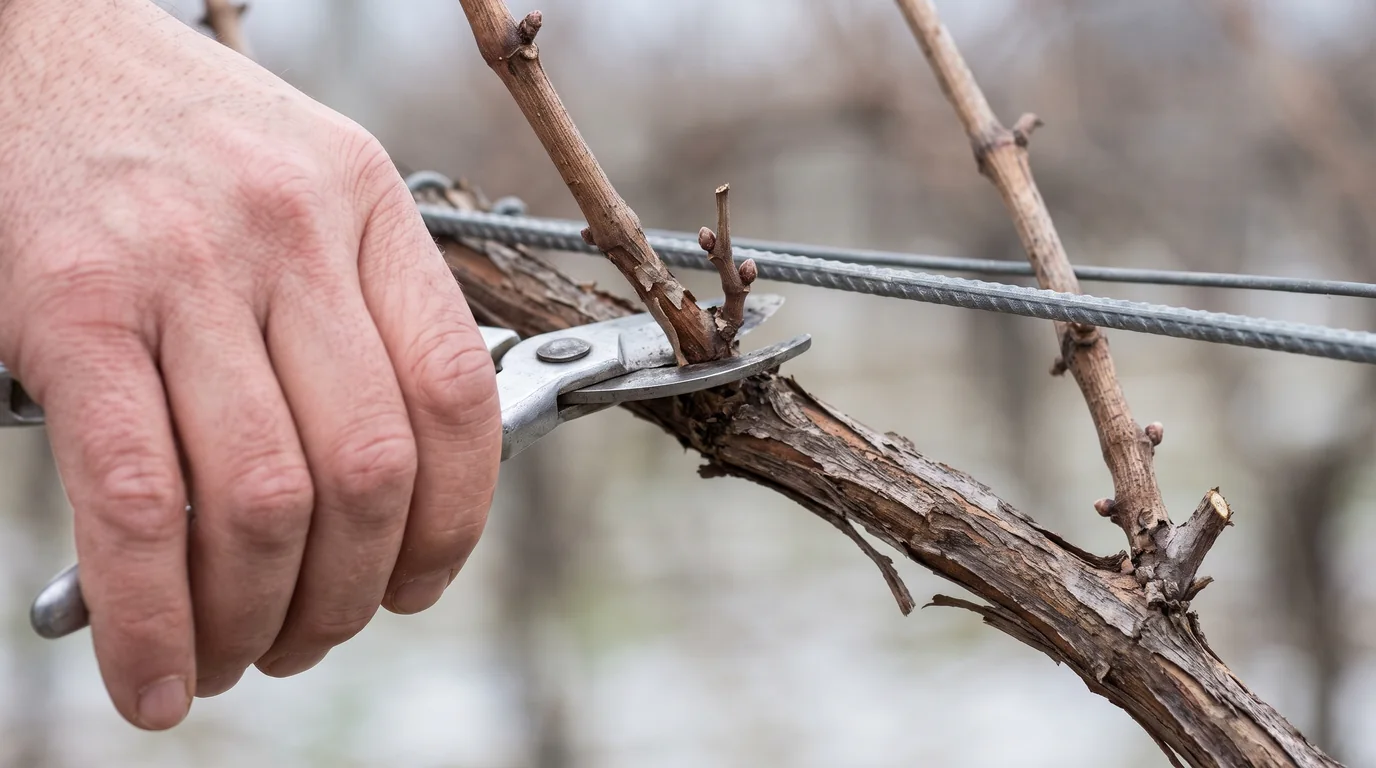
Pruning grape vines in Canada: prune in late winter or early spring while the vine is dormant, after the hardest cold and before the buds swell. Grapes fruit on shoots from last year's canes, so you keep a few healthy one-year canes or spurs and remove the rest — often 80–90% of last season's growth. Cane pruning keeps two to four long canes; spur pruning keeps short two- or three-bud spurs on permanent arms. Sap dripping from the cuts in spring is harmless.
🍇 Still choosing or planting a vine? Growing grapes in Canada covers varieties by zone, trellises and winter protection. For every other plant in the yard, see the Canadian pruning calendar.
When to Prune Grape Vines in Your City
Grapes are pruned while dormant. Prune too early in a cold region and you have no way of knowing which buds the rest of the winter will kill; prune after the buds swell and they knock off easily as you work. So the window is the end of the dormant season. As a rule of thumb it runs from about six weeks to one week before your average last frost, which this table works out for each city from Environment and Climate Change Canada data.
| City | Zone | Prune grapes | Average last frost |
|---|---|---|---|
| Vancouver | 9a | February 12–March 19 | March 26 |
| Victoria | 9a | March 3–April 7 | April 14 |
| Windsor | 7b | March 11–April 15 | April 22 |
| St. Catharines | 7a | March 17–April 21 | April 28 |
| Montréal | 5b | March 18–April 22 | April 29 |
| Toronto | 7a | March 23–April 27 | May 4 |
| Ottawa | 5a | March 26–April 30 | May 7 |
| Halifax | 6b | March 27–May 1 | May 8 |
| Québec City | 5a | March 30–May 4 | May 11 |
| Kelowna | 7a | April 4–May 9 | May 16 |
| Fredericton | 5a | April 4–May 9 | May 16 |
| Saskatoon | 3a | April 10–May 15 | May 22 |
| Edmonton | 4a | April 10–May 15 | May 22 |
| Winnipeg | 3b | April 12–May 17 | May 24 |
| Calgary | 4a | April 14–May 19 | May 26 |
| Regina | 3a | April 16–May 21 | May 28 |
Last frost is the Environment and Climate Change Canada 1991–2020 average (the 50% date); zones are Natural Resources Canada 1991–2020. The pruning window is our rule of thumb from that date, not a measurement. The vine has the final say: once the buds start to swell and show fuzz, finish quickly. Not your city? Find your own dates with the frost date calculator.
What You Are Cutting, and Why So Much
A grape vine fruits on this year's green shoots, and those shoots grow from buds on last year's canes — the smooth, tan, pencil-thick wood that grew last summer. Older wood, with rough shaggy bark, carries no fruitful buds. So the whole job is choosing a few good one-year canes, deciding how many buds to leave on them, and taking away almost everything else.
- Pick canes that grew in the sun, about as thick as a pencil, with buds fairly close together. Thin, shaded canes are weak; very thick, fast-growing "bull canes" are less fruitful and less winter hardy, as the University of Minnesota points out.
- Count buds, not canes. The University of Minnesota Extension suggests about four to six buds for every 30 cm of row on a typical vine, more on a vigorous one. A home vine trained along a 2.4 m wire ends up with roughly 30 to 50 buds.
- Expect to remove 80–90% of last year's growth. An under-pruned vine sets so many bunches that none of them ripens well before the fall frost.
Grape pruning is hundreds of small cuts through tough one-year wood, plus the odd thick cut through an old trunk or arm. A sharp bypass pruner handles the canes and spurs cleanly; the matching lopper does the renewal cuts on old wood. This 2-piece set covers the whole late-winter job on a home vine.
Affiliate link — GrowersGuide.ca may earn a commission on qualifying purchases, at no extra cost to you. See our affiliate disclosure.
Cane Pruning vs Spur Pruning
Cane pruning
Keep two to four one-year canes near the top of the trunk, cut each to 8–15 buds and tie them along the wire. Next to each, leave a renewal spur of two buds; its shoots become next year's canes. Remove everything else, including last year's fruited canes. Suits varieties whose lowest buds are less fruitful, and cold areas where permanent arms get winter-killed.
Spur pruning
Keep two permanent arms (cordons) along the wire. Each winter, cut the canes on them back to spurs of two or three buds, spaced about 15–20 cm apart, and remove the extra canes completely. Simpler to repeat every year once the arms are built, as long as the arms survive your winters.
Cold-hardy hybrids grow differently. Valiant, Beta, Frontenac, Marquette and their relatives tend to send their shoots downward, so in Minnesota and much of Canada they are usually trained high on a single top wire at about 1.5–1.8 m, with arms or canes along that wire and the shoots left to hang. Tender varieties trained low for burying (below) are cane pruned from a short trunk instead.
The First Three Years
- Year 1, at planting: cut the vine back to two or three buds. Let the strongest shoot grow, tie it to a stake as the future trunk and rub off the rest. The roots matter more than top growth this year.
- Year 2, late winter: if the trunk reached the wire, cut it just below the wire; if not, cut it back to a strong bud and grow it again. Through the summer, train two shoots along the wire as arms or canes and remove the shoots lower down on the trunk.
- Years 1 and 2: pick off any flower clusters. A crop this early stunts the vine.
- Year 3, late winter: the first proper prune, cane or spur as above. The vine carries its first real crop this summer.
Established Vines, Step by Step
- Check the buds. In a cold area, slice a few buds across with a sharp knife. Green inside is alive; brown is dead. If many died, keep more buds than usual.
- Take out dead and broken wood and anything growing from below the trunk.
- Remove last year's fruited canes (cane pruning) or the extra canes on the arms (spur pruning).
- Choose and shorten the canes or spurs you are keeping, then count the buds against the guide above.
- Tie canes to the wire loosely before the buds swell, when they still bend without snapping.
- Renew old wood. Every few years, replace an old, unproductive arm or trunk with a strong shoot from lower down.
The University of Minnesota Extension notes that a longer prune, such as four buds per spur instead of two or three, also gives some protection against a late spring frost, because the lowest buds open later. That is worth considering on the Prairies and in frost pockets.
Vines Laid Down and Covered for Winter
Where a variety is not hardy for your zone, the canes are taken off the wire in fall, laid on the ground and covered with soil or straw. If you do this, keep the vine on a short trunk and cane prune it, so there is little permanent wood to bend. In fall, cut away only the obvious excess so the vine is easy to lay down. Do the real pruning in spring, after you uncover it and can see which canes and buds made it through. The simpler answer in zones 3 and 4 is a hardy variety that stays on the wire; see the varieties in growing grapes in Canada and fruit hardiness in hardiest fruit trees and vines for Canada. Not sure of your zone? Use the zone finder.
Common Grape Pruning Mistakes
Leaving too much
The most common one. A vine with hundreds of buds sets more fruit than it can ripen in a short season, and the canopy shades itself. Count buds.
Keeping old wood for fruit
Two-year-old and older wood has no fruitful buds. Fruit comes only from shoots on last year's canes, so a cane that already fruited has done its job.
Pruning in fall or midwinter in a cold region
A vine pruned to its final bud count before the cold has no spare buds if the winter kills some. Wait for late winter and check the buds first.
Worrying about bleeding
Sap dripping from spring cuts looks alarming and does not harm the vine. It is no reason to prune in summer instead.
Grapes are not the only cane fruit with a pruning rule built on the age of the wood. Raspberries and blackberries fruit on second-year canes too: see how to prune raspberries. For apples, pears, cherries, plums and peaches, see when to prune fruit trees in Canada.
Frequently Asked Questions
When should I prune grape vines in Canada?
Prune in late winter or early spring while the vine is fully dormant: after the coldest weather has passed and before the buds start to swell. As a rule of thumb that is from about six weeks to one week before your city's average last frost, which puts it in February or March on the south coast of BC, March or April in southern Ontario and southern Quebec, and April into early May on the Prairies. In cold areas, waiting until late in that window lets you see which buds the winter killed before you decide how many to keep.
Is it bad if my grape vine drips sap after pruning?
No. Grapes often drip sap from fresh cuts in spring once the roots start pushing water up, which is called bleeding. University extension services describe it as harmless to the vine. It is not a reason to move pruning to summer. Pruning earlier in the dormant window simply means fewer drips.
What is the difference between cane pruning and spur pruning?
Both keep one-year-old wood, because that is where the fruit comes from. Cane pruning keeps two to four long canes of last year's growth, each with eight to fifteen buds, tied along the wire, plus a short renewal spur of two buds near the trunk to grow next year's cane. Spur pruning keeps permanent horizontal arms called cordons and cuts each of last year's canes on them back to a short spur of two or three buds. Most cold-hardy hybrid grapes grown in Canada do well with either; varieties whose lowest buds are less fruitful, and vines in areas where cordons get winter-killed, are usually cane pruned.
How much should I cut off a grape vine?
Usually far more than feels right: most home grape vines need 80 to 90 percent of last year's growth removed. The University of Minnesota Extension suggests keeping about four to six buds for each 30 cm of row on a typical vine, and more on a vigorous one. Leaving too many buds gives you a tangle of shoots, small bunches and fruit that ripens late, which is a real problem in a short Canadian season.
How do I prune a young grape vine?
In the first spring after planting, cut the vine back to two or three buds. Let the strongest shoot grow and tie it up a stake as the future trunk; remove the others. In the second winter, cut the trunk back to just below the top wire if it reached it, or to strong wood if it did not. In the second summer, train two arms along the wire. Remove any bunches in the first two years so the roots and trunk get established. The vine carries its first real crop in the third year.
Which grape varieties are hardy in a cold Canadian zone?
Cold-hardy hybrid grapes are the safe choice in zones 3 and 4. Table grapes such as Valiant and Beta and the blue Bluebell are hardy into zone 3, and the hybrids Frontenac and Marquette into zone 4. In zone 5 add Concord and the seedless Somerset Seedless and Reliance. These hardy types can stay on the wire all winter. Tender European grapes are usually only reliable in the mildest parts of southern Ontario and BC.
How do I prune grapes that were winter damaged?
Check the buds before you cut. Slice a few buds across with a sharp knife: a green centre is alive, a brown or black one is dead. If many buds died, leave more buds than usual to make up for it, for example spurs of four buds instead of two. The University of Minnesota Extension also notes that a longer prune helps protect against a late spring frost, because the lowest buds on a longer spur open later. If a whole trunk died back, train a vigorous shoot from the base as a new trunk.
Can I prune grape vines in the fall in Canada?
Do the main pruning in late winter, not in fall. A vine pruned in fall has no extra buds to fall back on if the winter kills some, and the fresh cuts sit open all winter. If you lay tender canes down and cover them for winter, you can cut away the obvious excess in fall so the vine is easier to bend and bury, then do the real pruning in spring once it is uncovered and you can see which buds survived.