
Easiest Vegetables to Grow in Canada — 2026 Beginner Guide
Every crop rated by ease and yield for every Canadian zone — from Vancouver's 250-day season to Calgary's 110-day sprint. First garden picks, balcony crops, short-season choices, and the most common beginner failures fixed.
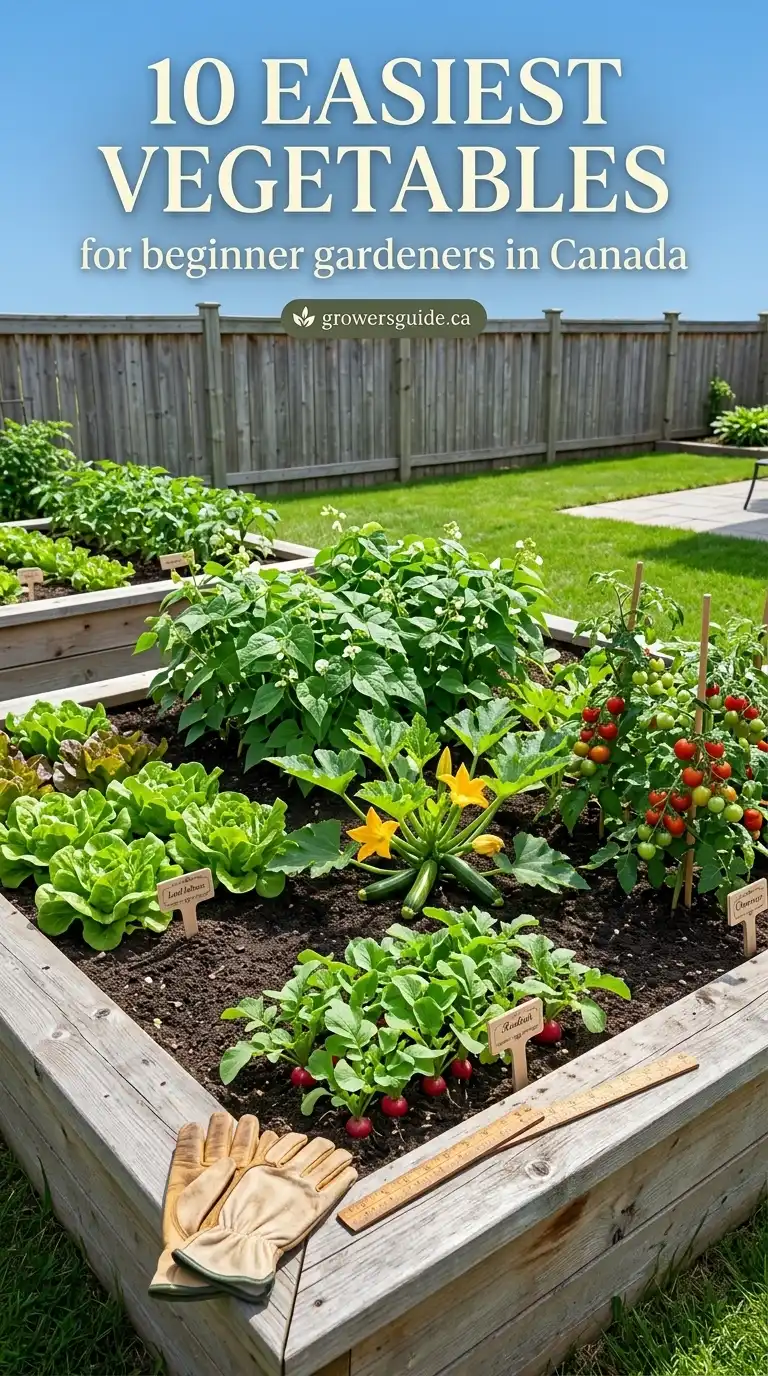
Easiest vegetables to grow in Canada depend almost entirely on where you live. A zucchini that practically grows itself in Toronto's zone 6b season is a real risk in Calgary's zone 3b, where the window from last frost to first frost can be under 110 days. A beefsteak tomato that thrives in Windsor is a disappointment in Ottawa. Most online "easiest vegetables" lists are written for American conditions and don't account for Canadian frost dates, short Prairie seasons, or the cool wet springs of coastal BC. This guide does.
Every crop below is rated on two axes — ease of growing and yield per plant — and flagged for which zones it's genuinely reliable in. There's a fast-track section for complete beginners (five crops, no experience needed), a container/balcony section for urban Canadian gardeners, a preservation guide for short-season zones where everything ripens at once, and a common-failures section for the questions every new Canadian gardener eventually searches for.
Quick zone guide: Vancouver/Victoria (8a): almost everything works. Toronto/Hamilton (6b): full range including melons. Montreal/Ottawa (5a–5b): stick to 75 days or less for heat crops. Quebec City/Calgary (3b–5a): early varieties only, 65 days max for heat crops. Every crop below is flagged accordingly.
5 easiest vegetables for Canadian beginners: Radishes (25–30 days, direct sow April+, almost impossible to fail) · Leaf lettuce (30–45 days, cut-and-come-again, tolerates partial shade) · Bush beans (50 days, direct sow after last frost, no staking or support needed) · Zucchini (50–55 days, prolific, modern varieties are disease-resistant) · Peas (60–70 days, sow before last frost, frost-tolerant seedlings). All five are direct-sow — no greenhouse or indoor starting required.
Your First 5 Crops — Start Here
If you've never grown a vegetable in Canada before, start with these five. They germinate fast, show results quickly, produce heavily with minimal effort, and work in every Canadian zone from Victoria to Halifax. Master these before adding anything else.
1. Radishes — 25 days, the fastest win in Canadian gardening
Radishes germinate in 3–5 days and are ready to eat in 25 days — faster than any other vegetable you can grow. They need nothing: direct sow in early spring as soon as the soil is workable (April in most Canadian cities), thin to 5 cm apart, water occasionally, and pull. Cherry Belle and French Breakfast are the two most reliable Canadian varieties. Sow every two weeks from April through May and again in August for a fall crop. The only failure mode: leaving them in the ground too long — radishes become pithy and hot within days of reaching full size. Pull them promptly.
2. Lettuce — cut-and-come-again harvest from May to November
Loose-leaf lettuce (not head lettuce) is the most space-efficient beginner crop in any Canadian garden. Direct sow or transplant in late April, harvest outer leaves continuously rather than pulling the whole plant, and get multiple cuttings from a single planting. The key technique: cut leaves to 3 cm above the soil — the plant regrows from the base. Buttercrunch and Red Sails are the most heat-tolerant varieties for Canadian summers. When lettuce bolts in July heat (it will), immediately resow for a fall crop that often surpasses the spring one. Works in full ground, raised beds, or any container with 15 cm of soil depth.
3. Bush beans — 50 days, no staking, enormous yield
Bush beans are the highest-yield beginner crop for Canadian summer gardens. Direct sow after last frost when soil is above 15°C — this is the critical rule that most first-year gardeners miss. Beans planted in cold soil rot rather than germinate. Provider (50 days) and Contender (50 days) are the most reliable across all Canadian zones. Sow every 2–3 weeks from late May through early July for continuous harvest. No staking, no trellising, no indoor starts. Inoculate seeds with rhizobium inoculant (available at any Canadian garden centre for a few dollars) to double yields in nitrogen-poor soil. Harvest when pods snap cleanly — before the seeds inside bulge.
4. Zucchini — one plant will feed your whole neighbourhood
Zucchini is the most productive vegetable per plant in any Canadian garden — one Black Beauty plant produces 10–20 kg of fruit over the season. Start 3–4 weeks indoors before transplanting, or direct sow after last frost. The non-negotiable: zucchini needs 6+ hours of direct sun. In shade it grows enormous leaves and produces almost no fruit. Harvest when fruits are 15–20 cm long — do not let them grow to the giant marrow stage, as large fruits stop the plant from setting new ones. In Calgary and Quebec City, choose Black Beauty (50 days from transplant) and transplant in early June. In Toronto and Vancouver, one plant is usually enough — seriously, one plant.
5. Green onions (scallions) — harvest in 30 days, almost impossible to fail
Green onions from sets (small bulbs) are the most foolproof crop for Canadian beginners. Plant sets in early May — pointed end up, 2–3 cm deep, 2–3 cm apart — and harvest as scallions from late May onward, or leave to develop into full storage onions by August. They tolerate light frost, grow in any soil, need no special care, and can be planted densely so even a small raised bed produces a meaningful harvest. A second sowing in July gives green onions through October. For the beginner who wants a guaranteed win in their first season, green onions from sets are it.
First-Season Tips for Canadian Beginner Gardeners
Start smaller than you think
A single 4×8 raised bed or 4–5 m² of in-ground garden is the right size for a first year. Larger gardens require more watering, weeding, and harvesting time than most beginners expect. Success in a small space beats overwhelm in a large one every time.
Buy transplants for slow crops
For tomatoes, peppers, and eggplant — crops that need 8–10 weeks of indoor starting — buy transplants from a garden centre your first year. This removes the hardest part and lets you focus on learning the outdoor growing process.
Mulch from day one
A 5–8 cm layer of straw mulch after planting halves your watering frequency and suppresses most weeds. In a first-year garden, mulch is the single highest-leverage thing you can do. Apply after the soil warms in late May or early June.
Use the finger test, not a schedule
Push a finger 5 cm into the soil: if it feels dry, water deeply. If moist, wait. This beats any "water every X days" rule — it adjusts automatically for temperature, soil type, sun, wind, and plant size. See the full watering guide for how each factor affects your garden.
Ease and Yield Ratings — All Major Canadian Vegetables
Each crop rated 1–3 for ease of growing (3 = almost impossible to fail) and yield per plant or per metre of row (3 = exceptional). Container suitability and zone reliability noted. Days to harvest measured from transplant for started crops, from direct sow for direct-sown crops.
| Vegetable | Days | Ease (/3) | Yield (/3) | Container | Reliable Zones | Key tip |
|---|---|---|---|---|---|---|
| Radishes | 25 | 3/3 | 3/3 | ✅ | All zones | Pull promptly — pith quickly |
| Lettuce (loose-leaf) | 45 | 3/3 | 3/3 | ✅ | All zones | Cut-and-come-again; shade in July |
| Spinach | 40 | 3/3 | 2/3 | ✅ | All zones | Spring and fall only — bolts in July |
| Green onions | 30–40 | 3/3 | 2/3 | ✅ | All zones | Sets not seeds — much easier |
| Bush beans | 50 | 3/3 | 3/3 | ✅ | All zones | Warm soil only — never below 15°C |
| Zucchini | 50 | 2/3 | 3/3 | ⚠️ large pot | All zones | 6+ hrs sun required |
| Peas | 52–65 | 3/3 | 2/3 | ⚠️ deep pot | All zones | Sow as early as April — frost tolerant |
| Kale | 55–65 | 3/3 | 3/3 | ✅ | All zones | Harvest outer leaves; improves after frost |
| Swiss chard | 55–60 | 3/3 | 3/3 | ✅ | All zones | Cut-and-come-again all season |
| Broccoli | 60–70 | 2/3 | 2/3 | ❌ | All zones | Two crops possible in 6a+ zones |
| Carrots | 70–80 | 2/3 | 2/3 | ⚠️ deep pot | All zones | Loose soil essential — fork in clay |
| Beetroot | 55–70 | 3/3 | 2/3 | ✅ | All zones | Greens edible too — zero waste |
| Cucumbers | 55–65 | 2/3 | 3/3 | ⚠️ trellis | All zones | Needs warm soil; harvest often |
| Tomatoes (cherry) | 57–65 | 2/3 | 3/3 | ✅ | All zones | Sungold/Jasper most reliable Canada-wide |
| Tomatoes (slicer) | 70–80 | 1/3 | 2/3 | ⚠️ large pot | 5a+ (70 j); 6b+ (80 j) | Celebrity most reliable across zones |
| Garlic | Oct–July | 3/3 | 3/3 | ✅ | All zones (Music variety) | Plant Oct, harvest July — mostly hands-off |
| Pole beans | 60–70 | 2/3 | 3/3 | ⚠️ trellis | 5a+ zones | Higher yield than bush; needs trellis |
| Potatoes | 65–100 | 2/3 | 3/3 | ⚠️ large bag | All zones (Norland 65 j) | Hill twice; Norland for short seasons |
Find Your City's Exact Planting Dates
Enter your city for precise indoor start and outdoor sow dates for every crop above
🌿 Free Seed Starting CalculatorEasiest Crops by Canadian Zone
The same crop can be "easy" in one Canadian zone and genuinely difficult in another. This section cuts through the noise zone by zone.
Zone 8a — Vancouver, Victoria (250-day season)
Almost every vegetable is easy in zone 8a — the limiting factor is summer heat, not season length. The crops that are uniquely excellent here: peas (cool summers extend production from May to August, 4× longer than anywhere else in Canada); brassicas (broccoli, kale, cabbage — they love the cool damp climate and can be harvested well into November or December); and winter gardening (kale, spinach, carrots in ground, and mâche under a cold frame in January). Zucchini and beans are reliable but not exceptional — the cool July temperatures (22°C) mean they produce adequately but not at the peak volumes seen in Toronto's 27°C summers. Cherry tomatoes (Sungold, Jasper) outperform slicers here; pick early varieties and the sunniest possible spot.
Zone 6b — Toronto, Hamilton, Windsor (197-day season)
Zone 6b is the most forgiving Canadian zone for the widest range of crops. The same list of easy vegetables as everywhere else, plus: beefsteak tomatoes (Brandywine 78 days, Big Beef 73 days — both reliable); San Marzano paste tomatoes (80 days — marginal everywhere else in Canada); melons (Alvaro 68 days with black plastic mulch); and corn (Bodacious 75 days, Peaches & Cream 83 days). Toronto also supports two full broccoli crops (spring and fall), and cucumbers are among the most productive in Canada due to hot summers. If you're in zone 6b and struggling with any of the beginner crops listed above, the issue is almost certainly timing (cold soil in May) or location (not enough sun), not the zone.
Zone 5a–5b — Montreal, Ottawa, Winnipeg (140–155 days)
All five beginner crops work reliably. For tomatoes, stick to 70–75 days maximum — Celebrity (70 days) is the most reliable slicer, Sungold (57 days) the most productive cherry. Beans, zucchini, and cucumbers all thrive in the warm continental summers. Ottawa and Montreal have hot Julys (26°C) that push beans and zucchini into high production. The key adjustments vs zone 6b: no beefsteaks reliably, no San Marzano, no melons in Ottawa/Montreal (marginal at best). Broccoli is excellent — two crops possible with spring and fall plantings. Garlic is outstanding — plant Music variety every October for a July harvest, hands-off all winter. Carrots sweeten beautifully after the first fall frosts.
Zone 3b–5a — Calgary, Quebec City, Saskatoon, Edmonton (110–135 days)
Short-season zones require the most selective crop and variety choices. What's genuinely easy here: all leafy greens and root vegetables (no season length constraint), peas (Sugar Ann 52 days — sow late April, harvest before July heat), garlic (Music variety, autumn planted, the most hands-off crop in any Canadian garden), and zucchini (Black Beauty 50 days from transplant — reliable if planted after June 1). Tomatoes require early varieties only: Stupice (52 days), Sub-Arctic Plenty (45 days), Early Girl (52 days). Anything over 70 days is a gamble. Skip beefsteaks, melons, patates douces, and corn entirely. The payoff of these zones: carrots left in ground past the September frosts are exceptionally sweet, and broccoli harvested in cool fall weather has outstanding flavour.
Balcony and Container Growing — For Urban Canadian Gardeners
A significant portion of Canadian gardeners — particularly in Toronto, Montreal, and Vancouver — only have balcony space. These crops and approaches are specifically suited to container growing on Canadian balconies.
Best balcony crops and container sizes
Cherry tomatoes — Sungold or Tumbling Tom in a 20-litre pot with a 1.2 m stake; the most productive balcony crop by far. Lettuce and spinach — any container 15+ cm deep, cut-and-come-again all season. Radishes — any pot at least 15 cm deep, ready in 25 days, the fastest balcony return. Herbs (basil, chives, parsley, cilantro) — any container, 4+ hours of sun, harvest continuously. Bush beans — a 20-litre pot minimum, no staking, 50 days. Dwarf kale — 20-litre pot, harvests outer leaves continuously from June through October. Green onions — dense sowing in any container, no depth requirement, remarkably productive in small spaces.
Container growing rules for Canadian balconies
Use premium potting mix — never garden soil, which compacts in pots and drains poorly. Containers dry out much faster than ground beds: daily watering is often needed during Canadian July and August heat waves. Fertilise every two weeks with a balanced liquid feed — container soil depletes of nutrients significantly faster than in-ground beds. Above the 4th floor in Canadian cities, wind is a serious concern — choose compact determinate varieties over tall indeterminate ones. Hardening off is as critical for balcony plants as for in-ground ones; moving a greenhouse-grown transplant directly onto a Toronto balcony in early May will cause transplant shock regardless of the temperature outside. Start with a 20-litre pot minimum for any fruiting crop — smaller pots dry out too fast and produce undersized fruit.
What doesn't work on Canadian balconies
Zucchini — needs too much space and produces fruit too large and heavy for most balcony pots above 3rd floor. Corn — needs mass planting for pollination; doesn't work in isolated containers. Large squash (Butternut, Hubbard) — not worth the pot space, sprawls, and produces heavy fruit that strains containers. Potatoes — possible in grow bags but the yield per litre of potting mix is poor; better to use that space for tomatoes or beans. Indeterminate tomatoes above 5th floor — wind regularly snaps the main stems of 1.5 m plants; stick to determinate and semi-determinate varieties on high-rise balconies.
Preserving the Harvest — Essential for Short-Season Canadian Zones
In short-season zones (Calgary, Quebec City, Ottawa), many crops ripen in a compressed window in August and September. The ability to preserve that abundance is the difference between a successful garden that feeds a family for months and one that overflows for three weeks and then ends. These are the most practical preservation approaches for each crop.
Beans — blanch and freeze in 10 minutes
Bush beans freeze perfectly with minimal processing: blanch in boiling water for 2 minutes, cool in ice water for 2 minutes, drain, spread on a baking sheet to freeze individually, then transfer to freezer bags. Frozen beans retain their texture for 12 months and cook from frozen directly into soups, stews, and stir fries. A single 3-metre row of bush beans can produce 4–6 kg of beans over the season — well worth freezing the surplus from any picking that exceeds what you can eat fresh. Succession-sow every 2–3 weeks to spread the harvest and reduce the single-day processing load.
Zucchini — freeze grated for baking, or make relish
Zucchini is too watery to freeze in chunks (it turns to mush), but grated zucchini freezes beautifully for baking — zucchini bread, muffins, and pancakes. Grate, squeeze out moisture in a clean tea towel, pack in 250 ml portions, and freeze. Portion directly into baking recipes from frozen. For the inevitable giant marrow that escapes notice for a week, zucchini relish (similar to pickle relish, excellent with grilled meats) is the best use. Every Canadian zucchini grower eventually discovers this — the plant produces too much for fresh eating alone.
Garlic and onions — cure for 2–3 weeks, store 6–9 months
Garlic and onions harvested in July must be cured before storage — this is the most important post-harvest step and the one most beginners skip. After pulling, lay bulbs in a single layer on slatted racks or hang in bunches in a warm (25–30°C), well-ventilated, dry space for 2–3 weeks. The neck must be completely dry and papery before storage. After curing, trim roots to 1 cm and tops to 2–3 cm. Store in mesh bags or open-weave crates at 0–5°C in darkness — a cool basement, cold room, or unheated garage in most Canadian provinces. Music garlic stores 9 months reliably under these conditions; Chesnok Red stores 5–7 months.
Carrots — leave in ground or store in damp sand
Carrots are the easiest Canadian vegetable to store without any processing. In zones 5a and warmer, carrots can be left in the ground under a layer of straw mulch and pulled through October and into November as needed — they actually sweeten after frost as their starches convert to sugars. For longer storage, pull in October before the ground freezes, remove tops to 1 cm, and layer in a box of slightly damp sand or sawdust in a cold room, unheated garage, or root cellar at 0–2°C. Stored this way, carrots remain crisp and fresh-tasting for 4–6 months — well into February or March in most Canadian provinces.
Tomatoes — sauce, freeze whole, or roast and freeze
Cherry tomatoes are the easiest to preserve: freeze whole on a baking sheet (they don't need blanching), then transfer to freezer bags. Use directly from frozen in sauces, soups, and braises — the skins slip off after thawing. For slicer tomatoes, the simplest approach is roasting: halve, drizzle with olive oil, roast at 375°F for 1 hour, cool, and freeze in containers. Roasted frozen tomatoes are significantly more flavourful in winter cooking than fresh-tasting canned tomatoes. For high-volume sauce making with Roma or San Marzano, a food mill (mouli) is worth the investment — it processes skins and seeds in one pass and is far faster than blanch-and-peel for Canadian-scale harvests.
Harder Than They Look — What to Avoid Your First Season
These crops are not impossible, but they're significantly more demanding than most gardening content suggests. Save them for year two once you have a season of successes behind you.
🍅 Tomatoes — More Demanding Than Advertised
Tomatoes need 6–8 weeks of indoor starting, careful hardening off over 7–10 days, staking or caging, regular deep watering, disease management (blight is prevalent across Ontario, Quebec, and the Maritimes), and pruning of indeterminate varieties. A first-year gardener who buys a transplant from the garden centre succeeds most of the time — but starting from seed in a first-year garden is genuinely difficult. Buy transplants year one; grow from seed year two.
🥕 Carrots — Only Easy in the Right Soil
Carrots need deep, loose, stone-free soil to grow straight roots. In clay-heavy soils (common in Prairie and Atlantic Canada gardens), they fork and distort. Germination is slow (10–21 days) and the surface must stay moist continuously — a crust forming on the soil prevents emergence entirely. Round varieties like Parisian and Thumbelina are easier in challenging soils. Save long Nantes types for well-amended established beds.
🌽 Corn — Needs More Space Than Most Gardens Have
Corn is wind-pollinated and must be grown in a block of at least 4×4 plants (16 plants minimum) for ears to set properly. A single row produces nothing edible. It also occupies 70–90 days of prime growing space and produces only one ear per plant. For most Canadian home gardens, corn takes too much space for too little return — grow beans, zucchini, or tomatoes in the same space instead.
🧅 Onions from Seed — Very Slow, Easy to Lose
Onions from seed need 10–12 weeks of indoor starting in January or February — longer than any other vegetable. The seedlings are thin grass-like threads that dry out quickly, need precise light, and are easy to accidentally kill. Onion sets (small dried bulbs sold at garden centres in spring) are dramatically easier and mature in 70–90 days. Buy sets for your first few seasons, not seeds.
Common Beginner Failures — and How to Fix Them
Beans that rot in the ground instead of germinating
The cause is almost always cold soil. Beans need soil at 15°C minimum to germinate reliably — below that, the seeds sit in cold damp soil and rot within 1–2 weeks. This is the single most common first-year failure across Canada. Fix: buy a $15 soil thermometer (available at any Canadian Tire or garden centre) and check the actual soil temperature before sowing. In Toronto, soil reaches 15°C around May 15–20; in Ottawa, May 25–30; in Calgary, June 5–10. Waiting 2 weeks longer than you think you need to is almost always the right call for beans. If you planted too early and beans rotted, resow immediately — there's still time for two full crops in most Canadian zones.
Zucchini with lots of flowers but no fruit
Two causes: insufficient sun or all male flowers. Zucchini produces male flowers first (no tiny fruit at the base), followed by female flowers (tiny fruit at the base) a week or two later. Early-season flower drop of male flowers is completely normal — the plant isn't failing. Wait for female flowers to appear and confirm bees are visiting. If the garden receives less than 5–6 hours of direct sun, zucchini grows abundant foliage but produces minimal fruit regardless of how well you fertilise or water — this is a light problem, not a nutrient problem. Move pots to maximum sun exposure or reassign the sunniest bed to zucchini.
Forked, stubby, or hairy carrots
Forked carrots hit an obstruction — stone, hard clod, or compacted sub-soil — and split to grow around it. Stubby carrots ran out of loose soil depth. Hairy carrots were stressed by inconsistent watering or nitrogen-heavy soil applied too recently. The fix for all three is the same: a dedicated, deeply loosened carrot bed. Loosen soil to 30 cm, remove all stones and large clods, amend with sand and mature compost (not fresh manure), and water consistently. In clay-heavy Canadian soils (common in Montreal, Ottawa, and the Prairies), raised beds filled with a custom mix are far more reliable than clay in-ground for carrots — the loose texture allows the root to grow straight and long.
Lettuce that goes bitter and bolts in July
Lettuce bolts (sends up a flower stalk and turns bitter) when daytime temperatures consistently exceed 24°C — which happens throughout July in Toronto, Montreal, Ottawa, and Calgary. This is not a failure; it's a predictable response to heat. The fix is succession planting: sow a new row every 2–3 weeks from April through June so that no single planting is at peak maturity during the July heat peak. When bolting starts, pull the plants, compost them, and sow immediately for a fall crop. Fall lettuce in Canada is often the best lettuce of the year — cooler temperatures, less pest pressure, and longer shelf life on the plant. A 40% shade cloth suspended over the bed reduces soil temperature enough to extend spring sowings by 2–3 weeks.
Tomato transplants that stall for weeks after being moved outside
Stalled tomatoes after transplanting almost always indicate cold soil, insufficient hardening off, or both. A tomato planted into soil below 15°C stops growing completely — the roots cannot function at that temperature. Accompanying symptom: purple discolouration on leaf undersides (phosphorus uptake blocked by cold). The other cause: moving a greenhouse-grown transplant directly outside into May conditions without a 7–10 day hardening-off period. The fix: check soil temperature with a thermometer before transplanting; harden off for a minimum of 7 days by placing plants outside for increasing periods; and transplant on a calm, overcast day to reduce moisture stress during establishment. A plant transplanted May 28 into 18°C soil will surpass one transplanted May 10 into 12°C soil by mid-June.
Peas that produce for only 2 weeks then die
Peas are a cool-season crop that shuts down production when temperatures consistently exceed 24°C. In Toronto and Montreal, that means production ends around early to mid-July regardless of when you planted. This is normal and unavoidable — it's not a disease or watering problem. The fix is to sow as early as possible (April in most Canadian zones — peas germinate at 4°C and tolerate frost) so that the peak production window falls in June when temperatures are ideal, not late July when heat has already ended the season. A second sowing in late July produces a fall crop that avoids the heat entirely. In Vancouver, peas produce from May through August thanks to the cool coastal summers — the longest pea season in Canada.
Three Sisters and Companion Planting — What to Grow Together
Companion planting reduces pest pressure, improves yields, and makes better use of space. These are the most practical combinations for Canadian gardens — not the overpromised associations that fill most gardening books, but the pairings with actual evidence behind them.
Three Sisters — corn, beans, and squash
The Three Sisters is a traditional Indigenous polyculture that works genuinely well in Canadian zone 6b and warmer. Corn provides a trellis for pole beans; beans fix atmospheric nitrogen that feeds corn and squash; squash's large leaves shade the soil, retaining moisture and suppressing weeds. Plant corn first in blocks (minimum 4×4 for pollination), add beans 2 weeks later around corn stalks, and plant squash in the gaps another week later. The system requires at least a 4×4 m bed to work properly and is not suited to zone 5a or colder where corn needs full season length. In Calgary and Quebec City, skip the Three Sisters — corn doesn't mature reliably and the timing is too tight.
Tomatoes and basil
Growing basil alongside tomatoes is the most practical companion pairing for Canadian gardens — both need warm soil, transplant at the same time, and thrive under similar conditions. Some evidence suggests basil repels aphids and whitefly from tomato plants; the clearer benefit is that basil and tomatoes harvested together from the same bed need no coordination. Plant basil 30–40 cm from tomato stems so it doesn't compete for root space. Do not let basil flower — pinch flower buds continuously through the season to keep leaves productive. Basil is extremely frost-sensitive; in Calgary and Quebec City, protect it on cool nights in June with a cloche or bring pots inside.
Carrots and onions — the classic interplanting
Onions and carrots interplanted in alternating rows is a traditional companion pairing — onion scent is thought to confuse carrot fly (Psila rosae), a common pest in Eastern Canadian gardens that lays eggs at carrot crown level. The practical benefit of interplanting is also space efficiency: carrots and onions have very different root depths and canopy heights, so they don't compete significantly. Sow carrots in rows 15 cm apart, with onion sets planted in the gaps. Both crops are harvested at similar times (late summer to fall), which simplifies bed management.
Frequently Asked Questions
What are the easiest vegetables to grow in Canada for beginners?
Radishes (25 days, germinate in 3–5 days), loose-leaf lettuce (cut-and-come-again), green onions from sets (almost impossible to fail), bush beans (50 days, no staking), and zucchini (50 days, one plant feeds a family). All five work in every Canadian zone. Start with these before adding tomatoes, peppers, or cucumbers — they build confidence fast and produce real harvests in your first season.
What is the most productive vegetable for a small Canadian garden?
Zucchini produces the most food per plant (10–20 kg per season from one plant), but cherry tomatoes like Sungold produce the most food per square foot over the longest period — continuously from July through October. Garlic is the most hands-off high-value crop: planted in October, left all winter, and harvested in July with almost no active effort. For a balcony with limited space, cherry tomatoes are the highest-value crop by a significant margin.
Can I grow vegetables on a Canadian apartment balcony?
Yes — cherry tomatoes (Sungold in a 20L pot), lettuce, green onions, radishes, bush beans, herbs, and kale all grow well on Canadian apartment balconies with 4+ hours of direct sun. Use premium potting mix and water daily in July and August. Above the 4th floor, choose compact determinate varieties — wind damages tall indeterminate plants. Hardening off is still required: never move greenhouse-bought transplants directly onto a balcony in May without a 7–10 day acclimatisation period.
What vegetables can I grow in Calgary or Quebec City with a short season?
All root vegetables and leafy greens (no season length constraint), peas (Sugar Ann 52 days, sow late April), garlic (Music variety, autumn planted), zucchini (Black Beauty 50 days, plant after June 1), bush beans (Provider 50 days), broccoli (Green Magic 60 days), and cherry tomatoes (Stupice 52 days, Sungold 57 days, Early Girl 57 days). Avoid melons, beefsteak tomatoes, corn, and any crop over 70–75 days. Every day counts in a 110–130 day season — plant on time, use warm soil, and don't skip hardening off.
Why did my beans fail in my first Canadian garden?
Almost certainly cold soil. Beans planted in soil below 15°C rot rather than germinate — this is the most common first-year Canadian gardening failure. Check soil temperature with a thermometer before sowing: Toronto needs to wait until around May 20, Ottawa until May 28, Calgary until June 5–10. Resow immediately if your first attempt rotted — there's still time. Succession-sow every 3 weeks through early July for a continuous harvest.
What is the easiest way to preserve a Canadian vegetable harvest?
Beans: blanch 2 minutes, freeze. Zucchini: grate, squeeze dry, freeze in 250 ml portions for baking. Garlic and onions: cure 2–3 weeks in warm dry air, store in mesh bags at 0–5°C (9 months for Music garlic). Carrots: leave in ground under straw mulch through October, or store in damp sand in a cold room. Cherry tomatoes: freeze whole on a baking sheet, then bag. The preservation step is what converts a summer abundance into a winter food supply — especially important in short-season zones where everything ripens in a compressed August–September window.