
Cast Iron Plant Care Guide — Canada
How to grow the cast iron plant (Aspidistra elatior) in Canadian homes — the toughest, lowest-light, most forgiving houseplant. Pet-safe, drought-tolerant, and capable of thriving in dim corners where everything else gives up.
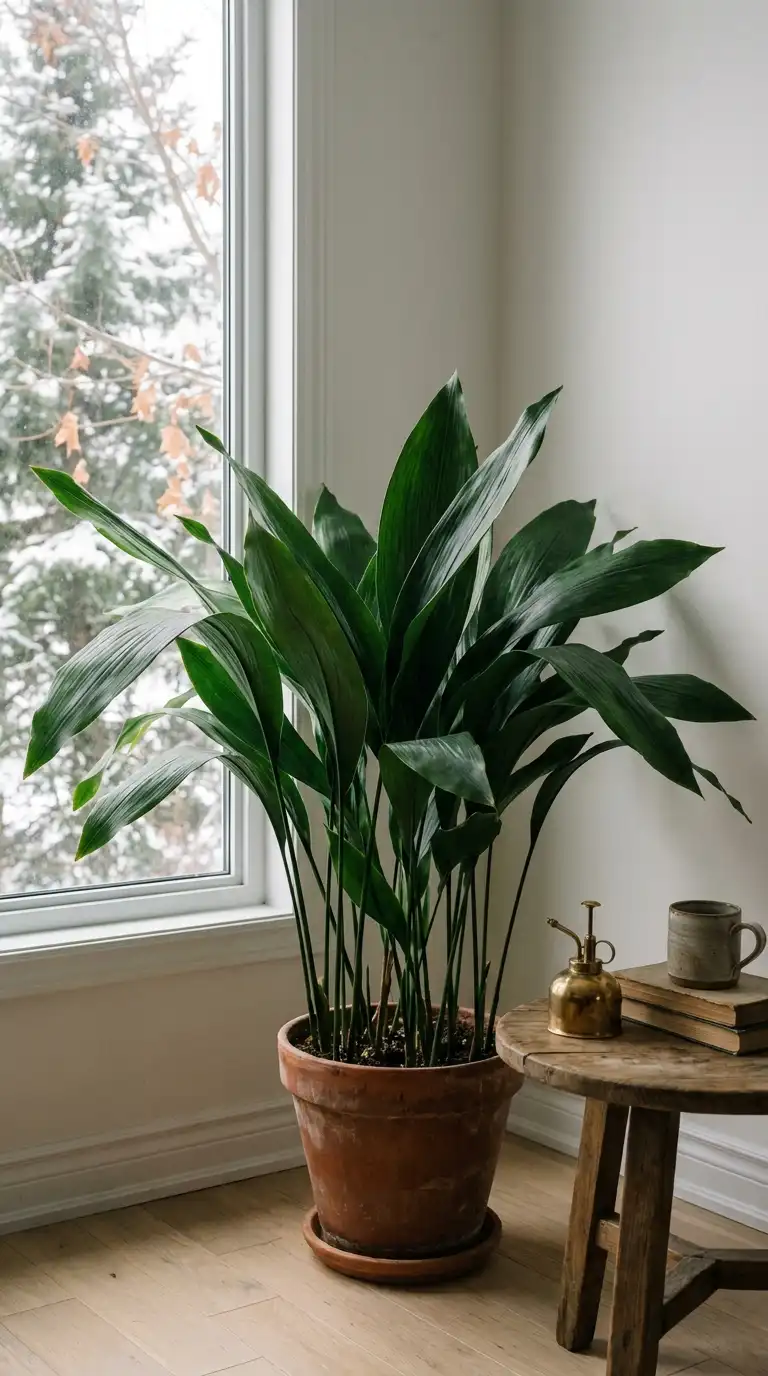
Cast iron plant earned its name in Victorian parlours, where it survived gas lamps, coal smoke, and weeks between dustings — conditions that killed everything else on the windowsill. That toughness is still its defining feature. Of all the common houseplants, it tolerates the lowest light, the longest droughts, and the most neglect — while staying glossy, dark green, and pet-safe. The trade-off is its pace: cast iron plant grows extremely slowly. A specimen that fills a 30 cm pot took its grower five years to produce.
This guide covers the full cast iron plant care routine for Canadian homes — the watering it actually wants (not much), why low light is genuinely fine, how to propagate by dividing the rhizome, and the few troubleshooting issues that ever come up.
Cast iron plant at a glance: Water — when top half of soil is dry. Light — low to medium indirect; tolerates dim corners. Humidity — average is fine. Yellow leaves — overwatering. Pet safe — yes, non-toxic to cats and dogs ✅
Is your Cast Iron Plant getting enough light this winter?
A Canadian winter cuts daylight roughly in half. See what your city actually gets this month, and whether a grow light is needed.
🌿 Cast Iron Plant Quick Care Card
How to Water a Cast Iron Plant in Canada
Cast iron plant grows from a thick underground rhizome that stores water, which is the secret to its drought tolerance. The plant is forgiving of forgetfulness and intolerant of fussing — watering on a fixed weekly schedule is the most common way to kill it. The rule: water when the top half of the soil has dried out. In a low-light spot in winter this can be three to four weeks between waterings; in a brighter spot in summer it might be ten days.
Cast iron plant watering schedule — Canada: Summer (May–Sept): every 10–14 days. Fall (Oct–Nov): every 17–24 days. Winter (Dec–Feb): every 21–30 days. Spring (Mar–Apr): every 14–20 days. Always confirm the top half is dry first. Use room-temperature water; empty the saucer after 30 minutes.
Cast iron plant rots from chronic overwatering. A 3-in-1 soil meter takes the guesswork out — push the probe into the root zone and the dial tells you whether the pot is wet, moist, or dry. No batteries needed.
Affiliate link — GrowersGuide.ca may earn a commission on qualifying purchases, at no extra cost to you. Learn more.
The other thing Canadian houseplants run short on all winter is light. From November to March most homes are too dim to keep plants growing — leaves stretch toward the window, variegation fades, and new growth stalls. A small full-spectrum LED grow light on a timer bridges the dark months, even for tough low-light plants that only survive (rather than grow) in a dim room.
Affiliate link — GrowersGuide.ca may earn a commission on qualifying purchases, at no extra cost to you. Learn more.
Is Cast Iron Plant Safe for Cats and Dogs?
Yes — cast iron plant is non-toxic to both cats and dogs. Aspidistra elatior appears on the ASPCA’s non-toxic list, so a chewed leaf is not a poisoning risk. That makes it one of the very few plants that is both pet-safe and genuinely happy in a dark corner — most low-light standbys are not: pothos, philodendron, peace lily, ZZ plant, dieffenbachia and snake plant are all toxic to some degree.
Non-toxic is not the same as edible. A cat that eats a mouthful of any plant can still vomit from the fibre alone, and the stiff leathery leaves are unpleasant enough that most pets try once and lose interest. The practical reason it suits pet households is different anyway: it is heavy, slow and low-slung, so a cat that jumps at it tends to bounce off rather than shred it — unlike a trailing pothos, which reads as a toy.
Light — The Lowest-Light Houseplant There Is
Cast iron plant is the rare houseplant that genuinely thrives in low light. It evolved on the floor of Japanese forests, in shade so deep that other plants couldn't compete. In a Canadian home that means it can live in a north-facing window, a dim corner several metres from any window, or even a hallway with no direct daylight — conditions that would kill snake plants and ZZ plants over time. The only catch is the slow growth: in low light, expect one or two new leaves a year.
Low light — fine
North window, dim corner, hallway. Plant stays healthy; growth is very slow.
Medium indirect — best
East window or a few metres back from a south or west one. Faster growth, glossier leaves.
Direct sun — avoid
Bleaches and scorches leaves. Even brief midday sun causes pale patches. Filter or move.
Cast Iron Plant Varieties in Canada
Plain Aspidistra elatior is the most common — deep glossy green strap-shaped leaves. Variegated and spotted cultivars exist and turn up at specialty nurseries, but they need brighter (medium indirect) light to keep their markings.
| Variety | Look | Notes |
|---|---|---|
| Aspidistra elatior (plain) | Glossy deep-green strap leaves, 40–60 cm long | The classic Victorian parlour plant; toughest of all |
| 'Variegata' | Bold cream-white vertical stripes through green leaves | Wants medium indirect light to hold the stripes |
| 'Milky Way' | Deep green leaves splashed with small white star-like spots | Striking; harder to find in Canada |
| 'Asahi' | Upper third of each leaf is cream-white, lower two-thirds green | Unusual two-tone effect; very collectible |
| 'Lennon's Song' | Yellow-cream vertical stripes on bright green | Compact form; specialty nurseries only |
Finding One to Buy in Canada
Cast iron plant is uncommon on big-box garden-centre benches in Canada, and the reason is the same one that makes it expensive: it grows too slowly to be profitable as mass nursery stock. A saleable specimen takes years, so most of what reaches Canadian shelves arrives in small numbers through independent plant shops, or by special order from a garden centre that will bring one in on request — worth asking, because staff often can.
Two things worth knowing before you pay. Buy the small one. A large plant costs several times more and will not grow appreciably faster once home — you are paying for the grower’s years, and you would spend the same years yourself either way. And check the crown, not the leaves. Cast iron plant grows from a rhizome at soil level; leaves can look immaculate on a plant whose rhizome has been sitting wet. Firm rhizome, no sour smell, a few new spears coming up: that is a healthy one.
How to Propagate by Division
Division is the only way to propagate cast iron plant — leaf and stem cuttings do not work. Best done in spring at repotting time, every 3–5 years.
1. Unpot and clean the rhizome
Tip the plant out and gently brush soil away from the thick, finger-like rhizome under the leaves. You will see distinct clumps of leaves emerging from joined sections of rhizome.
2. Cut between growing points
Using a clean, sharp knife, slice through the rhizome between leaf clusters, making sure each division has at least 2–3 leaves and a section of rhizome with some roots attached. Let the cut surfaces air-dry for an hour to callus.
3. Pot each division
Pot each piece in fresh, well-draining indoor mix at the same depth as before. Water lightly — just enough to settle the soil — and place in medium indirect light. Each division re-establishes slowly; do not expect new leaves for several months.
Aftercare
Keep divisions warm, in indirect light, and on the drier side until you see new growth. Do not fertilise for the first 6 months. Once a division is clearly established, treat it like a mature plant. This is the only propagation method; cuttings will not root.
Canadian Winter Care
Water much less from November to February
A cast iron plant in a dim winter spot can comfortably go three to four weeks between waterings. The biggest mistake is sticking to a summer schedule and rotting the rhizome. Stop fertilising October through February.
Cold tolerance is unusual for a houseplant
Cast iron plant tolerates temperatures as low as 5–10°C without damage — useful for cool entryways, unheated mudrooms, or windowsill spots that get a chill. It will survive frost-free conditions where most tropicals collapse. Avoid sub-zero exposure; the leaves freeze.
Dust the leaves occasionally
In low-light spots, dust accumulation on the broad leaves further reduces the light the plant can use. A damp cloth wipe every couple of months keeps the leaves glossy and helps the plant photosynthesise in a dim corner.
Cast Iron Plant Troubleshooting
Yellow leaves
Almost always overwatering — the rhizome is rotting. Stop watering, unpot, trim away any mushy black rhizome with clean shears, and repot the healthy part in fresh, dry-side mix.
Brown crispy leaf tips
Salt build-up from tap water or fertilizer burn. Flush the soil thoroughly with plain water every few months, dilute fertilizer more, and in hard-water cities (Calgary, Regina, Saskatoon) consider using filtered or rainwater.
Bleached or pale patches on leaves
Direct sun damage. Move out of the path of any direct rays, even brief ones, and the new leaves will come back fully green. Damaged leaves do not recover but can be trimmed.
No new growth at all
Cast iron plant is genuinely slow — a leaf or two a year in low light is normal. If you want faster growth, move it to brighter indirect light. If it hasn't grown at all in a year, check that the rhizome is firm; a soft rhizome means rot.
Spider mites in dry winter air
Rare on cast iron plant but possible — look for fine webbing on leaf undersides. Rinse leaves in the shower and treat with insecticidal soap weekly until clear.
Frequently Asked Questions
Is cast iron plant the same as ZZ plant or snake plant?
No — all three are tough, low-light tolerant plants, but they are different species in different families. Cast iron plant (Aspidistra) has broad glossy strap leaves and is pet-safe. Snake plant (Sansevieria) has stiff upright sword leaves and is mildly toxic to pets. ZZ plant (Zamioculcas) has shiny pinnate leaves and is also toxic to pets. If you need a truly low-light pet-safe plant, cast iron is the one.
Why is cast iron plant so expensive?
Because it grows extremely slowly. Producing a 30 cm pot of mature cast iron plant takes a commercial grower four to five years — far longer than fast-growing tropicals like pothos. The cost reflects the bench time. A small cast iron plant is a much cheaper buy and will fill out over years; a large specimen is a real investment.
Does cast iron plant flower?
Yes — rarely. Mature plants occasionally produce small, fleshy purple-brown flowers right at soil level, hidden under the leaves. In their native Japanese forests the flowers are pollinated by ground-level invertebrates; indoors they go unpollinated and unnoticed. The plant is grown entirely for its foliage.
When should I repot a cast iron plant?
Every 3–5 years in spring — cast iron plant actively prefers to be pot-bound and grows better in a snug pot than a roomy one. Repot only when roots are visibly bursting from the drainage holes or pushing the soil surface up. Move up just one pot size, into fresh well-draining mix. Repotting is the natural moment to divide the rhizome if you want more plants.
Can I grow cast iron plant outdoors in Canada?
Only seasonally. Cast iron plant is hardy to roughly USDA zone 7 — meaning it survives outdoors year-round only in coastal BC (Victoria, Vancouver, Sidney). Everywhere else it is a houseplant or a summer container plant brought indoors before frost. In coastal BC it makes an excellent shade-garden groundcover under trees, exactly as it does in Japan.
How often should I water a cast iron plant in Canada?
Water a cast iron plant when the top half of the soil has dried out — typically every 10–14 days in summer and every 21–30 days in a Canadian winter. The fleshy underground rhizome stores water, so this is one of the most drought-tolerant common houseplants — underwatering is rarely a problem. Overwatering is the one reliable way to kill it. Water thoroughly until it drains, empty the saucer, and let the soil dry well before watering again. In low-light spots the soil dries very slowly; always check by touch rather than following a schedule. Use room-temperature water.
Will a cast iron plant survive in low light?
Yes — this is the plant's defining quality, and the reason it was a Victorian parlour staple before electric lighting. Cast iron plant tolerates lower light than almost any other houseplant, including snake plant and ZZ plant. It grows happily in a north-facing window, a dim corner several metres from any window, or a hallway with no direct daylight at all. Growth in low light is slow (one or two new leaves a year), but the plant stays healthy. For faster growth, move it to medium indirect light. The only light it cannot tolerate is direct sun — even brief midday sun scorches and bleaches the leaves.
Is cast iron plant safe for cats and dogs?
Yes — cast iron plant (Aspidistra elatior) is non-toxic to both cats and dogs according to the ASPCA. A pet that chews a leaf will not be poisoned. As with any plant, eating a large amount can cause mild stomach upset simply from the fibre, but there are no toxic compounds. Cast iron plant is one of the rare houseplants that ticks every safety box: pet-safe, child-safe, and low-light tolerant. It pairs particularly well with pet-safe parlour palm, peperomia, and prayer plant in dim corners where most other plants struggle.
How fast does a cast iron plant grow indoors in Canada?
Slowly — one of the slowest common houseplants. A healthy plant in medium indirect light typically pushes only 2–5 new leaves a year, each unfurling from the soil over several weeks. In low light it may add just one leaf annually. This is part of why cast iron plant lasts so long: it does not stress, does not crowd its pot, and does not require constant adjustment. A specimen plant can live in the same pot for 10+ years. The slow growth means it is also a relatively expensive houseplant to buy at full size — growers spend years producing each one.
How do I propagate a cast iron plant?
By division at repotting time, in spring. Cast iron plant grows from a thick underground rhizome that slowly extends sideways; over years it produces multiple growing points connected by the rhizome. To divide, unpot the plant, brush soil from the rhizome, and use clean shears or a sharp knife to cut through the rhizome between growing points, leaving at least 2–3 leaves per division. Pot each piece in fresh, well-draining mix at the same depth. Water lightly and keep in medium indirect light. Each division re-establishes slowly — expect little new growth in the first year — but the divisions all survive. Stem and leaf cuttings do not work for this plant; division is the only method.
Why are the leaves on my cast iron plant turning yellow or brown?
Yellow leaves on a cast iron plant almost always mean overwatering. The rhizome is rotting and the leaves are dying back in response — check the soil, let it dry out fully, and reduce watering. Brown crispy leaf tips usually mean salt build-up from tap water (especially in hard-water cities like Calgary) or fertilizer burn; flush the soil thoroughly every few months and dilute fertilizer more. Sudden bleached white patches mean the plant has been moved into direct sun — relocate to indirect light. Brown spots with yellow halos suggest fungal leaf spot from leaves staying wet; water at the soil only and improve airflow.
🐾 Have pets? Cast iron plant is one of the safe ones — see our Pet-Safe Houseplants guide for the full list of which common houseplants are toxic to cats and dogs, and which are safe.
📖 More Houseplant Guides
Other tough, pet-safe, low-light tolerant plants for Canadian homes.
Also Growing Vegetables?
Free planting calendars for 30+ vegetables across every major Canadian city.