
Oiseau du Paradis — Entretien et Lumière au Canada
Comment cultiver et entretenir l'oiseau du paradis (Strelitzia nicolai et Strelitzia reginae) dans les foyers canadiens — lumière, arrosage, pourquoi les feuilles se fendent (normal!), attentes de floraison intérieure et soins hivernaux.
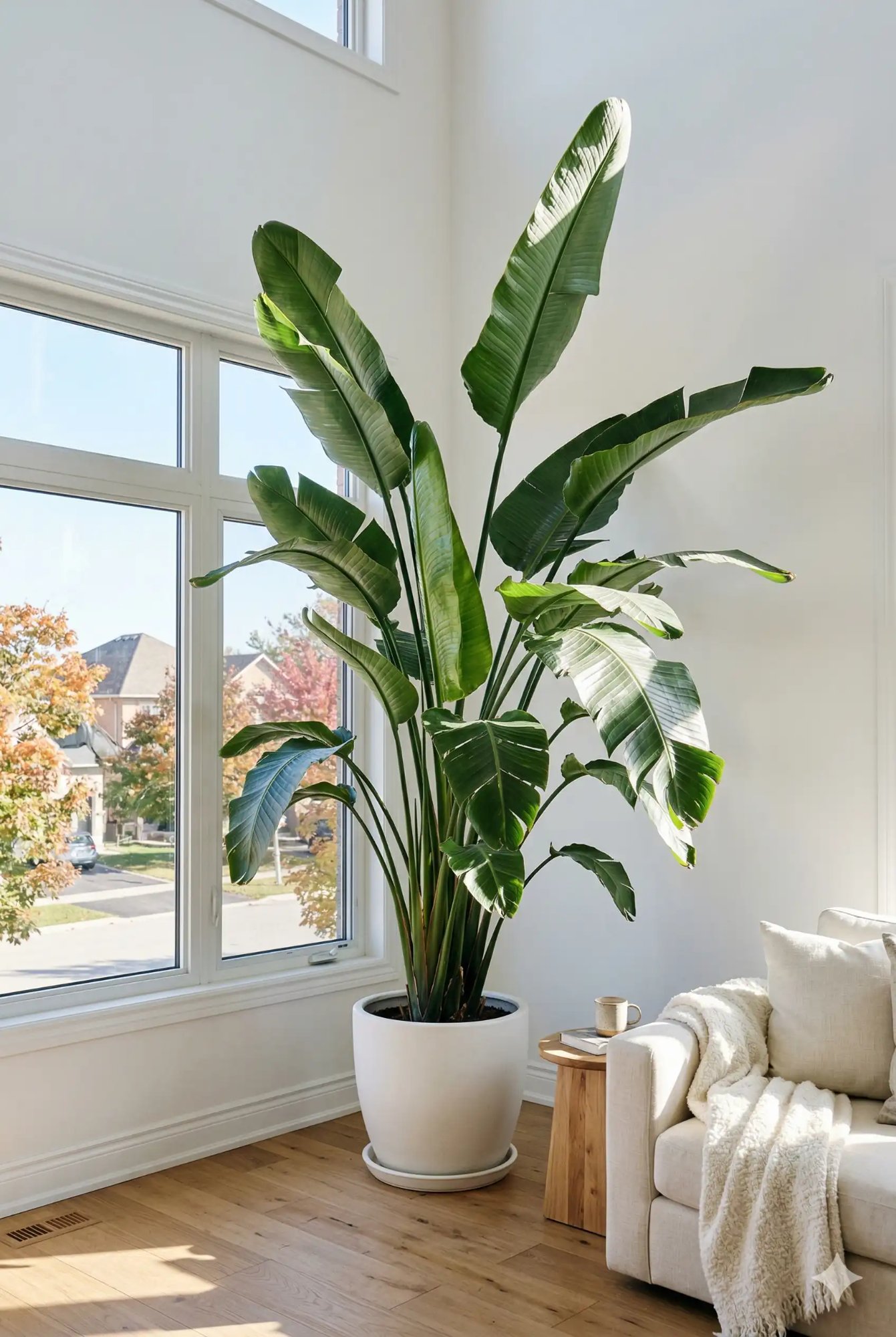
L'oiseau du paradis (Strelitzia) est l'une des plantes d'intérieur les plus dramatiques que vous puissiez cultiver au Canada — grandes feuilles tropicales en pagaie, présence sculpturale qui transforme un espace. Mais c'est une plante qui exige beaucoup de lumière, et au Canada cela limite sérieusement où elle peut prospérer.
Ce guide couvre tout ce qui est spécifique à la culture de l'oiseau du paradis dans un foyer canadien — différence entre les deux variétés courantes (nicolai géant vs reginae plus petit), pourquoi les feuilles fendues sont normales (et désirables), attentes réalistes pour la floraison intérieure (rare!), et soins hivernaux.
Votre plante reçoit-elle assez de lumière cet hiver ?
Un hiver canadien coupe les heures d'ensoleillement de moitié. Voyez ce que votre ville reçoit ce mois-ci et si une lampe de croissance est nécessaire.
Deux variétés — sachez laquelle vous avez
Strelitzia nicolai — Géant blanc
Variété la plus courante en pépinière. Atteint 2-3 m à l'intérieur. Cultivée pour ses grandes feuilles fendues (les fentes sont normales et désirables). Fleurit presque jamais à l'intérieur — fleurs blanches sur tiges noires si jamais. Choisissez si vous voulez le drame des feuilles.
Strelitzia reginae — Plus petit orange
Atteint 1-1,5 m. Cultivée pour les fleurs orange iconiques en forme d'oiseau (la "vraie" fleur d'oiseau du paradis). Floraison intérieure POSSIBLE au Canada avec fenêtre sud + soleil direct intense + 3-5 ans de maturité. Choisissez si vous visez les fleurs.
L'oiseau du paradis est-il toxique pour les animaux ?
Oui — l'oiseau du paradis est toxique aux chats et chiens. L'ingestion cause nausées, vomissements et somnolence. Les graines sont plus toxiques que les feuilles et fleurs. Gardez hors de portée des animaux. Contactez votre vétérinaire si votre animal ingère une partie de la plante. Étant donné la grande taille de la plante et l'envergure dramatique des feuilles, garder hors de portée des animaux déterminés peut être difficile — tenez-en compte lors de la décision de placement dans votre foyer canadien.
🌿 Fiche d'entretien rapide
Oiseau du paradis en bref : Lumière — fenêtre sud avec soleil direct, plus de lumière que presque toute autre plante d'intérieur. Feuilles fendues = normales et désirables, pas un dommage. Floraison intérieure = rare au Canada (lumière insuffisante généralement). Arrosage — quand 5 cm sec, tous les 7-21 jours. Toxique aux chats et chiens (graines particulièrement).
Lumière — le défi principal au Canada
L'oiseau du paradis est originaire d'Afrique du Sud — habitat ensoleillé toute l'année. C'est l'une des plantes d'intérieur les plus exigeantes en lumière. Au Canada, cela signifie qu'une fenêtre sud n'est pas optionnelle — c'est essentiel.
☀️ Fenêtre sud (essentiel)
Soleil direct plusieurs heures par jour. Requis pour croissance saine et seul espoir de floraison intérieure (reginae). La position idéale pour les deux variétés au Canada.
🪟 Fenêtre ouest (acceptable)
Lumière vive d'après-midi avec quelques heures de soleil direct. Croissance acceptable, peu probable de fleurir à l'intérieur, feuilles peuvent être plus petites.
✖ Est ou nord (à éviter)
Insuffisant. La plante décline lentement, ne produit pas de nouvelles feuilles, devient étiolée. Ne pas acheter un oiseau du paradis si vous n'avez pas de fenêtre sud ou ouest.
Pourquoi les feuilles se fendent (c'est normal!)
C'est l'une des questions les plus recherchées en français sur l'oiseau du paradis — et la réponse est simple : les feuilles fendues sont normales, intentionnelles et désirables. Ce n'est pas un dommage.
Dans la nature, les grandes feuilles en pagaie du Strelitzia nicolai poussent dans des environnements côtiers venteux d'Afrique du Sud. Les feuilles ont évolué pour se fendre le long de leurs nervures — cela permet au vent de passer à travers sans casser la feuille ou faire tomber la plante. C'est une adaptation évolutive remarquable.
Verdict : les feuilles fendues sont un signe de plante mature et en santé. À l'intérieur, les fentes se développent avec le temps à mesure que les feuilles bougent (vent de la circulation, votre famille qui passe, etc.) ou simplement avec l'âge. Beaucoup de gens trouvent l'effet plus tropical et dramatique qu'une feuille entière. Acceptez les fentes — c'est ce que la plante fait.
Comment arroser l'oiseau du paradis au Canada
Arrosez quand les 5 cm supérieurs de terreau sont secs. L'oiseau du paradis est plus tolérant à la sécheresse que la plupart des tropicales mais moins qu'une succulente.
Horaire d'arrosage : Été (mai-sept) : tous les 7-10 jours. Automne (oct-nov) : tous les 10-14 jours. Hiver (déc-fév) : tous les 14-21 jours. Printemps (mars-avril) : tous les 10-14 jours. Utilisez de l'eau à température ambiante (jamais glacée — choc des racines).
L'arrosage excessif en hiver est l'erreur principale avec l'oiseau du paradis canadien. Un humidimètre 3-en-1 confirme que le terreau est vraiment sec — enfoncez la sonde pour une lecture instantanée d'humidité, lumière et pH. Aucune pile requise.
Lien affilié — GrowersGuide.ca peut toucher une commission sur les achats admissibles, sans frais supplémentaires pour vous. En savoir plus.
Fleurira-t-il à l'intérieur au Canada ? (honnêtement)
Question recherchée par presque tous les nouveaux propriétaires d'oiseau du paradis au Canada. La réponse honnête : c'est peu probable, voici pourquoi.
Strelitzia reginae (orange) — possible mais difficile
Requis : 4+ heures de soleil direct par jour, plante mature de 3-5 ans, racines bien à l'étroit dans le pot, fertilisation phosphorique régulière, températures hivernales fraîches mais pas froides (10-15 °C) pour induire la floraison printanière. Possible avec véranda ensoleillée ou très grande fenêtre sud canadienne.
Strelitzia nicolai (blanc géant) — presque jamais
À l'intérieur, le nicolai géant ne fleurit presque jamais peu importe les conditions. Cultivez-le pour les feuilles, pas les fleurs. Si vous voyez quelqu'un en ligne avec un nicolai en fleurs intérieur au Canada, c'est l'exception extrême.
La consolation : les feuilles sont la vraie attraction
Acceptez que vous cultivez la plante pour ses feuilles architecturales dramatiques, pas pour les fleurs. C'est ce que la plupart des Canadiens font et c'est complètement satisfaisant — la plante est spectaculaire même sans fleurs.
Soins hivernaux canadiens
Maximisez la lumière disponible
Déplacez à la plus grande fenêtre sud possible. En hiver canadien, la lumière est tellement réduite que même la fenêtre sud n'est qu'à peine suffisante. Gardez 30 cm de la vitre pour éviter les dommages au froid.
Réduisez drastiquement l'arrosage
Passez à toutes les 14-21 jours en hiver. La plante en dormance utilise très peu d'eau. L'arrosage au rythme d'été cause une pourriture rapide en hiver canadien.
Acceptez la dormance — pas de nouvelle croissance
L'oiseau du paradis arrête de produire de nouvelles feuilles de novembre à mars au Canada. C'est NORMAL. Une ou deux feuilles peuvent jaunir et tomber — aussi normal. La croissance reprend mars-avril avec le retour de la lumière. Arrêtez la fertilisation novembre-février.
Ne rempotez pas en hiver
Le rempotage stresse la plante. Attendez le printemps quand elle a assez de lumière pour récupérer. L'oiseau du paradis fleurit mieux à l'étroit dans son pot — ne rempotez que quand les racines sortent par les trous.
Diagnostic — problèmes courants
Feuilles fendues (NON un problème)
C'est NORMAL et désirable. Ne rien faire. C'est ce que la plante fait naturellement.
Bords bruns ou pointes brunes
Cause : faible humidité ou sels d'eau du robinet. Tolère 40-60 % mais souffre sous 30 %. Utilisez un humidificateur en hiver canadien. Rincez occasionnellement avec de l'eau distillée pour évacuer les sels d'engrais et de fluor.
Feuilles jaunes
Cause principale : arrosage excessif. Vérifiez le terreau et inspectez les racines. Une feuille jaune occasionnelle = normal. Plusieurs en même temps = problème. Aussi possible : manque de lumière chronique ou besoin de nutriments en saison de croissance.
Nouvelles feuilles très petites ou aucune croissance
Cause : manque de lumière. Sans assez de lumière, la plante stagne. Déplacez vers une fenêtre sud ou ajoutez une lampe horticole puissante. En hiver canadien, aucune croissance est normale et attendue.
Plante trop grande pour l'espace
Strelitzia nicolai grandit beaucoup. Peut atteindre 2-3 m de haut à l'intérieur en bonnes conditions, avec envergure de feuilles d'1 m+. Si l'espace devient un problème, on peut tailler les vieilles feuilles à la base mais ne pas couper les tiges principales (ne repoussent pas).
Questions fréquentes
Pourquoi mon oiseau du paradis a-t-il des feuilles fendues ?
C'est NORMAL et désirable. Les feuilles se fendent naturellement pour laisser passer le vent dans la nature (Afrique du Sud côtière). À l'intérieur, c'est un signe de plante mature et en bonne santé. Pas une maladie ni un dommage.
Fleurira-t-il à l'intérieur au Canada ?
Probablement non. Strelitzia reginae (orange) PEUT fleurir avec fenêtre sud + soleil direct intense + 3-5 ans de maturité. Strelitzia nicolai (géant blanc) presque jamais à l'intérieur. Cultivez pour les feuilles dramatiques.
L'oiseau du paradis est-il toxique pour les animaux ?
Oui — toxique aux chats et chiens. Cause nausées, vomissements et somnolence. Les graines sont les plus toxiques (mais rares à l'intérieur). Gardez hors de portée — challenge avec la grande taille de la plante.
Faut-il une fenêtre sud absolument ?
Au Canada, oui — ou au minimum une grande fenêtre ouest avec soleil direct. Avec moins, la plante survit mais décline lentement. Sans bonne lumière, ne pas acheter d'oiseau du paradis.
📖 Autres guides de plantes d'intérieur
Plantes-statement aux côtés de l'oiseau du paradis dans les foyers canadiens.
Vous cultivez aussi des légumes ?
Calendriers de plantation gratuits pour 30+ légumes dans toutes les grandes villes canadiennes.