
Crabgrass Control in Canada
How to recognise it, why your lawn has it, when to act by soil temperature, and what you are actually allowed to buy in your province.
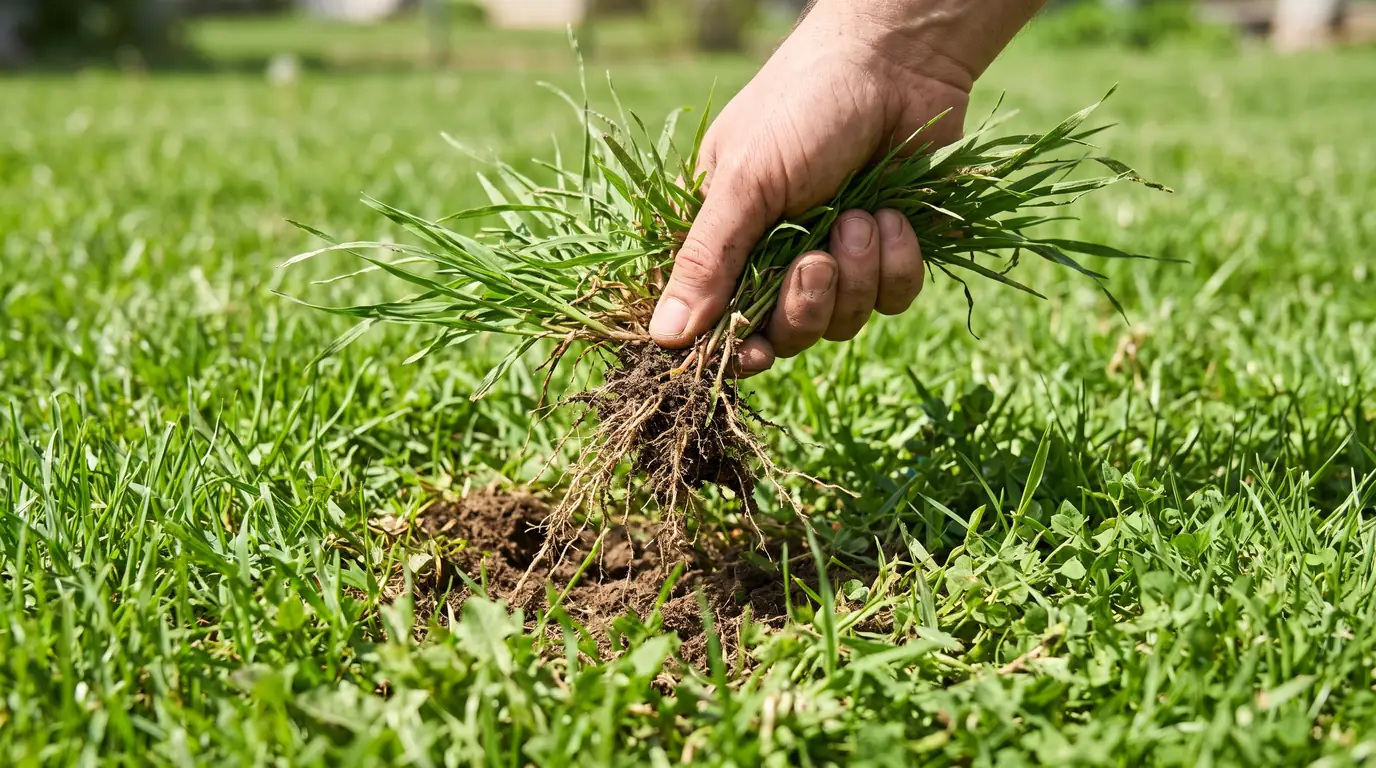
Crabgrass control in Canada starts with one fact most US advice skips: the chemical crabgrass preventers sold in American garden centres are not sold to homeowners here. What you have is a thick lawn, a mower set high, your hands, and corn gluten meal. Used at the right time, that is enough for most lawns.
Quick answer: crabgrass is a summer annual that sprouts when the top few centimetres of soil hold about 13 °C (55 °F) for four or five days. Put down a preventer 10 to 14 days before that, roughly when forsythia drops its petals. In Canada the preventer a homeowner can buy is corn gluten meal. Mow at 7.5 cm or higher, pull young plants before they seed, and overseed thin spots in late summer so there is no bare soil for next year's seed.
How to identify crabgrass
Two species turn up in Canadian lawns: large (hairy) crabgrass, Digitaria sanguinalis, and smooth crabgrass, Digitaria ischaemum. They look and behave much the same, and they are managed the same way. What to look for:
- Colour: lighter, yellower green than the lawn around it (University of Minnesota Extension).
- Leaves: wide and coarse, roughly 1 to 2 cm across, with a thin pale midrib (Penn State Extension). Large crabgrass has scattered long hairs; smooth crabgrass has few.
- Shape: stems spread flat from the centre and can root where they touch the soil, so a plant becomes a low, star-shaped clump.
- Seedheads: thin, finger-like spikes 5 to 15 cm long that fan out from the tip of a stem, from mid-summer on.
- Timing: it appears in late spring and summer, turns reddish-purple in late summer, and dies at the first fall frost, leaving brown patches and bare soil.
Not crabgrass? If a coarse grass is already green when your lawn greens up in spring, it is a perennial, most often quackgrass or tall fescue. University of Wisconsin–Madison Extension points out that those are managed differently, and nothing on this page will remove them.
Why it shows up in your lawn
Crabgrass seed needs warm soil and bright light to sprout. It is an opportunist: it fills the gaps a weak lawn leaves. The usual reasons, from Wisconsin and Minnesota Extension:
- A thin lawn and bare soil, especially in full sun.
- Mowing too short. Wisconsin calls it a primary reason lawns fill with crabgrass, because short grass lets light reach the soil.
- Hot, dry edges: south- and west-facing slopes and the strips along driveways and sidewalks.
- Light, frequent watering, which keeps the surface moist for germinating seed while grass roots stay shallow.
- Compacted soil that the lawn grass struggles in.
A single plant can produce about 150,000 seeds (University of Minnesota), and the seed builds up in the soil. That is why one bad summer turns into three.
What a Canadian homeowner can actually buy
Every pesticide sold in Canada carries a registration number from Health Canada, and the registration says who may use it. We checked each crabgrass chemical named by US extension services in Health Canada's pesticide label database on November 20, 2026:
| Ingredient (US use) | What the database lists |
|---|---|
| Prodiamine (preventer) | No product registered |
| Dithiopyr (preventer) | Commercial products only |
| Pendimethalin (preventer) | Farm and commercial products only |
| Quinclorac, mesotrione, topramezone (kill emerged crabgrass) | Commercial products only |
| Corn gluten meal (preventer) | Domestic products, for homeowners |
So in practice there is no crabgrass killer for plants that are already up on a Canadian store shelf for homeowners, and the one preventer is corn gluten meal. Two more rules worth knowing:
- No weed-and-feed with a chemical herbicide. Quebec's official guide to its Pesticides Management Code explains that Canada cancelled the registration of fertilizer-pesticide combinations for lawns in 2011, and sales stopped in December 2012. The exception is a single ingredient that is both, such as corn gluten meal.
- Do not import a US product. Buy only a product with a Canadian registration number (PCP or REG. NO.) on the label, use it only as the label says, and check your province and city below.
Provincial rules for home lawns
Several provinces limit what you can put on a lawn for looks (the legal term is cosmetic use). This is what the official sources say, read on November 20, 2026. Rules change, and many cities have stricter bylaws, so check before you buy.
| Province | The rule | Corn gluten meal |
|---|---|---|
| Ontario | Only products whose active ingredients are all on the province's Allowable List. 2,4-D and glyphosate are named as banned for cosmetic use. | On the Allowable List |
| Quebec | Domestic lawn products containing an ingredient in Annex I of the Pesticides Management Code cannot be sold in stores. Annex I includes dithiopyr, 2,4-D, MCPA and mecoprop. | Classed as a biopesticide |
| Nova Scotia | Non-essential (cosmetic) use is limited to the provincial List of Allowable Pesticides. | On the list |
| British Columbia | Since July 1, 2016, a homeowner needs a free Residential Applicator Certificate to use most domestic pesticides on a lawn, except products on Schedule 2 or 5. | On Schedule 2 (no certificate needed) |
| Manitoba | Homeowners may now use any domestic-class product registered with Health Canada on their own lawn, following the label. Use stays restricted at schools, child care centres, hospitals and some municipal spaces. | Allowed |
| Prince Edward Island | The province has restricted domestic lawn-care pesticides since 2010. Its official page would not load for us, so we could not read the current list. | Not confirmed. We could not read the list; ask the province before you buy. |
We have not checked New Brunswick, Newfoundland and Labrador, Alberta, Saskatchewan or the territories for this page. Wherever you live, your city may go further than the province, so check its bylaws too.
When to put down a preventer: go by the soil
A preventer only works on seed that has not sprouted yet. Too early and it breaks down before the seed wakes up; too late and the seedlings are already through. Three ways to hit the window, best first:
- Soil temperature. Crabgrass begins to sprout when the top 2.5 cm (one inch) of soil reaches about 13 °C (55 to 58 °F) at daybreak for four or five days (Penn State; the University of Massachusetts gives the same 55 °F). Penn State puts the best time to apply at 10 to 14 days before that. Our soil temperature checker shows the forecast for your city.
- Forsythia. Wisconsin Extension uses forsythia shrubs past full bloom and dropping their petals as the signal; the University of Massachusetts says to finish before the flowers drop. Penn State warns the cue is not always reliable in a year with odd weather. Handy coincidence: that same week is when to prune forsythia, right after it blooms.
- Not the calendar. The date moves with the spring and with your region.
Water the product in after spreading it, as the label directs; University of Minnesota Extension notes that a preventer left on the surface lets seed sprout underneath. Seed keeps germinating for weeks: Penn State says germination tapers off in mid-June, with some seed still sprouting in July.
By region: use your own soil reading
We do not print a crabgrass date per city, because none of the extension sources gives one for Canada and the soil decides it year by year. As a rule the window opens first on the BC coast and in southwestern Ontario, later in Ottawa, Quebec and the Atlantic provinces, and last on the Prairies, where the soil warms late. Wherever you are, start checking the soil temperature once your lawn is greening up, and watch the forsythia in your street.
Corn gluten meal: what to expect
Corn gluten meal is a by-product of milling corn. Compounds in it slow root growth in seeds that are just sprouting, which is why it is sold as a weed preventer. Be realistic about it:
- It builds over years. The University of Massachusetts cites studies with 50 to 60% crabgrass control in the first year and up to 90% after three years in a row. Wisconsin Extension says results may disappoint in year one and improve each year after.
- Much of the effect may be the nitrogen. A three-year University of Massachusetts trial found ordinary fertilizers at the same nitrogen rate controlled crabgrass about as well. It is roughly 9 to 10% nitrogen, so count it as your spring feed rather than adding another one.
- It works better in a dry spring than a wet one (University of Massachusetts).
- It does nothing to plants that are already up, and it slows grass seed too, so do not spread it where you plan to seed this spring.
The window is set by soil temperature, not the date. A probe thermometer pushed 2.5 to 5 cm into the lawn in the early morning tells you when the soil is nearing 13 °C, so the preventer goes down before the seed sprouts, not after.
Affiliate link — GrowersGuide.ca may earn a commission on qualifying purchases, at no extra cost to you. See our affiliate disclosure.
Corn gluten meal and grass seed both need an even spread. A push or hand-held broadcast spreader set to the rate on the bag beats throwing it by hand, which leaves strips and gaps.
Affiliate link — GrowersGuide.ca may earn a commission on qualifying purchases, at no extra cost to you. See our affiliate disclosure.
Preventer or spring seeding: pick one
A crabgrass preventer stops grass seed as well. University of Wisconsin–Madison Extension says that, unless the label says otherwise, seeding cannot be done along with a preemergence herbicide, and advises waiting until late August or early September to seed treated areas. Wisconsin also advises against spring seeding and dethatching in lawns with a crabgrass problem, because both leave bare soil just as crabgrass starts to sprout.
- Bad crabgrass last year, lawn mostly full: preventer in spring, seed the gaps in late summer.
- Big bare patches that must be fixed this spring: skip the preventer on those patches, seed as early as the soil allows, and pull crabgrass as it comes up. Our grass seed timing guide has the spring dates by city.
- Thick thatch: leave the dethatching for late summer. See when to dethatch.
Pull it early, before it seeds
Hand pulling is the one way to remove crabgrass that is already up, and it works well while the plants are few. Wisconsin Extension advises pulling or digging them out as soon as they show, before they flower; Penn State suggests a trowel. Pull when the soil is moist, press the soil back down, and do not leave plants with seedheads lying on the lawn.
If the lawn is already full of large plants in August, pulling them all leaves a lot of bare soil. Mowing will not stop them: the University of Massachusetts notes crabgrass can set seed even when mowed to about 1 cm. At that point, pull the plants that are about to seed, let the first frost kill the rest, and overseed the bare soil in late summer.
A narrow fishtail or forked hand weeder gets under the clump so the whole root ball comes out, which is easier on your hands and on the surrounding grass than pulling by the leaves.
Affiliate link — GrowersGuide.ca may earn a commission on qualifying purchases, at no extra cost to you. See our affiliate disclosure.
Mow higher and water deeper
- Mow at 7.5 cm (3 inches) or higher. University of Minnesota Extension says raising the mowing height to at least 3 inches cuts down crabgrass germination, because taller grass shades the soil. That is the top of the 5 to 7.5 cm range in our mowing guide, and it matters most in late spring and early summer.
- Take off no more than a third of the blade at each mow, and leave the clippings (Wisconsin Extension).
- Water deeply and less often once the lawn needs it, not a light sprinkle every day (Wisconsin Extension). See our watering rules by city.
Overseed to crowd it out
The long-term fix is a lawn with no room for crabgrass. When the first frost kills it, it leaves bare soil, and that soil is next year's crabgrass bed unless grass fills it. Late summer and early fall is the best time to seed in most of Canada, because crabgrass has stopped germinating. Our guide to aerating and overseeding gives the last safe date for your city, and grass seed for a patchy lawn covers the steps.
A sun-and-shade mix for filling the bare spots crabgrass leaves behind. Seed it in late summer, not in a spring when you have used a preventer.
Affiliate link — GrowersGuide.ca may earn a commission on qualifying purchases, at no extra cost to you. See our affiliate disclosure.
West Coast Seeds, a Canadian seed company, sells lawn blends, tall fescue and microclover by the bag. Microclover mixed into a fescue lawn fills gaps and feeds the grass nitrogen.
Shop lawn seed at West Coast Seeds →Affiliate link — we may earn a commission on qualifying purchases, at no extra cost to you.
Frequently Asked Questions
When should I put down crabgrass preventer in Canada?
Before the seed sprouts, which happens once the top few centimetres of soil hold about 13 °C (55 °F) for four or five days, according to the University of Massachusetts and Penn State Extension. Penn State advises applying 10 to 14 days before that. Forsythia dropping its petals is a rough cue, but a soil thermometer is more reliable in an odd spring.
What crabgrass preventer can I buy in Canada?
For a homeowner, corn gluten meal. In Health Canada's pesticide label database the chemical preventers common in US advice are either not registered at all (prodiamine) or registered only as commercial or farm products (dithiopyr, pendimethalin). Buy only a product with a Canadian registration number (PCP or REG. NO.) on the label, and follow the label.
Does corn gluten meal work on crabgrass?
Partly, and it improves over the years. The University of Massachusetts cites studies showing 50 to 60% control in the first year and up to 90% after three years in a row, but its own trial found ordinary fertilizer did about as well, which suggests most of the effect comes from the nitrogen thickening the lawn. It does nothing to crabgrass that is already up.
Is crabgrass preventer legal in Ontario?
Only products whose active ingredients are all on Ontario's Allowable List can be used on a lawn for cosmetic reasons. Corn gluten meal is on that list. Prodiamine, dithiopyr and pendimethalin are not.
Can I seed my lawn and use crabgrass preventer in the same spring?
Usually not. University of Wisconsin–Madison Extension says that, unless the label says otherwise, seeding cannot be done along with a preemergence herbicide because the new grass is damaged too, and advises waiting until late August or early September to seed treated areas.
Should I pull crabgrass by hand?
Yes, while the plants are few and young. Wisconsin Extension advises pulling or digging them out as soon as they show, before they flower. A single plant can make about 150,000 seeds, according to the University of Minnesota.
Does crabgrass come back every year?
The plant does not: it is an annual and dies with the first fall frost. Its seed does. The University of Massachusetts notes that seed builds up in the soil over years, so it takes several seasons of thicker grass and fewer seedheads to bring the numbers down.
How do I tell crabgrass from quackgrass?
By when it appears. Wisconsin Extension notes that quackgrass and tall fescue are perennials that are already green when the lawn greens up in spring. Crabgrass shows up later, as light green, wide-bladed clumps that spread flat and turn reddish-purple in late summer before dying at the first frost.
Sources
- University of Minnesota Extension — Crabgrass
- University of Wisconsin–Madison Extension — Crabgrass Management in Lawns
- University of Massachusetts Amherst — Biology and Management of Crabgrass
- Penn State Extension — Smooth Crabgrass and Large Crabgrass
- Health Canada — Pesticide label search (checked November 20, 2026)
- Government of Ontario — Pesticides (home lawns and gardens) and the Allowable List
- Gouvernement du Québec — Guide de référence du Code de gestion des pesticides (July 2026)
- Nova Scotia — List of Allowable Pesticides
- Government of British Columbia — Integrated Pest Management Regulation amendments (guide for residents, Schedule 2)
- Government of Manitoba — Cosmetic Pesticides: What This Means to You
- Government of Prince Edward Island — Domestic home, garden and lawn care pesticides