
Dracaena Care Guide — Canada
How to grow dracaena in Canadian homes — filtered water to stop the brown leaf tips that affect almost every dracaena in Canada, the light it needs, watering, and the difference between the dragon tree, corn plant, and other varieties.
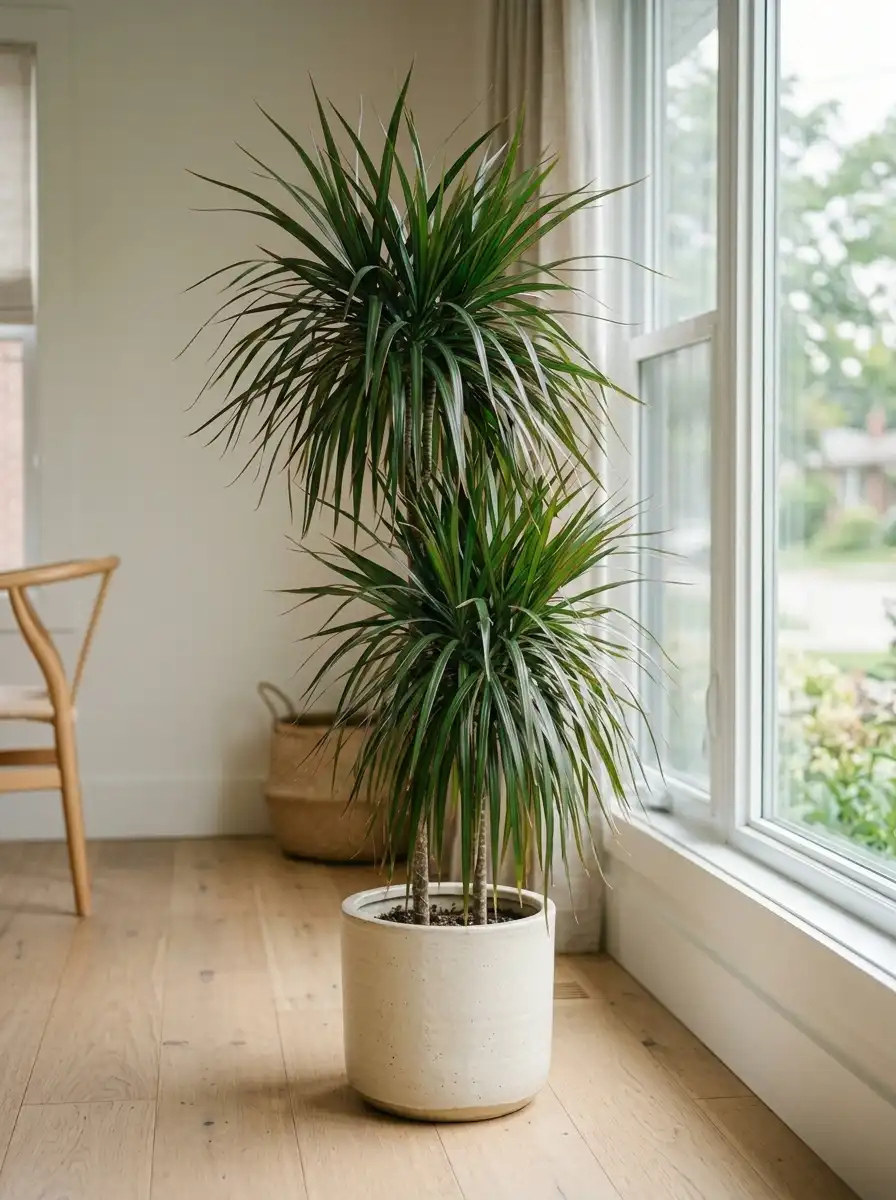
Dracaena is one of the most common houseplants in Canada — the arching, red-edged dragon tree (Dracaena marginata) and the thick-caned corn plant (Dracaena fragrans) are fixtures of garden centres, offices, and living rooms. They are genuinely easy plants: tolerant of low light, forgiving of irregular watering, and slow enough to stay tidy for years. The one problem that defeats almost every Canadian dracaena owner is brown leaf tips — and that comes down almost entirely to tap water.
This guide covers the complete dracaena care routine for Canada — why brown tips happen and how to stop them, the light and watering it needs, variety differences, winter care, and how to read yellowing leaves and leaf drop.
Dracaena at a glance: Water — filtered or distilled, when top 5cm dry. Light — bright indirect best, tolerates medium/low. Brown tips? — tap water fluoride, the #1 cause. Lower leaves dropping — usually normal cane ageing. Pet safe — no, toxic to cats and dogs ⚠️
Is your Dracaena getting enough light this winter?
A Canadian winter cuts daylight roughly in half. See what your city actually gets this month, and whether a grow light is needed.
🌿 Dracaena Quick Care Card
Why Dracaena Gets Brown Tips in Canada — and the Fix
Brown leaf tips are the signature dracaena complaint in Canada. The dominant cause is tap water — dracaenas are among the most fluoride-sensitive houseplants there are. Fix the water and the other contributing factors, and new growth comes in clean.
Cause 1 — Tap water fluoride and chlorine
Most Canadian municipal water is fluoridated and chlorinated. Dracaenas accumulate fluoride in their leaf tissue, where it burns the tips brown — the dragon tree (marginata) is especially sensitive. Fix: switch to filtered, distilled, or collected rainwater. Chlorine dissipates if water sits out 24 hours; fluoride does not, so filtered or distilled is the reliable answer. Existing brown tips won't heal, but new leaves come in clean once the water is changed.
Cause 2 — Fertiliser salt buildup
Dracaenas are slow feeders, and excess fertiliser salts accumulate in the soil and also burn leaf tips. Fix: fertilise lightly — a diluted feed once or twice over spring and summer is plenty — and flush the soil two or three times a year by watering thoroughly several times in a row to wash salts out the drainage holes.
Causes 3 & 4 — Dry air and underwatering
Forced-air heating drops Canadian homes to 25–30% humidity in winter, which can crisp dracaena tips even though the plant tolerates average humidity fine — a pebble tray or nearby humidifier helps. Letting the soil go bone dry for too long also browns the tips. Keep the top 5 cm test consistent and the plant away from heating vents.
Dracaena Varieties at Canadian Garden Centres
“Dracaena” covers a wide range of plants with very different looks — from the wispy dragon tree to the broad-leaved corn plant. All share the same core care, though the solid-green types tolerate low light better than the variegated ones.
| Variety | Look | Notes |
|---|---|---|
| Dragon Tree (D. marginata) | Thin arching leaves, red edges, slim canes | Most common; the most fluoride-sensitive of the group |
| Marginata 'Tricolor' / 'Colorama' | Pink, cream and green striped leaves | Needs brighter light to hold its colour |
| Corn Plant (D. fragrans 'Massangeana') | Broad leaves with a yellow centre stripe, thick cane | Classic floor plant; a little more water-tolerant |
| Warneckii (D. fragrans) | Upright sword leaves, white-and-green stripes | Compact, tidy; good for narrow spaces |
| Lemon Lime (D. fragrans) | Bright chartreuse and green striped leaves | Vivid colour; wants bright indirect light |
| Janet Craig (D. fragrans) | Solid dark glossy green strap leaves | The most low-light tolerant dracaena |
| Song of India (D. reflexa) | Short yellow-edged leaves, bushy growth | Fuller, shrubbier form; bright indirect light |
| Lucky Bamboo (D. sanderiana) | Upright green stalks, often grown in water | A dracaena, not a bamboo; use filtered water in the vase |
How to Water a Dracaena in Canada
Water when the top 5 cm of soil has dried. Dracaenas are fairly drought-tolerant and far more often killed by overwatering than by underwatering — soggy soil rots the roots. Water thoroughly until it drains, empty the saucer, then wait until the soil has well dried before watering again.
Dracaena watering schedule — Canada: Summer (May–Sept): every 10–14 days. Fall (Oct–Nov): every 2–3 weeks. Winter (Dec–Feb): every 3–4 weeks. Spring (Mar–Apr): every 10–14 days. Always use filtered or distilled water at room temperature. Water thoroughly until drainage; empty the saucer after 30 minutes.
Overwatering kills more dracaenas than anything else. A 3-in-1 soil meter shows you exactly when the root zone is dry — push the probe in for an instant moisture, light, and pH reading. No batteries needed.
Affiliate link — GrowersGuide.ca may earn a commission on qualifying purchases, at no extra cost to you. Learn more.
The other thing Canadian houseplants run short on all winter is light. From November to March most homes are too dim to keep plants growing — leaves stretch toward the window, variegation fades, and new growth stalls. A small full-spectrum LED grow light on a timer bridges the dark months, even for tough low-light plants that only survive (rather than grow) in a dim room.
Affiliate link — GrowersGuide.ca may earn a commission on qualifying purchases, at no extra cost to you. Learn more.
Why no fixed schedule works: How fast soil dries depends on temperature, light, pot material, room humidity, and plant size. A dracaena in a bright room at 23°C dries faster than one in a shaded corner in a Canadian winter — sometimes twice as fast. The top 5 cm finger test automatically accounts for all of these. See what affects soil drying rate →
Light Requirements for Dracaena in Canada
Dracaenas prefer bright indirect light but tolerate medium and low light better than most houseplants — one of the reasons they suit Canadian homes with limited window space. Avoid direct sun, which scorches the leaves. The solid-green types take low light best; variegated and coloured types need more light to keep their patterns.
Bright Indirect — Best
An east window, or 1–2 m back from a south or west window. Steady growth and strong colour. Best for variegated and coloured varieties.
Medium — Fine
A few metres from a window or a north exposure. Slower growth; perfectly healthy. Suits most green dracaenas year-round in Canada.
Low Light — Survives
Dim corners far from windows. 'Janet Craig' and other solid-green types cope well; variegated types lose their stripes. Growth slows markedly.
Canadian Winter Care
Water much less from November to February
Dracaena growth nearly stops in a Canadian winter. Soil stays wet far longer in low light, so stretch the watering interval to every 3–4 weeks and always confirm the top 5 cm is dry first. Overwatering in winter is the leading cause of dracaena root rot in Canada. Stop fertilising from October through February and resume a diluted feed in spring.
Keep away from cold drafts and heating vents
Dracaenas dislike temperatures below about 13°C and react badly to sudden cold. Keep them away from drafty exterior doors, single-pane windows, and unheated entryways — cold drafts cause leaf yellowing and drop. Equally, keep them clear of forced-air heating vents, where the blast of hot dry air crisps the leaf tips.
Add a little humidity
Dracaenas tolerate average humidity, but the 25–30% that forced-air heating produces can worsen brown tips. A pebble tray under the pot, grouping plants together, or a small humidifier nearby through the heating season all help. This matters less for dracaena than for a calathea, but combined with filtered water it keeps the tips clean.
How to Propagate a Dracaena
Dracaenas propagate easily from stem cuttings, and propagation doubles as the cure for a tall, bare, leggy cane. Spring and summer, in active growth, are the best times. A single overgrown dracaena can become two or three plants.
Top cuttings
Cut off the leafy crown of a cane with clean shears, taking 10–15 cm of stem below the lowest leaves. Root the top cutting in a jar of water or directly in moist, well-draining mix, kept warm and in bright indirect light. Roots form over 3–6 weeks. This is also how you rescue the healthy top of a plant whose base has rotted.
Cane cuttings
The bare length of cane left over can also be propagated. Cut it into segments 10–20 cm long, keeping track of which end is “up” (segments only sprout if planted the right way round). Let the cut ends dry for a day, then stand them upright in moist mix, or lay them on their side half-buried. New shoots emerge from the cane over several weeks.
The parent resprouts too
When you take a top cutting, don't discard the rooted stump — keep it potted, warm, and bright, and it will push out a fresh cluster of leaves (often two or three new heads) just below the cut. So one leggy dracaena yields a rooted top, new cane plants, and a bushier original. Use room-temperature filtered water for cuttings, as dracaenas are fluoride-sensitive.
Dracaena Troubleshooting
Brown leaf tips
Switch to filtered or distilled water — fluoride in tap water is the main cause. Flush the soil to clear fertiliser salts, and add a little humidity. Damage on existing leaves won't reverse; trim the brown tip following the leaf's natural point. New growth comes in clean once the water is changed.
Yellowing leaves
A slow loss of the lowest leaves is normal cane ageing. Many leaves yellowing at once, or yellowing higher up, points to overwatering — check the soil, cut back watering, and confirm the pot drains. Cold drafts also cause yellowing in a Canadian winter.
Drooping, soft, mushy stem
Root or stem rot from overwatering. Unpot and inspect — trim any brown mushy roots and repot in fresh well-draining mix. If a cane has gone soft, cut back to firm green tissue; healthy top sections can be re-rooted as cuttings.
Leggy, sparse, fading variegation
Too little light — common in Canadian winters. Move to a brighter window. A bare, leggy cane can be cut back; the plant resprouts below the cut, and the cut-off top can be rooted as a cutting. Variegated types regain colour on new growth in better light.
Frequently Asked Questions
My dracaena's brown tips came back even after I switched to filtered water — why?
Filtered water fixes the fluoride problem, but two other causes remain. Fertiliser salt buildup also burns tips — flush the soil thoroughly two or three times a year and feed only lightly. And very dry winter air from forced-air heating crisps tips even with clean water — add a pebble tray or humidifier. If you've addressed all three and still see browning, check for a cold draft and make sure the soil isn't going completely bone dry between waterings.
Is lucky bamboo a real bamboo?
No — lucky bamboo is Dracaena sanderiana, a dracaena, not a true bamboo. It is often grown in water rather than soil. The same water sensitivity applies: use filtered or distilled water in the vase, since fluoride and chlorine in tap water yellow and brown the stalks. Like all dracaenas, lucky bamboo is toxic to cats and dogs.
My dracaena is too tall and bare at the bottom — can I cut it back?
Yes. Dracaenas handle hard pruning well. Cut a tall, bare cane at the height you want with clean shears — the plant will sprout a new cluster of leaves just below the cut within a few weeks. Do this in spring or summer when the plant is actively growing. The cut-off top section can be rooted as a cutting in water or moist soil, giving you a second plant.
What is the easiest dracaena for a low-light Canadian home?
'Janet Craig' — a solid dark-green D. fragrans — is the most low-light tolerant dracaena and a near-indestructible office and apartment plant. The corn plant ('Massangeana') is also forgiving. The variegated and coloured types (Tricolor, Lemon Lime, Song of India) are just as easy to keep alive but need brighter light to look their best, so they suit a bright window rather than a dim corner.
Why does my dracaena have brown leaf tips?
Brown leaf tips are the most common dracaena problem in Canada, and the usual cause is fluoride and chlorine in tap water. Dracaenas — especially the dragon tree (Dracaena marginata) — are highly sensitive to fluoride, which most Canadian municipal water supplies add. It accumulates in leaf tissue and burns the tips brown. The fix is to switch to filtered, distilled, or collected rainwater. Two other causes contribute: salt buildup from fertiliser (flush the soil thoroughly two or three times a year) and dry winter air from forced-air heating. Underwatering can also crisp the tips. Damage already on a leaf will not heal, but you can trim the brown tip off following the leaf's natural point, and new growth comes in clean once the water is changed.
What water should I use for a dracaena in Canada?
Use filtered, distilled, or collected rainwater. Dracaenas are among the most fluoride-sensitive houseplants, alongside calatheas — and most Canadian cities fluoridate their tap water. Fluoride cannot be removed by letting water sit out (only chlorine dissipates that way), so filtered or distilled water is the reliable fix for the brown tips that plague dracaenas. Rainwater is excellent and free. If you must use tap water, let it sit uncovered overnight to release chlorine and use it at room temperature, but expect some ongoing tip browning over time. The dragon tree (marginata) is the most sensitive; the corn plant (D. fragrans) is a little more tolerant but still benefits from clean water.
How often should I water a dracaena in Canada?
Water a dracaena when the top 5 cm of soil has dried out — typically every 10–14 days in summer and every 3–4 weeks in a Canadian winter. Dracaenas are fairly drought-tolerant and far more often killed by overwatering than by underwatering. Soggy soil rots the roots and causes yellowing, drooping, and mushy stems. Always water thoroughly until it drains, empty the saucer, and then wait until the soil is well dried before watering again. In winter, when light is low and growth slows, stretch the interval considerably. Use room-temperature filtered water — cold tap water shocks the roots.
How much light does a dracaena need in Canada?
Dracaenas do best in bright indirect light but are notably tolerant of medium and even low light, which makes them excellent plants for Canadian homes with limited window space. An east window, or a few feet back from a south or west window, is ideal. Avoid direct sun, which scorches the leaves. The solid dark-green varieties — 'Janet Craig' in particular — handle low light better than the variegated and coloured types, which need brighter light to keep their stripes and colour. In a low-light spot, expect slower growth and some loss of variegation, but the plant will survive. Through a dim Canadian winter, move the plant to your brightest window.
Are dracaenas toxic to cats and dogs?
Yes — dracaenas are toxic to both cats and dogs according to the ASPCA. The plants contain saponins; ingestion can cause vomiting (sometimes with blood), depression, loss of appetite, and excess drooling, plus dilated pupils in cats. Reactions are usually unpleasant rather than life-threatening, but dracaena is not a pet-safe plant. Keep it out of reach of pets that chew foliage, or choose a non-toxic alternative — spider plant and calathea are both pet-safe. This applies to all dracaenas, including lucky bamboo, which is Dracaena sanderiana.
Why are my dracaena's lower leaves turning yellow and falling off?
Some lower-leaf loss is completely normal for a dracaena. Dracaenas grow as canes that shed their oldest, lowest leaves as they grow taller — that gradual loss of one or two bottom leaves at a time, leaving a bare cane with a leafy crown, is natural ageing, not a problem. What is a problem is many leaves yellowing at once, or yellowing higher up the plant: that points to overwatering and root rot. Check the soil — if it is staying wet, cut back watering sharply and make sure the pot drains. Yellowing can also come from cold drafts or, combined with brown tips, from fluoride and low humidity.
🐾 Have pets? See our Pet-Safe Houseplants guide — which common houseplants are toxic to cats and dogs, which are safe, and what to do if a pet eats one.
📖 More Houseplant Guides
Care guides for popular Canadian houseplants.
Also Growing Vegetables?
Free planting calendars for 30+ vegetables across every major Canadian city.